I had made a terrible mistake.
Not when I questioned Abigail.
Not when I opened the bedroom door.
Not even when I searched through her jewelry box for the hidden key.
My mistake was believing that finding the truth and doing something about it were the same thing.
They weren't.
I had seen my mother.
I had heard her voice.
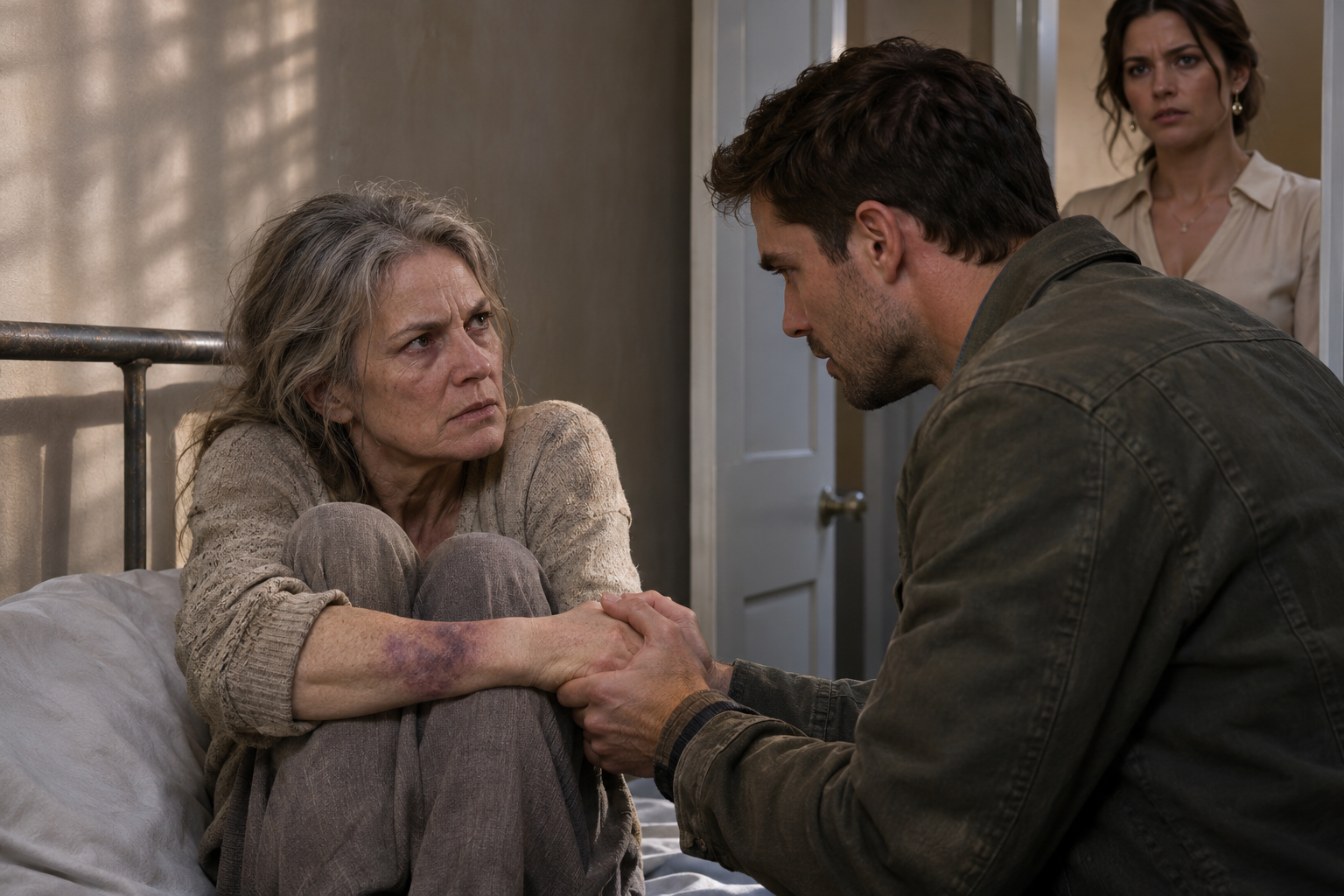
I had looked at the bruises around her wrists.
And I had still left her behind that door.
I kept telling myself I had needed more information.
That I had to be careful.
That revealing what I knew too soon might make everything worse.
Maybe those reasons had made sense at first.
But they were starting to sound like excuses.
I stood downstairs and stared toward the staircase.
The house was quiet.
Nothing about it looked different from when I had arrived.
The walls were familiar.
The rooms were familiar.
Even the ordinary sounds around me belonged to a place I had once considered safe.
But upstairs, my mother was locked inside a room without proper bedding.
That one fact changed everything.
I remembered Abigail standing outside with our neighbor.
Her voice had been soft.
Her expression had been full of concern.
She had described Mom as someone whose condition had become difficult to manage.
At the time, I hadn't known what to believe.
Now I knew enough to recognize that her explanation was missing something important.
It was missing my mother's voice.
And it was missing any explanation for the way she had been treated.
I looked down at my hand.
I could still remember the pressure of Mom's fingers.
It had lasted only a moment.
But I had carried the feeling with me ever since.
She had reached for me just before I left.
She had held on firmly.
I couldn't forget that.
I couldn't forget the way she had looked directly at me and told me she was thinking clearly.
I had promised that I believed her.
But what did that promise mean while she remained locked away?
I didn't have an answer I liked.
I thought about going upstairs immediately.
Then I thought about Abigail.
I still didn't know what she would do if she discovered I had entered Mom's room.
I didn't know whether she would become angry.
I didn't know whether she would offer an explanation.
I didn't know whether she would accuse me of misunderstanding the situation.
The uncertainty was exhausting.
And I was beginning to resent how much power I had given it.
I had allowed the possibility of Abigail's reaction to determine what happened next.
Meanwhile, Mom had no way to leave the room.
She had no phone within reach.
She couldn't simply come downstairs and explain herself.
She was waiting for someone else to make a decision.
That someone was supposed to be me.
I rubbed my hands together.
They felt unsteady.
I had spent my deployment believing I understood pressure.
But pressure overseas was different from discovering that someone you loved might have been suffering while you were absent.
There was no comfortable distance from this.
I could not tell myself that another person would handle it.
I could not wait for a report.
I could not pretend the problem belonged to someone else.
This was my mother.
This was my home.
And I had already seen enough to know that something needed to change.
I thought about Abigail's words.
"She's not herself."
That phrase bothered me more than it had at first.
Who decided when another person stopped being themselves?
Who decided when their own account no longer mattered?
Who decided that locking a door was acceptable because someone had become difficult?
I understood that serious confusion could require supervision.
I understood that some people needed help with everyday decisions.
But I also understood that care was supposed to protect dignity.
Nothing about the room I had found suggested dignity.
The bed was bare.
The water was warm.
Mom's clothes had not been changed for days.
And there were bruises around both wrists.
Those details had become impossible to separate from Abigail's claims.
Whenever I remembered her saying Mom was being protected, I saw the bruises.
Whenever I remembered her speaking about professional care, I saw the mattress without sheets.
Whenever I remembered her saying Mom was confused, I heard my mother's steady voice.
I had to stop treating those contradictions as something I could think about indefinitely.
I needed answers.
I needed Mom to have proper care.
And I needed to stop pretending that keeping Abigail comfortable was more important than either of those things.
I could hear movement elsewhere in the house.
For a moment, I stood still.
I had become so accustomed to hiding my concern that even an ordinary sound made me watchful.
That realization disturbed me.
I was afraid of being caught caring for my own mother.
There was something terribly wrong with that.
I looked toward the stairs again.
I remembered the first time I had noticed the curtain move.
Just a small movement at the upstairs window.
It had been enough to make me question why Mom hadn't come outside.
I wondered whether she had been watching for me.
I couldn't know.
But I imagined how it must have felt to see her son return while she remained behind a locked door.
Perhaps she had hoped I would come upstairs immediately.
Perhaps she had been afraid I would accept Abigail's explanation.
Perhaps she had already heard enough conversations about her supposed confusion to worry that nobody would believe her.
I didn't know which of those things was true.
But the possibility that she had been waiting for me made my chest tighten.
I had returned home carrying a duffel bag.
I had been thinking about ending my deployment and returning to ordinary life.
Mom might have been thinking only about whether I would open her door.
I felt ashamed.
I couldn't change the time I had been away.
But I could change what I did after learning what was happening.
I thought about the key.
The small piece of metal hidden inside Abigail's mahogany jewelry box.
When I first found it, I had felt relieved.
Now it seemed to represent something much larger.
Someone had controlled access to Mom's room.
Someone had decided when she could come out.
Someone had made it necessary for me to search for a hidden key before I could speak with her privately.
I still didn't know exactly how that arrangement had begun.
But I knew it had to be questioned.
I couldn't accept a locked bedroom as ordinary simply because it had already become part of life inside the house.
I remembered Abigail's face when I asked about it.
The brief stiffness.
The controlled answer.
The suggestion that I should trust her judgment.
I had given her that trust for a long time.
Perhaps that was why questioning her hurt so badly.
I didn't want my marriage to become an investigation.
I didn't want every sentence between us to feel like a test.
I didn't want to look at her and wonder whether she had concealed something terrible from me.
But wanting those things did not make the questions disappear.
I had to accept that.
My feelings for Abigail could not determine whether the bruises mattered.
They mattered regardless.
My desire to avoid conflict could not make Mom's room comfortable.
It wasn't.
And my fear of being wrong could not justify leaving her without a voice.
I took a slow breath.
Then another.
I had been trying to control my anger since the moment I saw those marks.
I knew how easily anger could make a difficult situation worse.
But suppressing anger was not the same thing as refusing to act.
I could speak calmly and still insist on answers.
I could acknowledge uncertainty and still recognize that the conditions upstairs were unacceptable.
I could refuse to accuse Abigail of something I couldn't prove while also refusing to leave Mom where I had found her.
The distinction felt important.
For the first time since returning, I was thinking about what I actually knew how to do.
Not how to conceal my suspicions.
Not how to make Abigail relax.
Not how to appear unconcerned.
How to protect someone who needed help.
I looked toward the staircase.
The bedroom was still up there.
The door was still locked.
Nothing had changed except my understanding.
That was not enough.
I needed another conversation with Mom.
I needed to ask about the bruises.
I needed to understand how long she had been kept in that room.
I needed to find out whether she had been given proper food, water, and care.
I needed to hear what she wanted.
But before asking anything else, I needed to make sure she understood something.
I had not forgotten her.
I had not accepted Abigail's version of events.
And I was not going to treat her as incapable of speaking simply because another person had described her that way.
I imagined walking into the room again.
I imagined seeing the same bare bed.
The same cup.
The same exhausted figure beside the wall.
I didn't want that image to become ordinary.
I didn't want repeated visits to make the conditions seem less shocking.
That could happen.
People became accustomed to things they saw too often.
They learned to explain away discomfort.
They stopped questioning what had once disturbed them.
I was determined not to let that happen.
Mom deserved more than my private concern.
She deserved to be heard and treated properly.
I thought again about the moment Abigail had asked whether I was upset with her.
I had avoided answering.
At the time, I believed that was necessary.
Now I understood how much I had been protecting our relationship from the truth.
I was afraid of what would happen if I said aloud that I had seen Mom's injuries.
I was afraid of the explanations Abigail might offer.
I was afraid of discovering that someone I loved had made decisions I could never accept.
Those fears were real.
But Mom's situation was real too.
I couldn't let my fear take priority.
I thought about the neighbor.
She had listened while Abigail described Mom's confusion.
She had apparently accepted that professional care was being arranged.
I wondered what she would think if she saw the bedroom.
Would she still believe everything was being handled properly?
Would she ask the same questions I had asked?
Would she understand why I was so troubled?
I couldn't know.
But it reminded me that Abigail's explanation had already reached people outside our family.
Other people might now believe Mom was incapable of understanding what happened around her.
That mattered.
A person's reputation could be changed by the words of someone others trusted.
And once those words had been repeated, they could become difficult to challenge.
I thought about my mother having to defend herself against that description.
She had done so immediately.
Before discussing anything else.
Before asking about my deployment.
Before explaining the bruises.
She had insisted that she was still thinking clearly.
That told me how important the issue was to her.
I had to honor that.
Not by automatically deciding that every word she said must be correct.
But by giving her the same chance to be heard that Abigail had already been given.
It was such a basic thing.
And yet I had spent hours struggling to find the courage to do it.
I looked down at my hands.
The memory of Mom's grip returned.
I wondered whether she had understood why I closed the door.
I hoped she had.
I hoped she knew I was trying to find a way to help without making her situation worse.
But hope was not certainty.
She might simply have felt abandoned again.
That thought hurt.
I couldn't undo the sound of the lock.
I couldn't take back the moment I walked away.
But I could refuse to repeat it without good reason.
I had been thinking about my next conversation with Abigail as though it needed to produce a complete explanation.
Perhaps it wouldn't.
Perhaps she would continue speaking in general terms.
Perhaps she would become defensive.
Perhaps she would tell me I didn't understand what caring for Mom had been like.
I was prepared to listen.
But I was no longer prepared to let the conversation end without addressing what I had found.
There were specific things I needed explained.
The bruises.
The missing phone.
The bedding.
The clothes.
The lock.
Not broad statements about difficulty.
Not assurances that everything had been necessary.
Specific answers.
And if those answers did not come, that would not make the questions disappear.
I thought about Mom's face again.
She had looked tired.
But her eyes were steady.
I remembered the quiet anger in them.
It had not frightened me.
It had made me understand how much she needed someone to listen.
I wondered how long she had been holding that anger inside.
How many times she might have tried to explain herself.
How many times someone might have dismissed her words as confusion.
Those were possibilities, not facts.
I reminded myself of that.
I couldn't fill the missing parts of her experience with my imagination.
I needed to hear them from her.
That was the only way to know.
I looked up the stairs.
For the first time since arriving, I stopped thinking about how to make my behavior look ordinary.
I was tired of ordinary.
There was nothing ordinary about what I had seen.
I wanted Mom to have a clean, comfortable place to rest.
I wanted her to be able to communicate.
I wanted someone to examine the injuries on her wrists.
I wanted her wishes taken seriously.
Those were not unreasonable demands.
They were the most basic things I could think of.
And I could no longer understand why I had been so afraid to insist on them.
I realized something else.
I had been treating the truth as though it would arrive all at once.
One revelation.
One explanation.
One moment when everything finally made sense.
But real life rarely worked that way.
Sometimes the truth began with a curtain moving.
Sometimes it began with a key.
Sometimes it began with a room that looked wrong.
And sometimes it began with an older woman saying that she still understood what was happening.
I didn't yet know the complete story.
I didn't know exactly how Mom's wrists had been bruised.
I didn't know everything Abigail had done while I was away.
I didn't know whether anyone else had seen the conditions in that bedroom.
But I knew I could not keep waiting for perfect answers before taking Mom's well-being seriously.
I had already waited long enough.
I looked toward the stairs and made a decision.
The next time I opened that door, I would not treat the visit as something I had to hide indefinitely.
I would listen to Mom.
I would address what I had seen.
And I would stop allowing the fear of Abigail's reaction to control whether my mother could speak.
I had come home believing that being calm meant being strong.
Now I understood that calmness meant very little if I used it only to avoid a difficult decision.
I could be calm.
I could be careful.
But I also had to act.
Mom was waiting.
And I was finally ready to stop treating her situation as something that could remain hidden behind a closed door.
Click here to continue reading: PART 10: I Had Come Home Believing Abigail’s Story Was the Only Explanation, but My Mother’s Hand Made Me Understand What I Could No Longer Ignore
I Came Home From Deployment Expecting to See My Mother, but One Locked Bedroom Door Made Me Question Everything Abigail Said
Part 9 of 10