I had been thinking about the wrong question.
For most of the time since coming home, I had been asking myself whether Abigail was telling the truth.
It mattered.
Of course it mattered.
But I had allowed that question to become so large that it pushed everything else aside.
There was another question.
A simpler one.
What did Mom need from me right now?
I stood quietly and considered it.
She needed someone to believe her.
I had done that.
She needed someone to recognize the condition of the room.
I had seen it.
She needed someone to notice the injuries on her wrists.
I had noticed them.
But those things were only the beginning.
Believing a person did not make a locked door disappear.
Recognizing suffering did not automatically stop it.
And noticing bruises did not explain how they got there.
I had been acting as though the difficult part was gathering enough information to challenge Abigail.
But while I worried about that, Mom remained upstairs.
That was the truth I could no longer avoid.
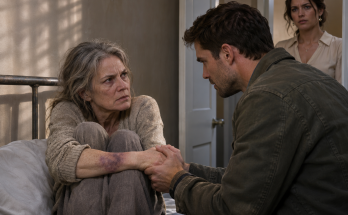
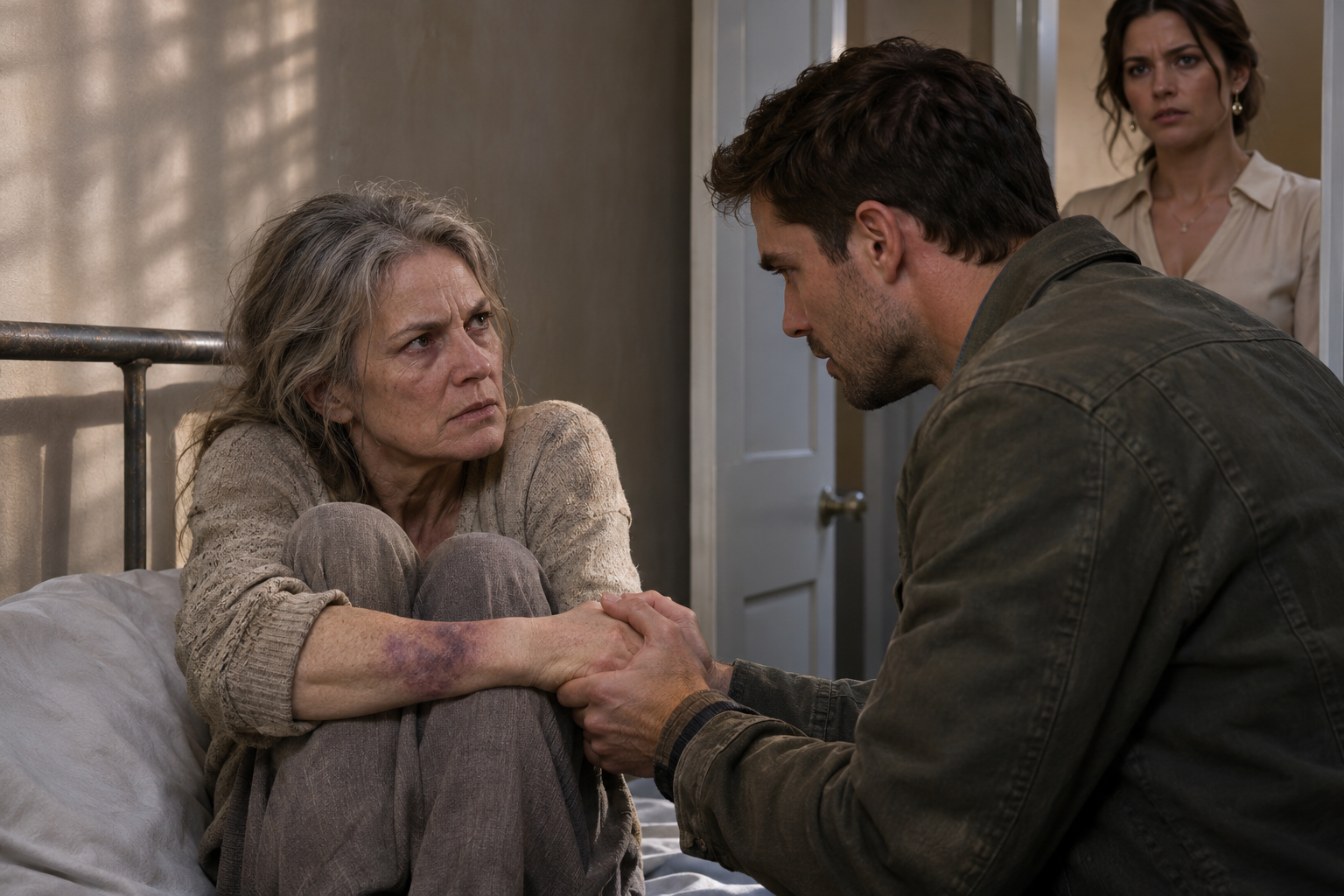
I thought about how she had looked when I first entered.
Her clothes had not been changed for days.
Her body was close to the wall.
Her eyes had moved toward me.
I had expected confusion because Abigail had told me to expect it.
Instead, I had found someone who seemed desperate to be believed.
That difference had stayed with me.
It was the difference between the story I had heard and the person I had seen.
I couldn't ignore it.
I also couldn't treat a single conversation as proof of everything.
I understood that.
Mom might have been frightened.
She might have had experiences during my absence that I didn't yet understand.
Her condition might have been more complicated than either of us could explain in a few sentences.
But none of that justified failing to take her words seriously.
And none of it made the bruises less real.
I looked toward the second floor again.
The hallway was out of sight.
I could picture it perfectly.
The bedroom door.
The lock.
The place where I had stood when Abigail approached.
I remembered the sound the lock made.
Small.
Ordinary.
It had been the sound of a decision I hated making.
I had told myself I was protecting Mom by hiding what I knew.
Perhaps I had been.
I still couldn't know whether a confrontation would have made things worse.
But I was beginning to understand that caution could become an excuse if I allowed it to continue without purpose.
I couldn't remain silent forever.
I couldn't keep watching Abigail speak about Mom as though she had no voice of her own.
I couldn't allow everyone else to discuss where she should live without hearing what she wanted.
There was a difference between waiting for the right moment and refusing to act.
I needed to be honest about that difference.
I thought about my deployment.
There had been times when the safest decision was to hold back until I understood the situation.
I had learned not to confuse speed with good judgment.
But there had also been times when waiting carried its own risks.
I knew that too.
I had brought those habits home with me.
At first, they had helped.
I had noticed Abigail's reaction.
I had found the key.
I had entered the room without announcing what I was doing.
Those choices had allowed me to see things I might otherwise have missed.
But I could not keep treating my home as though the only goal was to avoid revealing my position.
Mom was not a piece of information.
She was a person waiting for help.
I needed to remember that.
The thought made me feel both clearer and more ashamed.
I had spent so much effort controlling what Abigail could see that I had almost forgotten how important it was for Mom to see what I was willing to do.
She had heard me say I believed her.
She had squeezed my hand.
Then I had locked the door again.
I wondered what that had felt like from her side.
I couldn't bear to imagine it for long.
I had reasons.
I had fears.
I had a plan, or at least the beginning of one.
But from inside that room, all Mom could hear was the lock.
I closed my eyes briefly.
I could still feel her fingers.
They had gripped mine with more strength than I expected.
I remembered the pressure clearly.
It was not the touch of someone who had stopped understanding the people around her.
It was the touch of my mother.
Firm.
Deliberate.
Full of things she had not yet had the chance to say.
I wanted to hear those things.
I wanted to know what had happened before my return.
Not what Abigail believed had happened.
Not what the neighbor had been told.
What Mom remembered.
What she understood.
What she wanted.
I knew those answers might be difficult.
I knew hearing them might force me to make decisions I had been trying to avoid.
But that was no reason to leave them unheard.
I thought about Abigail again.
I couldn't pretend my feelings toward her had disappeared.
She was still my wife.
The person I had embraced when I arrived.
The person whose familiar voice had once made home feel comforting.
It hurt to look at her and wonder whether she had been involved in something terrible.
I did not want to believe that.
I was not searching for a reason to hate her.
I was searching for an explanation that matched what I had seen.
That was all.
But every answer she had given so far seemed to stop before reaching the facts that mattered most.
She spoke about Mom being confused.
She did not explain the room.
She spoke about protecting her.
She did not explain the bruises.
She spoke about professional care.
She did not explain why Mom had no phone.
The omissions weighed on me.
I didn't know whether they were deliberate.
But I could no longer accept them as harmless.
I needed to hear the missing parts.
I needed to understand what Abigail knew.
And I needed to let Mom tell her own account before anyone decided she wasn't capable of doing so.
I remembered the first moment I had seen Abigail outside.
She had been speaking to the neighbor with sadness in her voice.
Her words had made Mom sound like someone whose behavior had become impossible to manage.
The neighbor had appeared concerned.
I had stood listening.
For a moment, it had been easy to imagine that Abigail was simply exhausted by a difficult responsibility.
That possibility had not disappeared.
But it was no longer the only possibility.
The locked room had changed everything.
I thought about the curtain moving.
That small detail had been the beginning.
A movement at the second-floor window.
Nothing more.
I had nearly missed it.
I wondered whether I would have questioned the door so quickly if the curtain had remained still.
Perhaps not.
Perhaps I would have listened longer.
Perhaps I would have allowed Abigail to decide when I could see Mom.
I didn't like thinking about that.
It showed me how easily I might have failed to notice what was happening.
A curtain.
A lock.
A key hidden in a jewelry box.
They were ordinary things.
Any one of them could have seemed unimportant.
Together, they had led me to my mother.
And what I found had made it impossible to return to the comfortable assumptions I carried home.
I thought about the mahogany jewelry box again.
The key had been tucked toward the back.
I remembered finding it almost immediately.
It was strange how much relief I had felt.
I had believed the hard part was over once I held it.
But opening that door had only introduced questions I was not prepared to answer.
Why had Mom been kept there?
Why was her bed bare?
Why hadn't she changed clothes?
Where was her phone?
How had her wrists been bruised?
Who had decided that a locked room was the right way to keep her safe?
I still had no complete answers.
And I would not manufacture them.
I had already spent too much time imagining what might have happened.
I needed facts.
From Mom.
From Abigail.
From what I could see for myself.
I wanted to make decisions that could withstand the truth, whatever it turned out to be.
That meant listening without deciding everything in advance.
But it also meant refusing to dismiss what I had already witnessed.
I looked at my hands again.
I wondered when they had begun to shake.
Not visibly.
Not enough that anyone else would necessarily notice.
But I could feel the tension in my fingers.
I had been holding myself together since the moment I arrived.
Smiling.
Listening.
Nodding.
Pretending.
I was tired of it.
I wanted to stop measuring every sentence.
I wanted to go upstairs and sit beside Mom without worrying about Abigail finding us.
I wanted my mother to be able to speak without beginning by defending her own sanity.
Those were simple wishes.
I had never imagined they would feel so difficult to achieve in my own house.
I thought again about the moment Mom looked up at me.
Her eyes had been clear.
Angry.
Certain.
She had not asked me to believe some complicated explanation.
She had told me something about herself.
She was still capable of understanding what was happening.
I had answered her.
I had said I knew.
At the time, those words felt important.
Now they felt incomplete.
Because if I truly believed her, I had to behave accordingly.
I had to make sure her account was heard.
I had to find out why she was being kept behind that door.
I had to understand the injuries and the missing phone.
And I had to stop allowing the fear of confronting Abigail to decide how long Mom would remain isolated.
That realization did not give me an easy answer.
I still had to decide what to say.
I still had to consider how to approach Abigail.
I still needed more information than I had.
But I was no longer confused about what mattered most.
The first priority was not preserving the appearance of an ordinary home.
It was Mom's well-being.
I had spent too long thinking about how my return was supposed to feel.
I had imagined relief.
Familiarity.
Comfort.
Instead, I had come home to a question that challenged my trust in the person closest to me.
I couldn't change what I had found.
I couldn't make those bruises disappear by refusing to think about them.
I couldn't turn the bare bed into a comfortable one by accepting Abigail's explanation.
And I couldn't make Mom's words less important simply because hearing them complicated my marriage.
I looked toward the stairs once more.
I remembered the last thing Mom had done before I closed her door.
She had reached out.
She had taken my hand.
She had squeezed it firmly.
No confusion.
No uncertainty.
Just the clear, unmistakable touch of someone who wanted to be understood.
I had spent my deployment believing that when I returned, I would be coming home to the people I loved.
I hadn't expected to discover that one of them might need me to question another.
That possibility hurt more than I could explain.
But I could not allow the pain of questioning Abigail to become more important than the condition in which I had found Mom.
I would have to face whatever the truth revealed.
I would have to hear explanations I might not want to hear.
I might have to admit that I had trusted too easily.
Or that I had misunderstood something serious.
I couldn't know yet.
What I did know was that my mother's voice deserved more than a few whispered sentences through an opened door.
And her safety deserved more than a lock.
I thought about what she had told me.
She wasn't losing her understanding of the world.
She wanted me to recognize that.
I had believed her.
But belief could not be where my responsibility ended.
I had to listen.
I had to learn what had happened.
And I had to make sure the woman who had raised me was not reduced to someone else's description of her.
I turned my attention toward the upstairs room.
For the first time since coming home, I was no longer trying to decide whether I had been right to ask questions.
I knew I had been.
The room had answered that much.
The unanswered questions still mattered.
So did Abigail's explanation.
So did everything Mom had not yet been able to tell me.
But the most important thing was already clear.
My mother was behind a locked door.
I had seen what was inside.
And I could not let pretending everything was normal become the reason I failed her again.
Click here to continue reading: PART 9: I Could No Longer Pretend Abigail’s Explanation Was Enough, Because My Mother Was Still Upstairs Waiting for Someone to Believe Her
I Came Home From Deployment Expecting to See My Mother, but One Locked Bedroom Door Made Me Question Everything Abigail Said
Part 8 of 10