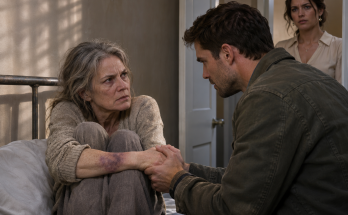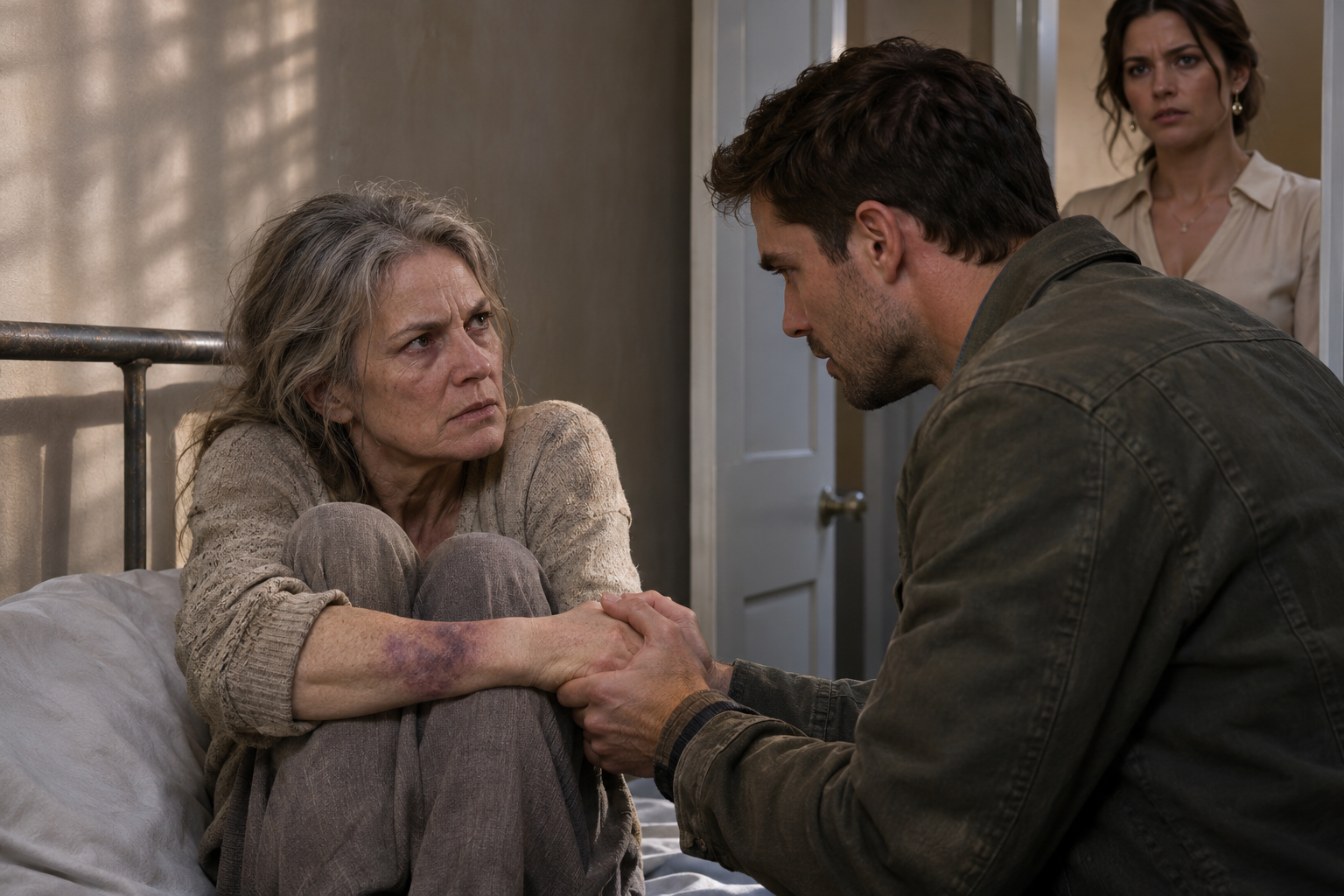
I knew something was wrong before I even stepped inside my own house.
It was the way Abigail spoke about my mother.
Quietly.
Carefully.
Like she was explaining something terrible that everyone else had already accepted.
I stood close enough to hear her talking to our neighbor.
She had that particular sadness in her voice.
The kind people use when they want everyone to understand how much they have suffered.
Only Abigail wasn't talking about herself.
She was talking about Mom.
"She's been getting terribly confused lately," Abigail said.
The neighbor stood listening.
Abigail lowered her voice.
"Sometimes she doesn't understand what she's doing. She can get upset and even hurt herself."
I looked toward the house.
Nothing seemed unusual from the outside.
It was the same place I had left when I went away on deployment.
The same front entrance.
The same upstairs windows.
The same familiar walls.
But I had never heard my mother described that way.
Not once.
Abigail continued speaking.
"We've been trying to find somewhere that can look after her properly. She needs more help than we can give her here."
I watched her face.
She looked exhausted.
Concerned.
Almost heartbroken.
I should have felt grateful that someone had been taking care of Mom while I was away.
Instead, I felt something tighten inside me.
I had spent enough time around people under pressure to recognize when words were being chosen too carefully.
That didn't mean Abigail was lying.
I knew that.
People behaved strangely when they were frightened.
They sometimes rehearsed explanations because they were tired of giving them.
I reminded myself of those things.
I didn't want to return home and immediately suspect the person who had been there while I was gone.
But then I noticed something upstairs.
A curtain moved.
Not much.
Just enough to catch my attention.
I raised my eyes toward the second-floor window.
For one brief moment, the fabric shifted away from the glass.
Then it settled again.
I kept looking.
Someone was in that room.
Someone had been standing close enough to the window to move the curtain.
I had no proof it was my mother.
But the possibility struck me immediately.
Why was she upstairs while Abigail discussed putting her into professional care?
Why hadn't she come down?
And why did I feel as though I had just seen someone trying to look outside without being noticed?
I told myself to stop.
I had only just arrived.
My duffel bag was still with me.
I hadn't spoken privately with either of them.
There were probably explanations I hadn't heard.
Still, the movement at that window stayed in my mind.
Abigail turned toward me.
Her expression changed.
The sorrow disappeared beneath a smile.
She stepped forward and wrapped her arms around me.
I returned the embrace.
It should have been a good moment.
Coming home after deployment was supposed to feel different from this.
I had imagined the ordinary comfort of seeing familiar faces again.
Instead, I was watching the upstairs window over Abigail's shoulder.
I hated that.
I hated what it suggested about the way I was thinking.
She pulled back just far enough to look at me.
I studied her face.
I wanted to ask about Mom immediately.
I wanted to know whether she had been ill, whether she was frightened, and whether someone had examined her.
But there was one question I couldn't put aside.
"Abigail, why is Mom's bedroom locked?"
Her body changed before her expression did.
I felt it through the embrace.
Her shoulders tightened.
Her arms became stiff.
For a second, it was as though she had forgotten how to hold me.
Then she answered.
"We have to keep her safe, Samuel."
I waited.
She didn't explain further.
I glanced toward the second floor again.
"Safe?"
"Yes. She's not always aware of what she's doing."
Her voice remained soft.
Nothing in her face seemed to suggest that the question was unusual.
That bothered me more than an angry response would have.
I understood that confusion could make an older person vulnerable.
I understood that some people needed constant supervision.
I had never believed otherwise.
But I also understood what a locked door meant.
A person inside could not leave when they wished.
Someone outside controlled when that door opened.
And Abigail was telling me that the person behind it was my mother.
I looked at her.
She looked back.
The neighbor was still there.
That mattered.
I could have demanded the key.
I could have insisted on seeing Mom immediately.
I could have asked Abigail to explain every decision she had made while I was away.
Part of me wanted to do exactly that.
But another part of me understood that I didn't yet know enough.
My deployment had taught me one lesson I had never forgotten.
Showing someone exactly what frightened you could give away more than you intended.
Fear made people hurry.
Anger made them careless.
And a careless question could end a conversation before the truth came out.
I wasn't going to make that mistake.
Not with my mother upstairs.
Not while I still had no idea what was happening behind that door.
So I smiled.
It felt wrong.
I could feel the muscles in my face doing something the rest of me resisted.
"All right," I said. "I understand."
Looking back, that was the first moment I truly felt ashamed of myself.
Not because I believed Abigail.
I didn't know whether I believed her.
I was ashamed because I had just agreed aloud to something that troubled me deeply.
My mother's bedroom was locked.
And I had pretended that was perfectly reasonable.
Abigail appeared to relax.
I watched the tension leave her shoulders.
I couldn't tell whether she felt relieved because I understood her situation or because I had stopped asking questions.
That uncertainty followed me toward the house.
I kissed her forehead.
A familiar gesture.
A normal gesture.
The sort of thing a husband might do after returning home.
But there was nothing normal about what I was thinking.
I was wondering about a curtain.
A locked bedroom.
And a woman who had gone rigid when I mentioned a door.
I picked up my duffel bag.
The weight of it was familiar.
I had carried it through my deployment and brought it back expecting to put everything behind me.
Instead, carrying that bag into my own house felt like the beginning of something I didn't understand.
The neighbors hadn't all gone home yet.
Their presence kept the conversation ordinary.
There were no raised voices.
No accusations.
No demand that Abigail take me upstairs.
I behaved as though I was simply glad to be back.
I let that impression stand.
I didn't like myself for it.
But I needed to see Mom without someone telling me what I was supposed to see.
I needed to hear her voice.
Not Abigail's explanation of it.
Not a neighbor's opinion.
Hers.
I kept remembering the way Abigail had described her.
Confused.
Unpredictable.
Dangerous to herself.
Those were serious words.
They could make almost anything sound necessary.
Even locking a bedroom.
Even deciding someone belonged in a facility.
I wondered how often that explanation had already been repeated.
The neighbor had listened without arguing.
Perhaps she believed Abigail.
Perhaps she had seen something that I hadn't.
I didn't know.
And that was the problem.
Everyone around me seemed to have accepted a story I had never been given the chance to question.
I was supposed to accept it too.
I had only been home a short while, and already I felt like a stranger inside my own family.
I looked upstairs again.
The curtain was still.
I couldn't see Mom.
I couldn't hear her.
I couldn't even tell whether she knew I had returned.
Abigail had told me that my mother was no longer thinking clearly.
But what I had seen from that window made me wonder whether someone upstairs was paying very close attention.
I wasn't ready to accuse anyone.
I wasn't ready to believe the worst.
All I knew was that I needed to open that door.
And I could not do it while everyone was watching.
So I kept my face calm.
I carried my bag inside.
And I waited for the house to become quiet.
Click here to continue reading: PART 2: Abigail Thought I Had Accepted Her Explanation, but I Already Knew Where She Kept the Key to My Mother’s Locked Bedroom
I Came Home From Deployment Expecting to See My Mother, but One Locked Bedroom Door Made Me Question Everything Abigail Said
Part 1 of 10