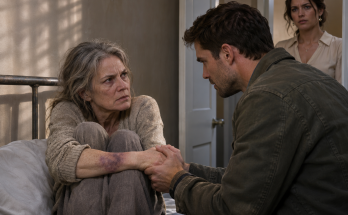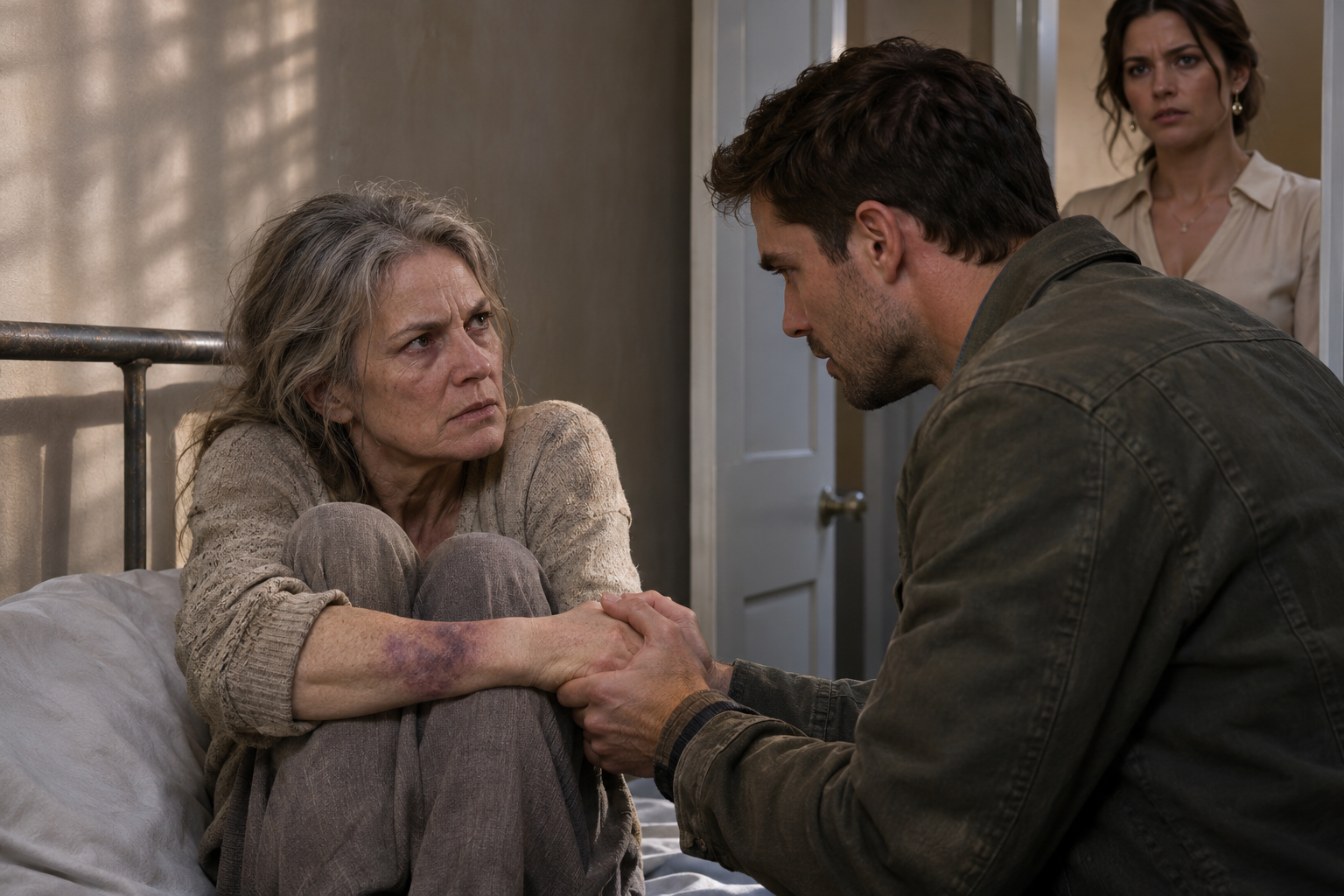
"Samuel, I'm not confused."
Mom spoke quietly.
But there was nothing uncertain about her words.
I stood looking at her.
For the first time since coming home, I heard her explain herself without anyone else speaking for her.
She didn't sound like the woman Abigail had described.
Her voice was controlled.
Her eyes remained fixed on mine.
She knew who I was.
She knew what Abigail had been saying about her.
And she wanted me to understand that she rejected it.
"Don't let anyone convince you I've lost my senses," she said.
I felt my throat tighten.
I had been trying to prepare myself for a difficult conversation.
I had expected that I might need to be patient.
That I might need to repeat questions.
That I might need to listen carefully because Mom was struggling to explain what had happened.
But she had gone straight to the one thing that mattered to her.
She wanted me to believe her.
I looked at the bruises again.
Then at the room.
Then at her face.
The contrast was almost unbearable.
Abigail had spoken about safety.
Mom was sitting against a wall with injuries on both wrists.
Abigail had spoken about professional help.
Mom was wearing clothes that hadn't been changed for days.
Abigail had spoken about confusion.
Mom was looking at me with the steady attention of someone who understood exactly why she needed to defend herself.
I couldn't pretend those things meant nothing.
I knew that a few clear sentences could not establish every detail of someone's health.
I knew that people could have moments of clarity even when they needed medical care.
But none of those facts explained the conditions in which I had found her.
None of them explained why she had been left behind a locked door without her phone.
And none of them explained the bruising.
I moved closer.
"Mom, I believe you."
She kept watching me.
I wanted to say more.
I wanted to explain that I had noticed the window.
That I had questioned Abigail.
That I had found the hidden key because something about the whole situation felt wrong.
But those details suddenly seemed unimportant.
Mom didn't need to hear how clever I had been.
She needed to know that her son wasn't going to dismiss her.
"I don't think you've lost your mind," I told her.
She looked at me for another moment.
I couldn't tell whether she was relieved or simply waiting to see what I would do next.
And I didn't blame her.
Words were easy.
I had just spent time downstairs saying things I didn't mean.
I had smiled at Abigail.
I had acted as though a locked bedroom was a reasonable answer to a medical problem.
I had kissed her forehead.
Then I had carried my bag inside like a man returning to an ordinary home.
If Mom had seen any of that from the window, I wondered what she must have thought.
Perhaps she had feared I believed Abigail.
Perhaps she had worried that I would leave the door closed.
I couldn't know.
But I remembered the curtain moving.
And now I couldn't think about it without seeing Mom huddled near that wall.
I looked around again.
The room was still dark.
The bed was still bare.
The plastic cup still held its small amount of water.
Nothing had changed because I had opened the door.
I had discovered what was inside.
That was all.
The next decision would be harder.
I was furious.
I wanted to go downstairs.
I wanted to confront Abigail with everything I had seen.
I wanted to ask her how she could speak of safety while my mother sat in these conditions.
I wanted to know who had grabbed Mom.
I wanted to know why her phone was missing.
I wanted to know why Abigail believed she had the right to lock my mother away.
Those questions crowded into my head.
I could barely separate one from another.
But the memory of Abigail's reaction stopped me.
Her body had stiffened when I asked about the bedroom.
She knew I had noticed the lock.
She had given me an answer.
And I had pretended to accept it.
If I confronted her immediately, that pretense would end.
I didn't know what Abigail would say.
I didn't know whether she would try to explain the bruises or deny that anything was wrong.
I didn't know whether she would admit that Mom had been left in the room this way.
I had no idea how she would react if she discovered I had taken the key.
That uncertainty frightened me.
Not for myself.
For Mom.
She was the one who had been locked inside.
She was the one with bruises.
She was the one who had been described to the neighbors as someone unable to understand her own behavior.
I could walk out of that room whenever I wanted.
She couldn't.
Not without the key.
I looked down at it.
I hated that small piece of metal.
I hated what it represented.
And I hated that I was still holding it instead of doing something that would immediately make everything right.
But I didn't yet know what that something should be.
I needed to think.
I needed to understand what had happened.
And I needed to avoid giving Abigail a chance to decide what Mom was allowed to say.
I wanted to remain there.
I wanted to sit with her until I had heard everything.
But I became aware that Abigail could come upstairs.
She could discover the door open.
She could find me standing beside Mom.
The thought changed the way I looked at the room.
A moment earlier, I had been focused entirely on what I had discovered.
Now I was thinking about what would happen if Abigail knew I had discovered it.
My mother watched me.
I think she understood that something was changing.
I couldn't be certain.
But her attention stayed on my face.
I lowered my voice.
"Mom, I need you to know I'm listening."
She didn't interrupt.
"I've seen the room. I've seen your wrists."
My eyes moved toward the bruises again.
I couldn't help it.
Those marks had become the center of everything.
I had returned home ready to hear that Mom needed care.
I was not prepared to accept that injuries and confinement were simply part of that care.
There was a difference.
A difference so important that I couldn't believe I had to remind myself of it.
I looked at Mom.
"I believe what you're telling me."
Her expression shifted slightly.
She had not been smiling.
She didn't suddenly become cheerful.
There was too much about that room for either of us to feel happy.
But her eyes remained steady.
And I felt that she understood me.
I wanted to tell her I was going to fix everything.
I wanted to say Abigail would never be allowed to make another decision about her.
I wanted to promise that the door would never be locked again.
But those promises were bigger than what I could honestly guarantee in that moment.
I had just arrived.
I had not heard the full story.
I had not confronted Abigail.
I didn't know what had happened during the days before my return.
I didn't even know where Mom's phone was.
The only thing I knew for certain was what I had seen.
The room.
The cup.
The missing bedding.
The clothes.
The bruises.
And the woman who had looked me directly in the eyes and insisted she was still capable of understanding her own life.
I held on to those facts.
They were enough to make me question everything.
But not enough to explain how it had happened.
Then I became aware of Abigail approaching.
The little time Mom and I had together was ending.
I didn't want to leave.
Every part of me resisted the thought of stepping outside that room and closing the door again.
But I had already decided not to reveal what I knew until I understood more.
I needed Abigail to believe her explanation had worked.
I needed her to think I had accepted what she said.
That meant doing something I despised.
I would have to leave Mom behind the door, at least for the moment.
I looked at her.
I couldn't find a way to make that decision sound acceptable.
There wasn't one.
A son had come home from deployment.
He had found his mother in a dark room with bruises on her wrists.
And now he was preparing to close the door.
I knew how terrible that sounded.
I knew how it felt.
I could barely look at the key.
But I was afraid that a confrontation before I understood the situation would make things worse for Mom.
That fear controlled me.
Whether it was the right decision was something I couldn't yet know.
I wanted her to understand why I was leaving.
But there was so little time.
"Mom, I need to go before Abigail sees me in here."
I could hear the strain in my own voice.
I hated it.
I hated that I was asking my mother to accept another moment behind a locked door.
I had come upstairs to prove she wasn't alone.
Now I was going to walk away from her.
I looked once more at the bed.
At the plastic cup.
At the dark corner where she had been sitting.
I wanted to remember everything exactly.
I didn't want to let Abigail's words soften what I had witnessed.
I didn't want to begin doubting myself once I went downstairs.
I knew how easy that could be.
Someone would offer an explanation.
Someone would speak with confidence.
Someone would say that I didn't understand how difficult the situation had become.
And if I wasn't careful, I might start questioning my own eyes.
So I fixed the details in my memory.
The bare mattress.
The warm water.
The same clothes.
The bruises on both wrists.
The absence of a phone.
My mother's clear voice.
I wouldn't forget them.
I wouldn't let anyone explain them away without answering the questions they raised.
I turned toward the door.
Every step felt wrong.
I didn't want Mom to think I was abandoning her.
That was the worst part.
I could bear Abigail believing I had accepted her story.
I could bear the neighbors thinking I had no concerns.
But the thought of Mom believing I had chosen to leave her there was unbearable.
I looked back.
She was watching me.
I wanted to say something that would make her feel safe.
Something that would make this strange, awful moment less frightening.
But I couldn't think of anything that wouldn't sound like a promise I had not yet earned the right to make.
So I returned to the only truth I could give her.
"I believe you, Mom."
She reached toward me.
I took her hand.
Her grip was stronger than I expected.
She closed her fingers around mine and held on firmly.
For one brief moment, nothing else mattered.
Not Abigail.
Not the neighbors.
Not the way I had pretended to accept the locked door.
Just my mother's hand holding mine.
I felt something change inside me.
Until then, I had been concentrating on keeping my expression calm.
On choosing my words.
On making sure Abigail didn't realize what I suspected.
But Mom's hand reminded me that this wasn't some problem I could solve from a distance.
This was my family.
This was the woman who had raised me.
And whatever had happened in my absence, she was living with its consequences.
Her grip did not feel confused.
It did not feel uncertain.
It felt deliberate.
She wanted me to know she understood.
And I wanted her to know I wasn't going to forget what I had seen.
I held her hand for another moment.
Then I let go.
It was harder than I expected.
I moved outside the room.
The door stood between us.
I looked at the key.
I still had time to refuse.
I still had time to walk away from the plan I had made.
But Abigail was approaching, and I believed I needed to protect what I had learned.
I closed the door.
The sound was small.
I remember that because the decision felt so enormous.
There was no dramatic noise.
No crash.
Just the ordinary sound of a bedroom door shutting.
I turned the key from the outside.
The lock caught.
I stood there for a moment.
I had become the person locking my mother in.
That thought nearly broke me.
I knew why I had done it.
I knew what I was trying to protect.
But knowing the reason did not make the action feel any less terrible.
A short while earlier, I had asked Abigail why Mom's room was locked.
She had told me it was necessary for her protection.
I had pretended to believe her.
Now I had seen what that protection looked like.
And I was still participating in the appearance of it.
The difference was that I no longer had any excuse not to question what was happening.
I had seen Mom.
I had heard her.
I had held her hand.
Abigail could tell me she was confused.
She could tell the neighbors that professional help was being arranged.
She could explain that keeping the door locked was unavoidable.
But I would remember my mother's eyes.
I would remember the marks around her wrists.
And I would remember the pressure of her fingers around mine.
Those were real.
I had felt them.
I stood outside the room with the key in my hand.
Abigail was about to enter.
I forced myself to look ordinary.
Calm.
Untroubled.
The same man who had smiled at her and said he understood.
But the man standing outside that bedroom was no longer the man who had arrived carrying his duffel bag.
Back then, I had questions.
Now I had seen enough to know those questions could not be ignored.
I couldn't yet say exactly what Abigail had done.
I couldn't explain every bruise or every missing comfort.
I couldn't know what had happened before I came home.
But I knew my mother deserved to be heard.
And I knew that I had to find out why she had been left in that room.
Abigail had told everyone Mom needed protection.
Standing outside the locked door, I understood that the first thing I needed to do was discover what, and whom, my mother needed protection from.
Click here to continue reading: PART 5: Abigail Came Upstairs Moments After I Locked My Mother’s Door Again, and I Had to Pretend I Had Seen Nothing Wrong
I Came Home From Deployment Expecting to See My Mother, but One Locked Bedroom Door Made Me Question Everything Abigail Said
Part 4 of 10