I thought I would feel better once I understood what was wrong.
I had been mistaken.
Understanding that something was wrong only made it harder to live with what I had seen.
I knew the bedroom was locked.
I knew Mom had been left without proper bedding.
I knew her phone was missing.
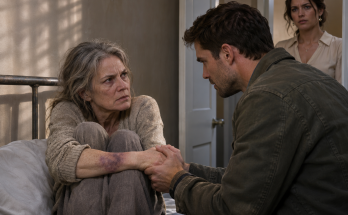
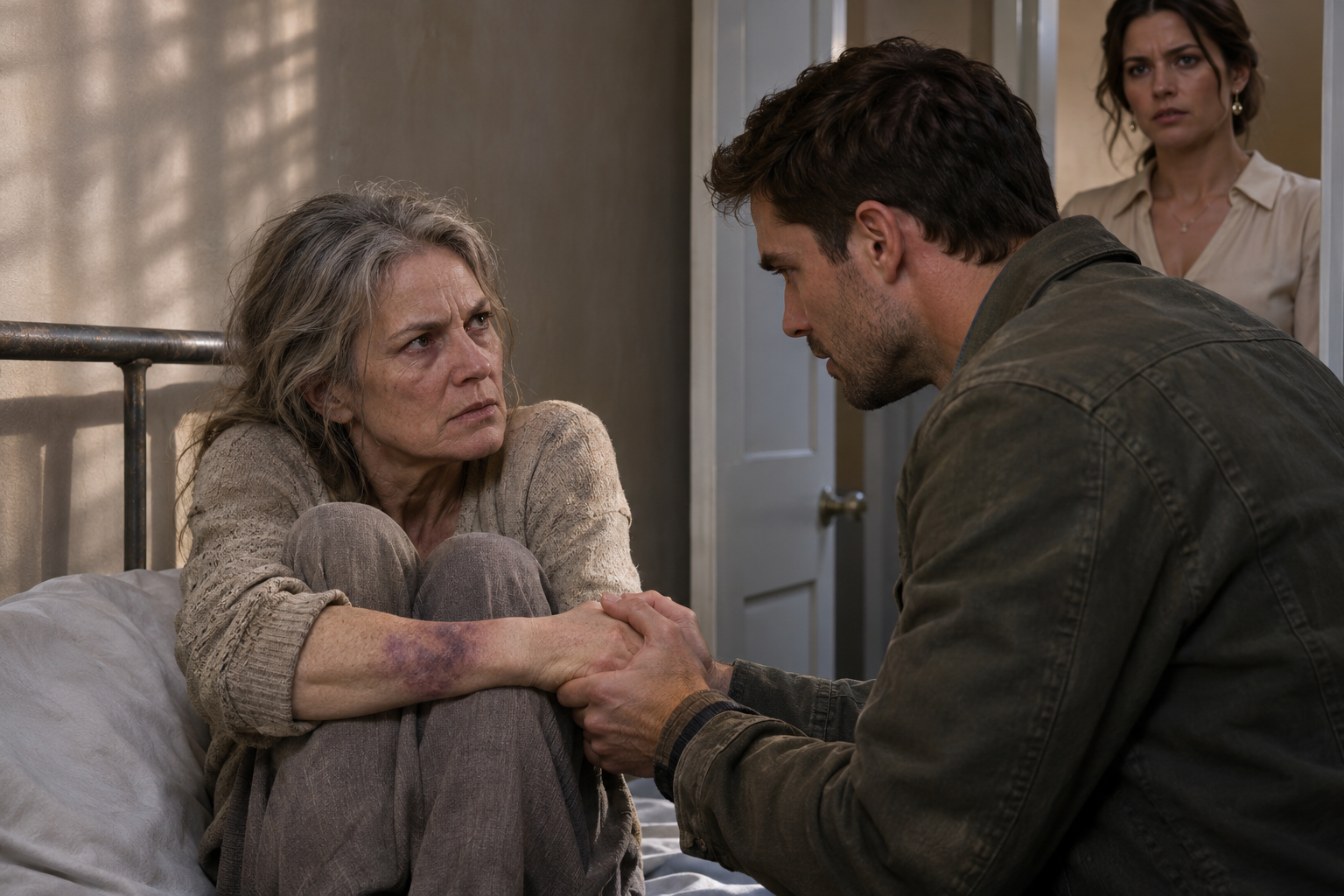
I knew there were bruises around both wrists.
And I knew she had looked directly at me and denied being confused.
Those were the facts.
I could not add to them without learning more.
But I could no longer pretend they were harmless.
I had spent too much time looking for a way to preserve everything as it had been before I returned.
My trust in Abigail.
The ordinary comfort of home.
The belief that my mother had been well cared for during my absence.
I wanted those things to remain true.
That was the part I had been reluctant to admit.
I wasn't only frightened for Mom.
I was frightened of losing the version of my life I thought I was coming home to.
When Abigail embraced me outside, I had wanted the moment to mean everything was all right.
I wanted to believe I could put my duffel bag down and return to familiar routines.
I wanted to trust the person who had been here while I was away.
But trust could not make an uncomfortable fact disappear.
It could not put sheets on Mom's bed.
It could not remove the marks around her wrists.
It could not explain why her phone was missing.
And it could not open a locked door.
I looked toward the stairs.
That door had become the clearest thing in my mind.
At first, it had been a question.
Why was it locked?
Then it had become a problem.
How could I get inside without Abigail stopping me?
After I opened it, the door became something worse.
It became the boundary between what Abigail told everyone and what I had witnessed myself.
I didn't know how I would ever forget that.
I remembered standing outside the house.
The neighbor listening.
Abigail shaking her head sadly.
Her explanation had sounded careful and reasonable.
Mom was confused.
Mom could hurt herself.
Mom needed professional care.
The words had formed a complete story.
And because the story sounded complete, it was easy to overlook what was missing.
Mom herself.
I had not heard her speak.
I had not seen her condition.
I had not asked what she wanted.
I had almost accepted a life-changing description of my own mother without hearing a word from her.
That realization hurt.
I knew better than that.
Or I had believed I did.
I had spent my deployment learning not to mistake confidence for accuracy.
I knew that a person could sound certain and still be wrong.
I knew that fear could distort what people remembered.
I knew that the calmest voice in a room was not necessarily the most truthful.
Yet I had returned home and nearly forgotten all of it.
Because Abigail was familiar.
Because she was my wife.
Because believing her would have been easier.
I had trusted the relationship more than I had examined the explanation.
That was my responsibility.
I couldn't put it entirely on Abigail.
I had made choices too.
I had smiled when I was worried.
I had nodded when I had doubts.
I had told her I understood when I didn't.
I had chosen to conceal my questions.
Some of those choices had allowed me to see Mom without interruption.
I understood that.
But they had also forced me to confront something uncomfortable about myself.
I was capable of pretending everything was fine even after seeing that it wasn't.
I didn't like knowing that.
I thought about the moment Mom had looked up at me.
There had been no long explanation.
No complicated defense.
She had simply insisted that she understood what was happening.
She had looked angry.
Exhausted.
Certain.
I had believed her.
But I also understood that belief was not the same as a complete account of what had happened.
There were still questions.
Many questions.
And I couldn't honestly claim to know answers I had never heard.
I didn't know who had gripped Mom's wrists.
I didn't know why her bedding had been removed.
I didn't know where her phone had gone.
I didn't know how long she had been kept behind the door.
I didn't know whether Abigail had been telling the neighbor what she genuinely believed or concealing something she knew was wrong.
Those questions remained unanswered.
I wanted them answered.
I needed them answered.
But I could not invent certainty simply because uncertainty was painful.
I had to begin with what I knew.
My mother's living conditions required immediate attention.
Her bruises required an explanation.
Her ability to speak for herself required respect.
And the decision to confine her could not remain unquestioned.
I returned to those facts whenever my thoughts became confused.
They were enough to guide what I needed to do.
I did not need to decide that Abigail was guilty of every terrible thing I feared.
I did not need to decide that Mom could never need medical care.
I did not need to choose between believing my wife completely and rejecting everything she said.
I needed to listen.
I needed to protect Mom's dignity.
And I needed to insist that her condition be assessed through more than one person's explanation.
I had spent too long treating the situation as a private disagreement.
It was more serious than that.
There was a person behind that bedroom door.
A person who had not been able to come downstairs when I returned.
A person who could not reach for her phone because it was not there.
A person whose wrists showed visible injuries.
Whatever Abigail believed about Mom's health, those circumstances mattered.
They could not be dismissed by calling her confused.
I thought again about the word safety.
I had heard it so often that it had almost lost meaning.
Abigail said the lock was for safety.
But safety could not mean merely keeping someone inside a room.
Safety also meant being comfortable.
Being able to communicate.
Receiving appropriate care.
Having injuries taken seriously.
Being listened to.
Being treated with respect.
When I thought about it that way, the explanation I had accepted outside seemed painfully incomplete.
I looked toward the upstairs window.
The curtain was still.
I remembered the first movement I had seen.
A small shift in the fabric.
Nothing dramatic.
At the time, I had wondered whether someone was watching me.
Now I understood why that possibility had bothered me so much.
If Mom had been at the window, she could have seen her son return without being able to come to him.
I could not know for certain whether that was what happened.
But the thought stayed with me.
It made the distance between the driveway and the bedroom feel enormous.
I had been so close to her.
Only a short walk away.
Yet there had been a locked door between us.
A hidden key.
And an explanation that discouraged me from asking questions.
I couldn't change those moments.
But I could refuse to repeat the mistake of accepting silence as evidence that everything was fine.
I thought about the neighbor again.
I wondered what she had taken away from Abigail's words.
Probably concern.
Perhaps sympathy.
Maybe the belief that Mom needed more supervision than her family could provide.
I didn't blame her for listening.
I had listened too.
The difference was that I had eventually opened the door.
Once I saw inside, I could not return to the same assumptions.
I knew too much.
Not enough to explain the entire situation.
But enough to recognize that it demanded attention.
I remembered the room.
The bare mattress was the first thing that came back.
I had looked at it and wondered why someone supposedly receiving care had been left without sheets.
Then the plastic cup.
The water that had been sitting there long enough to become warm.
Then Mom's clothes.
The same ones she had worn for days.
Each detail had seemed small by itself.
Together, they had formed a picture I couldn't ignore.
And then I remembered her wrists.
That was always the hardest part.
The dark marks against her skin.
The way I had recognized that someone had held her too tightly.
The thought made me angry all over again.
I wanted someone to explain those injuries.
I wanted to know who had been there.
I wanted to know whether Mom had tried to resist being held.
I wanted to know why she had been hurt.
But I reminded myself that questions were not answers.
I had to let her tell me what she knew.
I had to give her time.
I had to listen without putting words in her mouth.
That mattered.
Because the entire problem had begun with someone else describing her.
Someone else deciding what she understood.
Someone else telling the neighbors what she needed.
I would not make the same mistake by replacing Abigail's account with one I invented myself.
Mom deserved better.
She deserved to tell her own story.
I thought about the first thing I had said when I found her.
I had told her I knew she wasn't losing her mind.
At that moment, I had wanted her to feel believed.
I still wanted that.
But I also wanted her to know that being believed did not depend on her appearing perfectly calm or completely certain every moment.
Even if she became frightened, she deserved respect.
Even if she needed help, she deserved comfort.
Even if there were medical questions that required professional attention, she deserved to be treated as a person rather than a problem.
That was what I had failed to say.
I had been so focused on deciding whether Abigail was telling the truth that I had almost overlooked the more important issue.
My mother deserved care regardless of which explanation proved correct.
I thought about my return again.
I could still feel the strap of the duffel bag against my hand.
I had carried it into the house while pretending nothing was wrong.
That bag had represented the end of my time away.
I had believed I was returning to ordinary life.
But ordinary life had been happening without me.
Decisions had been made.
A bedroom had been locked.
A key had been hidden.
And my mother had been described as someone who could no longer safely manage her own behavior.
I had returned after those things had already happened.
There was nothing I could do to change the fact that I had been absent.
I couldn't go backward and ask questions sooner.
I couldn't undo days I hadn't witnessed.
I couldn't know what Mom had experienced simply by imagining it.
I had to accept those limitations.
But I didn't have to let them determine what happened next.
I could listen now.
I could question now.
I could refuse to let an unexplained arrangement continue without scrutiny.
That was the responsibility in front of me.
I thought about Abigail.
For a moment, I remembered only the woman who had stepped forward to embrace me.
Her arms around my shoulders.
Her familiar voice.
The kiss I had placed on her forehead.
It was painful to remember those things alongside the locked bedroom.
I didn't want to believe she had deliberately harmed my mother.
But I could no longer allow that wish to prevent me from questioning her.
I had to accept that two things could be true.
Abigail was someone I cared about.
And I had found circumstances in our home that I could not accept.
The second truth did not disappear because of the first.
I wished I had understood that sooner.
I had spent so much time trying to keep everything calm.
Trying not to reveal suspicion.
Trying to find the perfect moment to ask the perfect question.
But there was no perfect way to discover that someone you loved might have been mistreated.
There was only the responsibility to respond carefully and seriously.
I had been afraid of making a mistake.
Now I understood that refusing to make a decision could also be a mistake.
Mom had already been waiting.
I couldn't ask her to continue waiting simply because I hadn't yet learned how to face Abigail.
I remembered the moment just before I left the bedroom.
Mom had reached for my hand.
I had taken it.
Her fingers had closed around mine.
I had been surprised by the strength of her grip.
Not because I believed she was weak.
But because everything else in the room had made her seem so vulnerable.
The darkness.
The bare bed.
The injuries.
The missing phone.
Then her hand had reminded me that she was still herself.
Still capable of reaching for someone.
Still capable of telling me what she wanted me to understand.
I remembered looking at her face.
She had not asked me for a grand promise.
She had not demanded that I explain everything.
She had simply wanted me to know that she was thinking clearly.
I had answered her.
Then I had stepped outside.
The door had closed.
I had turned the key.
That sound had followed me ever since.
I knew why I had done it.
I had been trying to avoid alerting Abigail before I understood what was happening.
But the sound of the lock had forced me to recognize something.
Good intentions were not enough.
I could believe I was protecting Mom and still leave her feeling abandoned.
I could believe I was being careful and still delay something she urgently needed.
I could believe I was acting calmly and still fail to act when it mattered.
Those were difficult things to admit.
I had always thought of myself as someone who could make hard decisions.
Deployment had reinforced that belief.
But the hardest decision I faced after returning home was not complicated.
It was whether I would allow my mother's suffering to remain hidden because confronting it frightened me.
Once I understood the question that way, I knew what mattered.
I could not go back to accepting Abigail's story without evidence.
I could not overlook Mom's bruises.
I could not dismiss her words.
I could not treat the locked room as a normal part of caring for someone.
And I could not allow my desire to preserve the peace in our home to matter more than my mother's dignity.
I wanted the full truth.
I still did not have it.
The brief conversation behind that door had not established every cause or every consequence.
It had not settled who was responsible for the bruises.
It had not explained every decision Abigail had made.
It had not provided a final account of my mother's condition.
Those matters remained open.
I would not pretend otherwise.
But I no longer needed all of them settled before recognizing what I had to insist upon.
Mom needed to be heard.
Her injuries needed attention.
Her living conditions needed to be addressed.
And her freedom could not depend solely on an explanation that nobody had allowed her to challenge.
I looked upstairs again.
For a long moment, I simply stood there.
I thought about what I had expected from coming home.
Relief.
Rest.
Familiarity.
I had found something else.
A responsibility I hadn't known was waiting for me.
I could not say exactly how everything would end.
I could not promise that my relationship with Abigail would remain unchanged.
I could not claim that every question would have an easy answer.
And I could not erase the time Mom had spent behind that door.
Those were costs I had to acknowledge.
Whatever I learned next, the home I had expected to return to was already different.
My trust had been shaken.
My mother had been hurt.
And I had learned something painful about how easily a person could accept an explanation because questioning it threatened the life they wanted to keep.
I would carry that knowledge.
But I would not let it become another excuse.
I thought about Mom's hand one last time.
The way she had reached toward me.
The way she had held on.
The way she had looked at me and insisted that she still understood what was happening.
I had believed her then.
I believed she deserved to be heard now.
And whatever answers came next, I knew I could no longer allow her to disappear behind Abigail's explanation.
The truth had begun with a locked door.
It had begun with a curtain moving upstairs.
It had begun with a small key hidden inside a jewelry box.
But the thing I would remember most was not the lock.
It was my mother's hand.
Because in that brief moment, she had reminded me what I was supposed to be protecting.
Not my comfort.
Not my marriage from difficult questions.
Not the appearance of a peaceful home.
Her dignity.
Her voice.
Her right to be treated as someone whose life still belonged to her.
I had come home believing I needed to discover whether my mother was confused.
After seeing her room, I understood that another question mattered just as much.
How had I allowed someone else's description of her to matter more than hearing her for myself?
I could not change the answer to that question.
But I could refuse to make the same mistake again.
The End
Read more original stories on Feel Every Story.
I Came Home From Deployment Expecting to See My Mother, but One Locked Bedroom Door Made Me Question Everything Abigail Said
Part 10 of 10