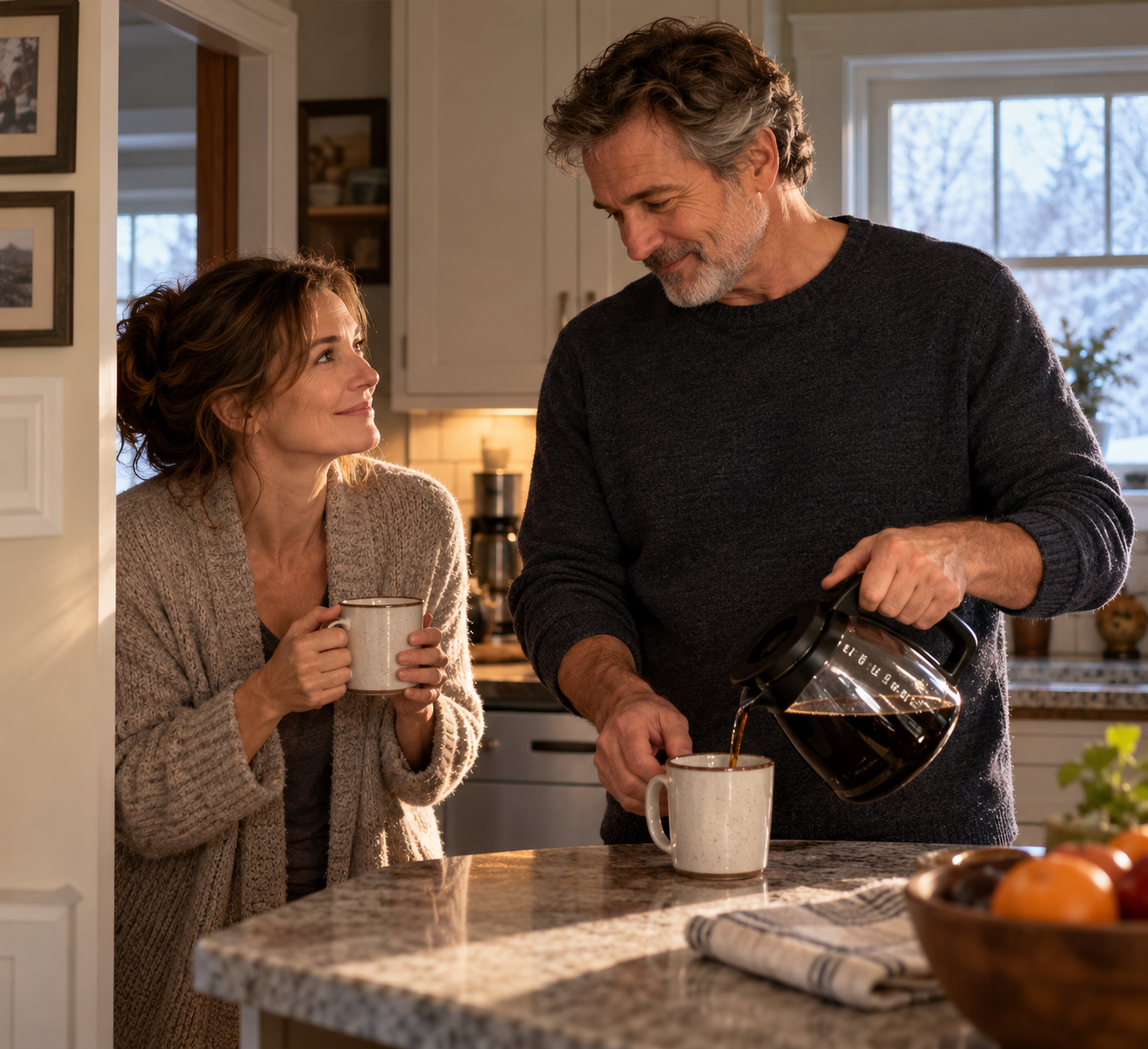
Frank came home on a Saturday.
He brought three boxes.
That was all.
I stood in the hallway and stared.
“Where is the rest of your stuff?”
“Apartment.”
“You own more than three boxes.”
“I know.”
He caught himself.
“I understand that I own more than three boxes.”
I laughed.
“You can bring your clothes.”
“I didn’t want to assume closet space.”
“Frank.”
“What?”
“You lived here for nineteen years.”
“Twenty.”
“Not helping.”
He smiled.
By evening his shirts hung beside mine again.
Not all.
Enough.
His shoes returned to the hall closet.
His razor returned to the bathroom.
The recliner stopped looking abandoned.
Ordinary objects became markers of negotiated trust.
We did not celebrate.
No champagne.
No family announcement.
I texted Sarah.
FRANK MOVED BACK.
She replied:
FOR REAL OR FAMILY-REAL?
I wrote:
FOR REAL.
She sent a laughing face.
Then:
PROUD OF YOU BOTH. ALSO TERRIFIED.
Fair.
Diane found out two days later because she stopped by and saw Frank’s truck at seven in the morning.
She knocked.
I opened wearing a robe.
She looked over my shoulder.
Frank appeared carrying coffee.
Diane smiled.
“Well.”
“Do not make it weird.”
“I would never.”
Frank laughed.
She stayed for breakfast.
Then asked whether we had heard from Aaron.
We hadn’t.
Her question had a reason.
A probate court hearing had been scheduled concerning Frank’s original estate documents.
Because Frank’s death certificate had been voided, most provisions disappeared automatically.
But one issue remained.
The behavioral inheritance clause.
The one reducing Diane and Ross to ten thousand dollars if they treated me badly after Frank’s death.
Legally meaningless now.
Emotionally radioactive.
Aaron believed Frank should formally revoke it.
Frank had not decided.
I stared at him.
“You didn’t tell me.”
His face fell.
“Yesterday.”
“What happened yesterday?”
“Aaron emailed.”
“And?”
“I wanted to think before bringing it up.”
There.
Not secrecy exactly.
Old instinct.
He saw it too.
“I should have told you first.”
“Yes.”
Diane looked uncomfortable.
“I can leave.”
“No,” I said.
This involved her.
Frank took out his phone.
The email was exactly as described.
Aaron recommended revocation because keeping the clause in future estate documents could create resentment and litigation.
Frank looked at Diane.
“What do you want?”
She surprised me.
“I don’t want you deciding today.”
“Why?”
“Because I don’t want to answer while money is in the room.”
That sounded like growth.
She asked whether Ross knew.
He did.
He had requested a family meeting.
Sunday.
I almost laughed.
Our Sunday five-o’clock call had once lasted eleven minutes.
Now the entire family needed conferences.
Sunday arrived.
Ross brought no tape measure.
I noticed.
He noticed me noticing.
“Therapy says humor can reinforce shame.”
“Your therapist sounds exhausting.”
“Very.”
We sat in the living room.
Frank in the recliner.
Me on the sofa.
Diane near the window.
Ross opposite.
Aaron joined by video.
He explained the legal issue.
Frank could create a new estate plan.
No behavioral test.
Equal inheritance.
Unequal inheritance.
No inheritance.
Charity.
Whatever he chose.
Frank looked at Diane and Ross.
“What do you expect?”
Ross answered first.
“Nothing.”
Frank frowned.
“That sounds performative.”
Ross sighed.
“Okay. I expect something because you’re my father and I grew up expecting inheritance.”
Honest.
“But I don’t want to know how much.”
Frank looked at Diane.
She nodded.
“Same.”
I asked, “Why?”
Diane looked at the empty space on the mantel where the funeral labels had once sat.
“Because knowing made us ugly before anything even happened.”
Ross added, “I turned furniture into advance payment on grief.”
That was painfully accurate.
Frank sat quietly.
Then said, “I built some of that.”
They looked at him.
“I used money instead of difficult conversations.”
Diane frowned.
“What conversations?”
“When you were angry after the divorce.”
He meant Frank and Margaret’s divorce.
“I bought you things.”
Diane looked down.
“When Ross dropped out of college, I paid his debts instead of asking why.”
Ross rubbed his face.
“When you both treated Eileen badly, I compensated privately instead of confronting it publicly.”
I looked at Frank.
That one mattered.
He had seen.
More than he admitted.
“I thought keeping peace was kindness.”
Diane whispered, “It wasn’t.”
“No.”
Frank said he wanted a new plan based not on punishment but clarity.
He would provide specific gifts while alive when appropriate.
Emergency help discussed openly.
No secret loans.
No using money to buy closeness.
After death, whatever remained would be divided among Diane, Ross, Sarah, and selected charities.
Sarah was not legally his child.
But nineteen years had made relationships that paperwork never captured.
I stared.
“You included Sarah?”
He looked at me.
“She’s family.”
Simple.
No bloodline mythology.
Just choice.
Diane smiled.
Ross nodded.
Neither objected.
Then Frank said something else.
“The house goes to Eileen entirely.”
Ross laughed.
“Obviously.”
A month after the funeral, that word had become possible.
Obviously.
Not Dad’s house.
Not inheritance property.
Mine.
Ours while married.
Mine if he died.
No debate.
Diane said, “Can I ask for one thing?”
Frank stiffened slightly.
“What?”
“The chair.”
Everyone froze.
Then she smiled.
“Not now.”
I laughed.
“When?”
“When you’re actually dead.”
Frank pointed at her.
“Morbid.”
“I’ve earned some clarity.”
She said she wanted the recliner someday because it reminded her of the night she failed to come when he called.
Not as punishment.
As reminder.
Frank looked at me.
“Your call.”
“The chair is yours.”
“For now.”
“For now.”
He looked at Diane.
“Then yes.”
She cried.
Ross cleared his throat.
“I would like the television.”
We all stared.
Then he laughed.
“I’m kidding.”
Even Aaron laughed through the computer.
The new estate plan took three weeks.
No secret clauses.
No red-coat provisions.
No seventy-two-hour tests.
No hidden legacy entities.
Aaron insisted on plain language.
So did I.
When Frank signed, he handed me the document immediately.
“You can read it.”
“I will.”
No offense taken.
That was new too.
January arrived.
Federal prosecutors announced coordinated indictments across three states.
Names from Thomas’s ledger became public.
Some charges involved crimes committed decades ago.
Others recent.
Several defendants were dead.
Their companies were not.
Asset proceedings continued.
Crescent Community Preservation Society was formally dissolved.
Helen House was reorganized as an independent restitution foundation with no family control.
Professional board.
Victim representatives.
Public audits.
Term limits.
No hereditary authority.
Mom cried when Lena told her.
“That’s what it was supposed to be.”
She agreed to serve as historical advisor for six months.
Then no more.
“I already gave it one life,” she said.
Howard volunteered in records instead.
They had begun seeing each other regularly.
Still separate homes.
One evening Mom told me Howard asked whether she wanted to marry him again.
I almost choked.
“What did you say?”
“No.”
“Poor Dad.”
“I also said ask me next year.”
I stared.
She smiled.
“People our age should not rush.”
Fair.
Sarah laughed for ten minutes when she heard.
Eleanor wrote me a letter.
Not hidden.
Mailed normally.
Stamp.
Return address.
Progress.
She apologized specifically for destroying Mom’s 2015 message.
She wrote that she had confused secrecy with loyalty for so long that destroying evidence felt like love.
She did not ask me to forgive her.
I wrote back.
One page.
I told her I was glad she survived.
I told her I was angry.
I told her both were true.
She responded:
That is more than I deserve and less than I hope for.
We began corresponding.
Slow.
Jonathan was sentenced to four years, reduced partly for cooperation.
He accepted the sentence.
At sentencing he read Peter’s letter aloud.
Not theatrically.
He stopped twice.
Afterward, Frank stood outside the courthouse.
Jonathan was led past in custody.
Their eyes met.
Jonathan said, “He would’ve liked you.”
Frank looked startled.
“Peter?”
“Yes.”
Frank swallowed.
“Thank you.”
No friendship.
No absolution.
Just something human leaving the building before the prison van did.
Pastor Dave received a shorter sentence than expected.
Home confinement followed by probation.
His church did not reinstate him.
He started volunteering with a legal aid group after release.
Not as clergy.
Mostly filing documents.
He told Frank, “Paperwork seems safer.”
Frank replied, “Debatable.”
Gregory’s trial began in February.
I testified.
So did Frank.
Sarah.
Howard.
Helena remotely from prison.
Margaret.
Claire.
Joanna.
Aaron.
Lena built the case slowly.
Not around one villainous act.
Around patterns.
Property coercion.
False documents.
Identity manipulation.
Threats.
Kidnappings.
Asset concealment.
The jury deliberated four days.
Guilty on most counts.
Not all.
Reality again refused theatrical perfection.
Gregory faced decades.
When the verdict was read, he looked at me.
No hatred.
Just disbelief.
He had spent years thinking the network made him powerful.
A jury of ordinary strangers reduced him to a defendant.
That seemed fitting.
Claire received a substantially reduced sentence for cooperation.
Joanna attended.
Afterward, she told me she had hugged her sister.
“Does that mean forgiveness?”
“No.”
“Good.”
She laughed.
“Why good?”
“Because I’m tired of moments being forced to mean more than they do.”
She nodded.
“Exactly.”
Rebecca ultimately pleaded guilty to conspiracy and falsifying court documents.
Michael visited her.
Not often.
Enough.
He and Frank developed an odd brotherhood.
They spoke every Sunday.
Not exactly at five.
Not exactly eleven minutes.
But regularly.
Michael told Frank stories about Daniel.
Frank sent him photographs of Helena from youth.
They were reconstructing a father neither of them had fully shared.
No money required.
In March, Helena became ill.
Nothing dramatic.
Pneumonia.
At her age, serious enough.
Frank visited the prison medical unit.
He invited me.
I went.
Helena looked smaller again.
She held Frank’s hand.
“I may die in here.”
Frank said nothing.
She smiled.
“Don’t look so offended.”
He laughed sadly.
“I spent half my life thinking you were dead.”
“Yes.”
“I would prefer less practice.”
Helena looked at me.
“Take care of him.”
I shook my head.
“No.”
She raised an eyebrow.
“He takes care of himself.”
Then I looked at Frank.
“And we take care of each other.”
Helena smiled.
“Better.”
She recovered.
Of course she did.
Nobody in that family knew when to leave.
Spring came.
The hydrangeas returned.
I pruned them myself.
Howard criticized my technique.
Mom defended me.
Then admitted he was right.
I threatened to ban both from the garden.
Frank installed a new latch on the shed.
He asked first.
We laughed about that too.
Then, one April afternoon, Aaron arrived with the final probate order.
Not urgent.
No hidden clauses.
Frank’s staged death was legally erased from the records.
His original death certificate void.
Thomas Vale’s burial corrected.
Samuel’s hidden burial corrected.
Howard’s false death record amended.
Helen’s death certificate rescinded.
The county clerk reportedly asked whether our family could stop creating paperwork.
Fair request.
Aaron placed one final form before me.
My name.
Eileen Harper Mercer.
Marital status.
Married.
I stared.
Frank looked nervous.
“Do you want that changed?”
The dissolution petition still existed in the walnut clock.
Untouched.
Available.
My choice.
I thought about twenty years.
About harm.
Change.
Fear.
Truth.
Not whether love existed.
It did.
The harder question was whether trust had become strong enough to live beside it again.
I signed the form.
Married.
Then looked at Frank.
“Not because we survived.”
He nodded.
“Why?”
“Because we changed what surviving means.”
His eyes filled.
He kissed my forehead.
Not like the corpse I kissed goodbye.
Warm.
Alive.
Real.
That night, the walnut clock stopped.
I noticed at 9:14.
Frank looked at it.
“Battery?”
“It’s mechanical.”
“Right.”
He reached for it.
I stopped him.
“What?”
“I want to check something first.”
The clock had held too many truths.
Letters.
Microfilm.
A divorce petition.
Frank’s apology.
Samuel’s shadows.
I opened the bottom compartment.
The dissolution papers were still there.
So was Frank’s letter.
Nothing new.
I took both out.
Frank watched.
I placed the divorce petition on the table.
“What are you doing?”
“Ending something.”
His face went pale.
I smiled.
“Not the marriage.”
He exhaled.
“Cruel.”
“Educational.”
I tore the petition in half.
Then again.
Not because divorce was unthinkable.
Because I no longer needed the document as proof that I had a choice.
The choice existed whether paper sat hidden in a clock or not.
Frank understood.
He did not cheer.
Did not make it larger.
He helped me throw the pieces away.
Then he opened the clock mechanism.
A tiny gear had slipped.
Five minutes later, it ticked again.
No secret compartment.
No revelation.
Just repair.
I listened.
Tick.
Pause.
Tick.
Time moving normally.
At last.
Click here to continue reading: PART 35: At Frank’s Real Funeral Years Later, Nobody Claimed the Chair, and I Finally Understood What My Mother Meant by a Path Home
Before the Funeral Flowers Had Wilted, Frank’s Children Began Dividing My Home as Though I Had Already Disappeared
Part 34 of 35