I had spent years thinking silence meant indifference.
That was one of the things the envelope changed.
Mr. Pickett had been silent about my driveway visits.
He had been silent about the mortgage.
He had been silent when I sat beside his hospital bed.
But his silence hadn't meant he was unaware.
I knew that now.
I looked down at the letter again.
His handwriting was unsteady.
I remembered seeing the same kind of writing on the short note.
My name had been written across the envelope.
Maggie.
It was strange to see it there.
He hadn't often used my name when he was alive.
Most of the time, I was simply the neighbor whose family bothered him.
I used to think that was all I meant to him.
I thought about the neighborhood meeting.
He had complained about my dog in front of other people.
I remembered how embarrassed I'd felt.
I'd sat there knowing I'd been clearing his driveway for years.
I could have said something.
One sentence would have changed how everyone in that room looked at him.
But I hadn't wanted to embarrass an elderly man.
And I hadn't wanted to turn my help into a public argument.
So I stayed quiet.
I went home angry anyway.
I remember that part clearly.
I didn't come home feeling noble.
I came home irritated.
I wondered whether I should stop helping him.
I thought about how much easier my mornings would be.
One driveway instead of two.
Less time in the cold.
Less work before spending the day standing behind the pharmacy counter.
I had enough responsibilities already.
There were days when our own driveway felt like too much.
And there I was, clearing another person's snow.
For someone who couldn't even speak kindly to my children.
Looking back, I don't think those feelings made me a bad person.
They made me tired.
I was a widow.
I was raising two children.
I was trying to keep working while doing all the things Conrad used to help me manage.
There were mornings when I wanted someone to notice that I was struggling too.
But no one was standing outside our house with a shovel for me.
I did what needed doing.
Then I went across the street.
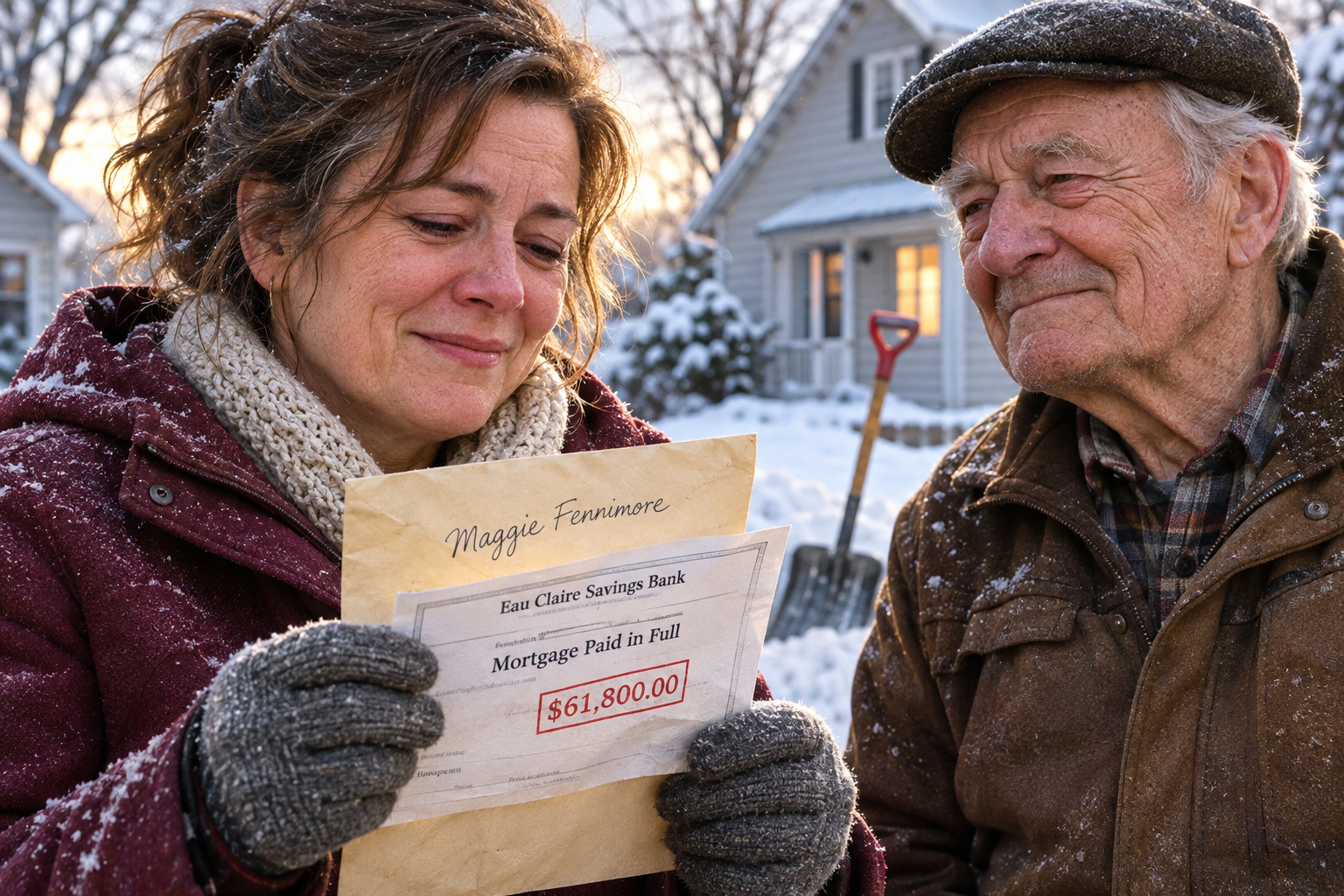
I think that was why the mortgage document affected me so deeply.
Because it proved that someone had noticed a problem much bigger than snow.
Someone had seen the burden hanging over our house.
And without asking me to explain myself, that person had paid it.
I didn't know exactly what Mr. Pickett knew about my situation.
I didn't know what he had seen or heard.
I wasn't going to claim that I understood his private thoughts.
But I knew the payment had been made.
I knew the amount.
And I knew he had arranged to keep his identity hidden.
Those were facts.
They were enough to make me rethink the man I'd known.
Not erase his faults.
Rethink him.
There was a difference.
Mr. Pickett could be harsh.
He could also be capable of generosity.
Both things could be true.
For years, I had only allowed myself to see one side.
The other had been sitting in a bank's records since January, eleven years earlier.
I remembered the first letter from the bank.
I had almost been afraid to believe it.
I thought that if I trusted the news, someone would eventually call and say a mistake had been made.
Then the mortgage payments would start again.
I kept worrying about that possibility even after the bank reassured me.
When you have been frightened about money for long enough, good news can feel suspicious.
I was relieved.
But I didn't know whom to trust.
Conrad was gone.
The mortgage had disappeared.
And I still had to go to work the next morning.
Life didn't stop to let me understand.
I had bills.
Children.
A job.
Winter.
There wasn't room to spend every day thinking about an anonymous payment.
So I kept moving.
And now the answer had found me eleven years later.
In a lawyer's office.
After the person responsible had died.
I wished he'd told me while he was alive.
That was the truth.
I wished I'd been able to look him in the eye.
Not to make a grand speech.
Not to embarrass him.
Just to let him know that I understood what he'd done.
But I also understood that he had deliberately remained anonymous.
He hadn't wanted me to know at the time.
I had to respect that the silence was his choice.
Even if it left me with feelings I couldn't put anywhere.
I remembered the oranges.
They started appearing after his accident.
A bag on my porch after work.
No conversation.
No explanation.
Then the bone for my dog.
The dog he had once complained about to the police.
I had thought those were small gestures of thanks.
Maybe they were.
I still couldn't know exactly what he intended.
But I knew they were unusual for him.
Mr. Pickett wasn't a man who expressed himself easily.
At least, he never had with me.
Perhaps those items were the most he could manage.
Perhaps he thought I'd understand.
I did understand something.
Not everything.
But something.
I didn't need the oranges to be payment for my work.
I didn't need the dog bone to erase his complaints.
What mattered was that he'd done something different.
He'd reached across the distance between our houses in the only way he seemed willing to manage.
I had done much the same thing with my shovel.
I'd never walked over and asked to be his friend.
I'd never invited him into my life.
I'd simply taken care of a job he couldn't do.
We had lived across from each other for eleven years.
And somehow, we'd built a relationship almost entirely out of things neither of us discussed.
That was the strange part.
I knew how much snow his driveway collected.
I knew when it needed clearing.
I knew how frightened I'd been when I found him on the ice.
But I didn't know what he thought about me.
Not until the short letter.
He had known.
All along.
I returned to that sentence in my mind.
It was so simple.
And it changed so much.
I could no longer picture myself slipping across the street unnoticed.
I had to picture another possibility.
That he knew whose footsteps had crossed his driveway.
That he knew whose shovel had cleared it.
That he understood what I was doing and chose not to mention it.
I couldn't say how he found out.
The source of that knowledge remained his own.
But I no longer needed to wonder whether my help had been seen.
He'd answered that question.
And the bank document answered the larger one I'd carried since Conrad died.
I had gone to the lawyer's office expecting almost nothing.
Now I had more to think about than I could manage in one sitting.
The man who seemed unable to give anyone a pleasant word had once made sure my family could keep its home.
The woman who thought he disliked her had spent eleven winters clearing his driveway.
Neither of us had known how to talk about those things.
And now one of us was gone.
I couldn't fix that.
I could only acknowledge it.
I had been wrong to assume I knew everything about him.
And that mistake had lasted eleven years.
Click here to continue reading: PART 7: After Learning Who Paid Conrad’s Mortgage I Could No Longer Think of That Icy Morning as an Ordinary Act of Neighborly Help
For Eleven Winters I Cleared the Driveway of a Man Who Hated My Family Without Ever Knowing Why I Kept Going Back
Part 6 of 10