I kept returning to the morning I found Mr. Pickett on the ice.
It had happened two winters before his death.
Until the lawyer's meeting, I thought of it as the day I saved my neighbor.
That was what the doctor had said, in a way.
Another thirty minutes outside could have killed him.
I knew how close it had been.
But after reading the mortgage document, I couldn't think about that morning in quite the same way.
I pictured the porch light.
It had been on when I went outside.
I remembered noticing the open front door.
It wasn't something I'd expected to see.
Mr. Pickett usually kept his house shut up tightly in the early morning.
I didn't often see him when I cleared the driveway.
Sometimes there wasn't any sign he was awake.
That morning, there was light.
And there was the open door.
I had been about to do the same work I'd done so many times before.
Clear the snow and ice as best I could.
Get home.
Go to work.
Instead, I saw him near the steps.
At first, I didn't understand what I was looking at.
Then I recognized him.
He had gone outside for his newspaper.
He'd slipped.
And he had been lying there in the freezing cold.
His lips were blue.
I remember that detail better than almost anything else.
Blue.
There was something terrifying about seeing a person who was usually so loud lying there without a word.
I had known him as a man who complained.
A man who didn't hesitate to tell you when you were bothering him.
But on the ice, he couldn't tell me anything.
He needed help.
I called 911.
Then I took off my coat.
I lay down beside him and wrapped him as well as I could.
I was cold.
I was frightened.
I didn't know whether he would survive.
I stayed until the ambulance arrived.
At the hospital, I learned he'd broken his hip.
He had hypothermia too.
The doctor explained how serious it was.
I remember feeling relieved that I'd gone outside when I did.
I didn't think about eleven years of shoveling.
I didn't think about his complaints.
I didn't think about whether he'd ever thanked me.
I was simply grateful he was alive.
When he woke up, I sat beside him.
He recognized me.
There wasn't much conversation.
We'd spent years not knowing how to speak to each other.
That didn't change just because he had nearly died.
He acknowledged that it was me.
I acknowledged that I was there.
And we sat with the rest of it unspoken.
I hadn't needed more from him that day.
I didn't want him to apologize for every unpleasant thing he'd ever said.
I didn't want him to promise to become a different person.
I wanted him to recover.
Three weeks later, he came home using a walker.
I watched the house across the street become occupied again.
The front door was closed.
The porch light came on when needed.
And Mr. Pickett was back where he belonged.
I continued clearing his driveway.
That didn't change.
What changed was the small evidence that he had begun thinking about someone besides himself.
Or at least, that was how it felt to me.
The oranges.
The dog bone.
Things left on my porch without explanation.
It was such a peculiar way to say anything.
But Mr. Pickett had never been ordinary when it came to communicating.
I used to think those gifts were his awkward way of thanking me for finding him.
I still thought that was possible.
But now I knew about the mortgage.
And I realized there were parts of our relationship that had been hidden from me for years.
I had been helping someone who had already helped my family.
He had been receiving care from someone who didn't know what he'd done.
We had both been involved in the other's life without saying so.
It was difficult to understand how that had happened.
I thought about what would have changed if he'd told me about the mortgage.
If he'd knocked on my door that January and explained what he had paid.
I would have been overwhelmed.
I probably would have cried.
I would have asked why.
And I would have felt the weight of owing him something I couldn't repay.
Maybe that was why he'd kept quiet.
Maybe not.
I couldn't know.
But I knew how I would have felt.
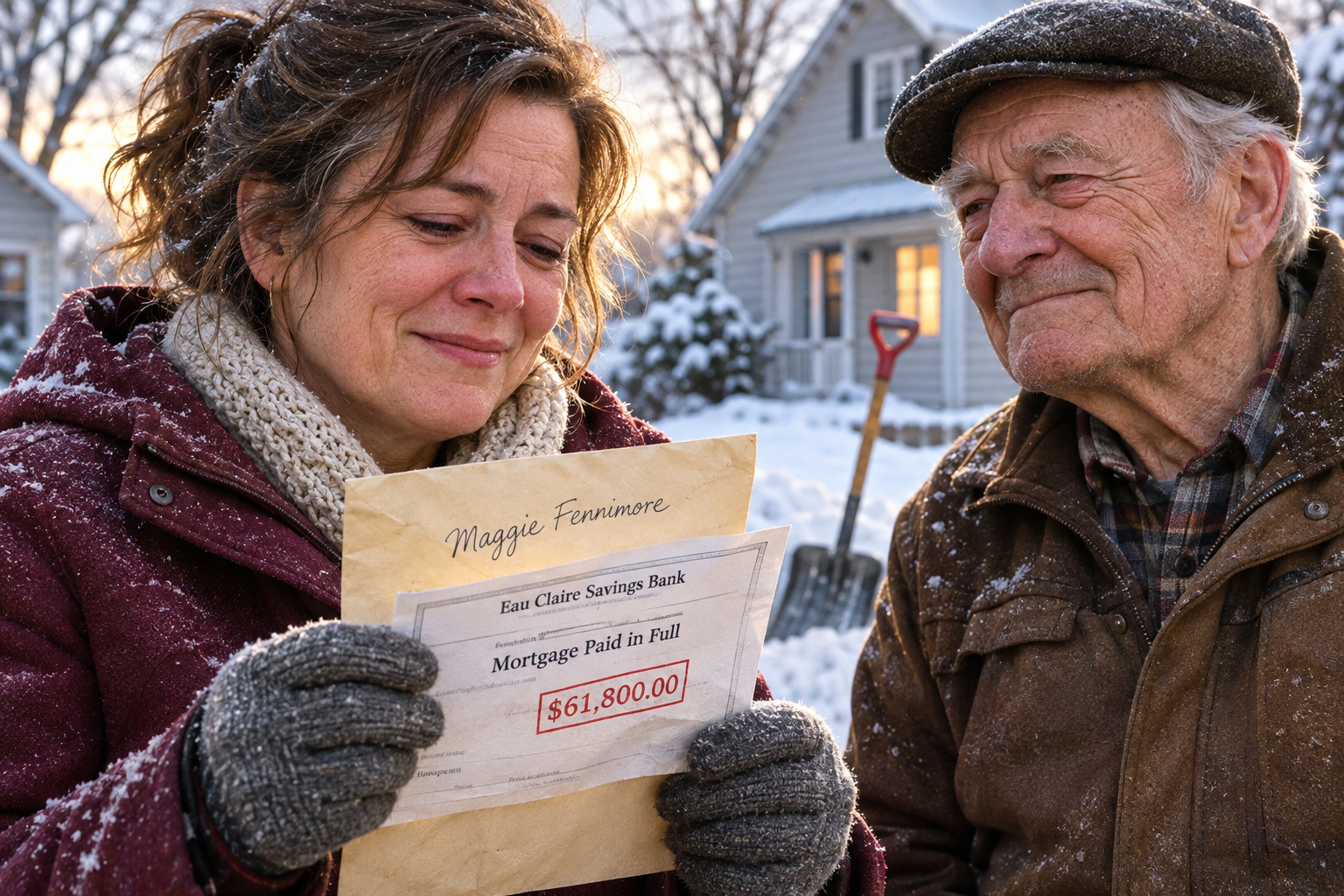
Sixty-one thousand eight hundred dollars was more money than I could imagine giving away at that point in my life.
My own bills were already more than I could handle.
The idea that someone had paid that amount on our behalf still made my stomach tighten.
I had lived for eleven years knowing we'd been helped.
I hadn't lived those years knowing whom I owed.
There was a difference.
The anonymous payment had allowed me to accept the relief without the embarrassment of facing the person responsible.
I wasn't sure I'd appreciated that at the time.
I was too frightened.
Too tired.
Too busy working.
Now I could see how much the anonymity had shaped my life.
It had left me free to continue living across from Mr. Pickett without knowing what he'd done.
And it had left him free to accept my help without reminding me of his.
I couldn't decide whether that was sad or generous.
Maybe it was both.
I remembered the day of his funeral.
Lyndon had come from Phoenix.
He spoke about taking care of the house.
I didn't think much about that at first.
It wasn't mine to worry about.
Mr. Pickett had family.
And Lyndon was his nephew.
But the way Lyndon spoke at the lawyer's office had hurt.
He had assumed the worst of me.
He believed I'd spent years making myself useful because I wanted property.
He hadn't understood why I'd started shoveling.
He didn't know about that first December morning.
He hadn't seen Mr. Pickett in his bathrobe, holding a shovel he couldn't lift properly.
He hadn't seen me crying over our own driveway because Conrad wasn't there to do it anymore.
He hadn't been there on the ice.
As far as I knew, he had visited only about twice in ten years.
Yet he felt certain he understood everything.
I recognized that certainty.
Because I had been certain about Mr. Pickett too.
I thought I knew he was only an unpleasant old man.
I had plenty of evidence.
The complaints.
The shouting.
The police calls.
But I hadn't known about the payment.
I hadn't known he'd been carrying his own secret.
Lyndon was wrong about me.
I had been wrong about part of his uncle.
That didn't make the accusations acceptable.
But it reminded me how easy it was to judge people using only the pieces of their lives we happened to see.
I looked at the mortgage letter again.
It didn't tell me what kind of man Mr. Pickett had been every day of his life.
It told me what he had done for my family in one desperate month.
And that mattered.
I thought about the doctor saying he had almost died on the ice.
I thought about Conrad, who never came home after his accident.
I thought about the two children I had once worried I couldn't keep in our house.
There were things none of us could control.
A logging accident.
An ice storm.
An elderly man slipping on his own steps.
But there were also things we could choose.
A mortgage payment.
A cleared driveway.
A phone call for an ambulance.
I couldn't make the world safe.
I couldn't protect everyone.
I couldn't undo what had happened to Conrad.
But I could recognize what Mr. Pickett had done.
And I could stop measuring the importance of a person's actions by how pleasantly they spoke.
That was something his final letter had changed in me.
Not my memories.
Not the facts.
My understanding.
Click here to continue reading: PART 8: The Man I Thought Had Never Appreciated My Kindness Left Me With an Answer That Changed How I Remembered Eleven Winters
For Eleven Winters I Cleared the Driveway of a Man Who Hated My Family Without Ever Knowing Why I Kept Going Back
Part 7 of 10