
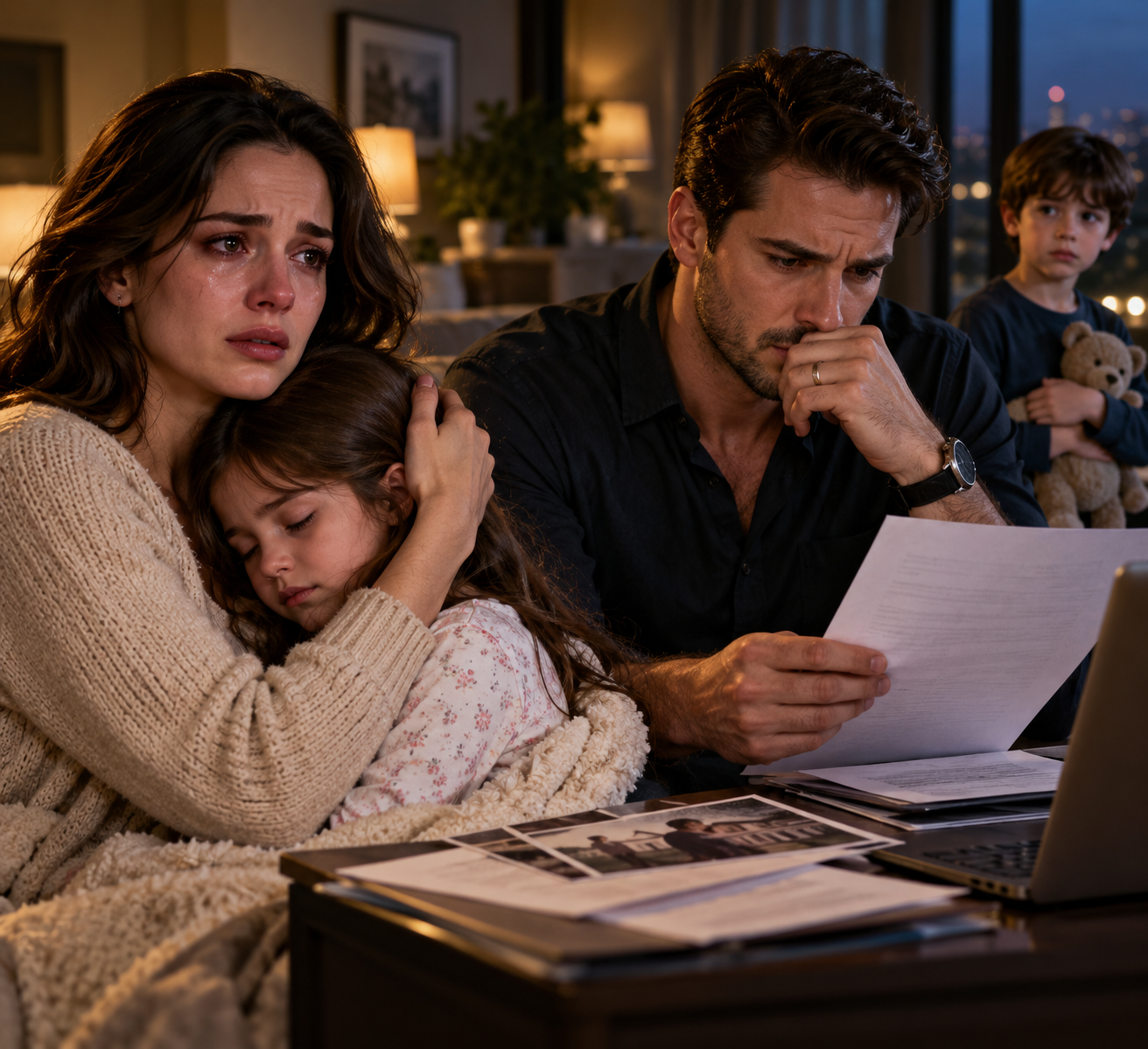
Laura Bennett arrived at my house the following morning carrying a folder she had refused to send electronically. She placed it on the kitchen table beside Sarah’s photograph and waited until Leo had gone upstairs. Daniel was already there, sitting with his cane propped against the chair. Neither of us had slept much since Laura’s call.
“The earlier statement is important,” Laura said. “But I want you to understand what it proves and what it doesn't. We have evidence that Dr. Bell changed his account. We don't yet know why.”
She opened the folder and laid two documents side by side. Both carried Dr. Bell’s name. Both described the hours surrounding Sarah’s delivery. The first had been written three days after her death. The second was submitted nearly six weeks later, following an internal hospital review.
In the original statement, Bell acknowledged that Sarah had shown signs of significant bleeding at 6:12 that evening. Marianne Cole had alerted him and requested immediate assistance. According to his own account, Bell delayed activating the full emergency response because he believed the bleeding could be controlled without additional intervention.
The revised statement gave a different sequence. It placed the first significant warning at 6:31, when the emergency team had already been summoned. The earlier observations, including Marianne’s warning, were absent.
Daniel leaned forward. “He removed the part where he waited.”
“That appears to be what happened,” Laura said. “But we need the underlying clinical records before we can establish the complete timeline.”
I stared at the first document. For ten years I had imagined Sarah’s final hours as a sudden catastrophe, something no one could have anticipated. The possibility that warning signs had appeared earlier, and that someone had chosen to wait, made the room feel airless.
“Why would he change it?” I asked.
Laura folded her hands. “There could be several explanations. He may have believed the original account was inaccurate. He may have been advised to revise it. Or he may have wanted to conceal a delay. We need evidence before choosing among those possibilities.”
Daniel rubbed his forehead. “My father was involved in the hospital. He knew Bell. He knew administrators.”
Laura nodded. “That's one of the relationships we'll investigate.”
I looked toward the stairs. Leo was in his room building a model airplane, humming while he worked. The sound came faintly through the ceiling. He had no idea that the adults downstairs were examining the minutes surrounding his birth as though they were pieces of a broken clock.
“Was Sarah conscious during that time?” I asked.
Laura looked at the records again. “We don't have enough information to say.”
That uncertainty stayed with me. I had wanted the truth for so long that I sometimes forgot the truth might contain things I could not bear to know.
Marianne arrived shortly before noon. She brought her notebook and a sealed envelope containing copies of notes she had made during the shift. Her handwriting was compact and precise, with times recorded along the margins.
She studied the two statements without speaking. Then she pointed to the earlier one.
“This is closer to what I remember.”
Laura asked her to explain.
Marianne described noticing that Sarah was bleeding more heavily than expected. She had checked her vital signs and contacted Bell. When the bleeding continued, she repeated her concerns. She remembered feeling that the response was too slow, although she was careful to distinguish what she had personally observed from what she had concluded afterward.
“Did you ask for an emergency team?” Laura asked.
“Yes.”
“At what time?”
“My notes say 6:12.”
“And what happened?”
“Dr. Bell said he was assessing the situation. He didn't activate the full response then.”
I watched Marianne’s hands. They were steady on the table, but her thumb pressed repeatedly against the edge of her notebook.
“Was there a reason he waited?” I asked.
“He believed the treatment already underway would work.”
“Did you agree?”
Marianne looked at me. “I was concerned enough to ask again.”
She explained that the emergency team was eventually summoned, but by then Sarah’s condition had deteriorated. More clinicians arrived, and the room became crowded with people working urgently.
I asked whether an earlier response would have saved her.
Marianne did not pretend to know. “I can't answer that. A specialist reviewing the complete records may be able to assess whether the delay affected her chances.”
I appreciated her restraint, though part of me wanted someone to say the answer plainly. I wanted certainty, even if it was terrible.
Laura asked Marianne about Daniel’s father.
Marianne remembered seeing him outside the delivery area before Sarah’s condition became critical. He had spoken privately with Bell. She did not hear the entire conversation, but she recalled him asking whether arrangements had been made concerning the baby.
“Arrangements?” Daniel repeated.
Marianne nodded. “I remember that word because it troubled me.”
I thought about the adoption plan Bell had described. Daniel’s father had wanted Sarah to surrender Leo. He had been trying to control the baby’s future while Sarah was giving birth.
“Did Sarah agree to anything?” I asked.
“No,” Marianne said. “She was very clear that she intended to keep her child.”
I closed my eyes. Sarah had been frightened, isolated, and physically vulnerable, yet she had continued refusing the demands placed upon her.
Daniel sat back. His face had become pale.
“My father told me Sarah had changed her mind about us,” he said. “He said she wanted a different life.”
Marianne looked at him with quiet sympathy. “She spoke about you during labor. She wanted you to know your son.”
For several moments, Daniel could not answer.
After Marianne left, Laura explained that she would request the complete medical records, the hospital’s internal review, and any surviving correspondence concerning Bell’s statements. She also wanted an independent obstetric specialist to examine the clinical timeline.
I asked whether the hospital might refuse.
“They may challenge some requests,” she said. “But we'll use the appropriate legal process.”
Daniel offered to cover the costs. I initially resisted, uncomfortable with the idea of relying on someone I had known for only a few days. But he reminded me that Sarah had been his partner and Leo was his son.
“This isn't something you should have to carry alone,” he said.
I looked at him for a long moment before agreeing.
That afternoon, Leo came downstairs carrying his unfinished airplane. One wing had been attached backward, and he wanted Daniel’s opinion.
Daniel studied it seriously. “I think this plane might have trouble turning left.”
Leo laughed. “That's what I said.”
They spent twenty minutes adjusting the pieces. I watched from the sink while rinsing cups, surprised by how naturally they worked together. Daniel did not try to impress him. He listened, asked questions, and let Leo make the decisions.
When Daniel left, Leo stood at the window until his car disappeared.
“Can he come back tomorrow?” he asked.
“We'll see.”
Leo nodded, then returned to his airplane.
I found myself thinking about Sarah at eighteen, trying to protect everyone she loved while making decisions no one her age should have faced alone. She had wanted Daniel to be part of their son’s life. Watching them together, I could finally understand what she had been trying to preserve.
Two days later, Laura called with news from the hospital.
The medical records department had located Sarah’s chart, but several pages referenced in the original index were missing from the copy prepared for release. The hospital claimed the discrepancy was likely an archival problem.
Laura was not satisfied.
“Do they know which pages?” I asked.
“Yes. Nursing observation sheets from the period immediately before the emergency response.”
I sat down at the kitchen table.
“The same nineteen minutes?”
“Part of that period, yes.”
She explained that the missing sheets could contain the observations Marianne had documented. Without them, an independent reviewer would have difficulty reconstructing exactly what happened.
I asked whether someone had deliberately removed them.
“We don't know,” Laura said. “But the fact that they appear in the index means we have a reason to request an explanation.”
After the call, I opened the drawer where I kept Sarah’s belongings. Beneath a stack of photographs was the small biscuit tin she had used to save money for the baby. I had never thrown it away.
Inside were a few coins, a hospital bracelet from an earlier appointment, and a folded shopping list.
I held the list beneath the kitchen light. Sarah had written diapers, soap, and oranges. At the bottom, in smaller letters, she had added: Ask Mom about the blue blanket.
I remembered the blanket. My mother had made it years earlier, and Sarah wanted Leo to have it.
I went upstairs and found it folded at the foot of his bed.
The thought that someone had tried to make decisions about Sarah’s child without her consent filled me with a quiet, persistent anger. But anger would not recover the missing records. We needed evidence.
That evening, Daniel called.
He had been reviewing the papers from his father’s cabinet and found a receipt for a payment made to a private records-storage company shortly after Sarah died. The receipt listed a sealed archive box and a retention period of fifteen years.
“Do you think it contains hospital documents?” I asked.
“I don't know. But the dates match.”
He had already given the information to Laura.
I asked why his father would preserve records that might expose him.
Daniel hesitated. “My father kept everything. Contracts, letters, recordings. He believed information gave him control.”
I thought about the photographs taken of Leo, the forged letter, and the documents hidden for years.
“Then perhaps he kept something he shouldn't have.”
The next morning, Laura confirmed that the storage company still held the box. It could not be released without proper authorization, and she was arranging the necessary steps.
For the first time, we had a possible source of evidence outside the hospital’s control.
I was standing beside Sarah’s photograph when another call came through.
It was Evelyn.
Her voice sounded frightened.
She said someone had entered her husband’s study during the night. The cabinet had been opened, and several papers were missing.
I asked whether she had called the police.
“Yes,” she answered. “They're here now.”
Then she told me what had been taken.
The missing folder contained copies of Sarah’s hospital records.

One Comment on “PART 5 – The Missing Nineteen Minutes in Sarah’s Hospital Records Revealed a Decision No One Had Ever Admitted Making”