The morning after my seventy-fourth birthday, I woke to the sound of rain tapping against the bedroom window. The sky was pale and overcast, and the garden lay beneath a thin layer of fallen leaves. I stayed in bed for several minutes, remembering the evening before.
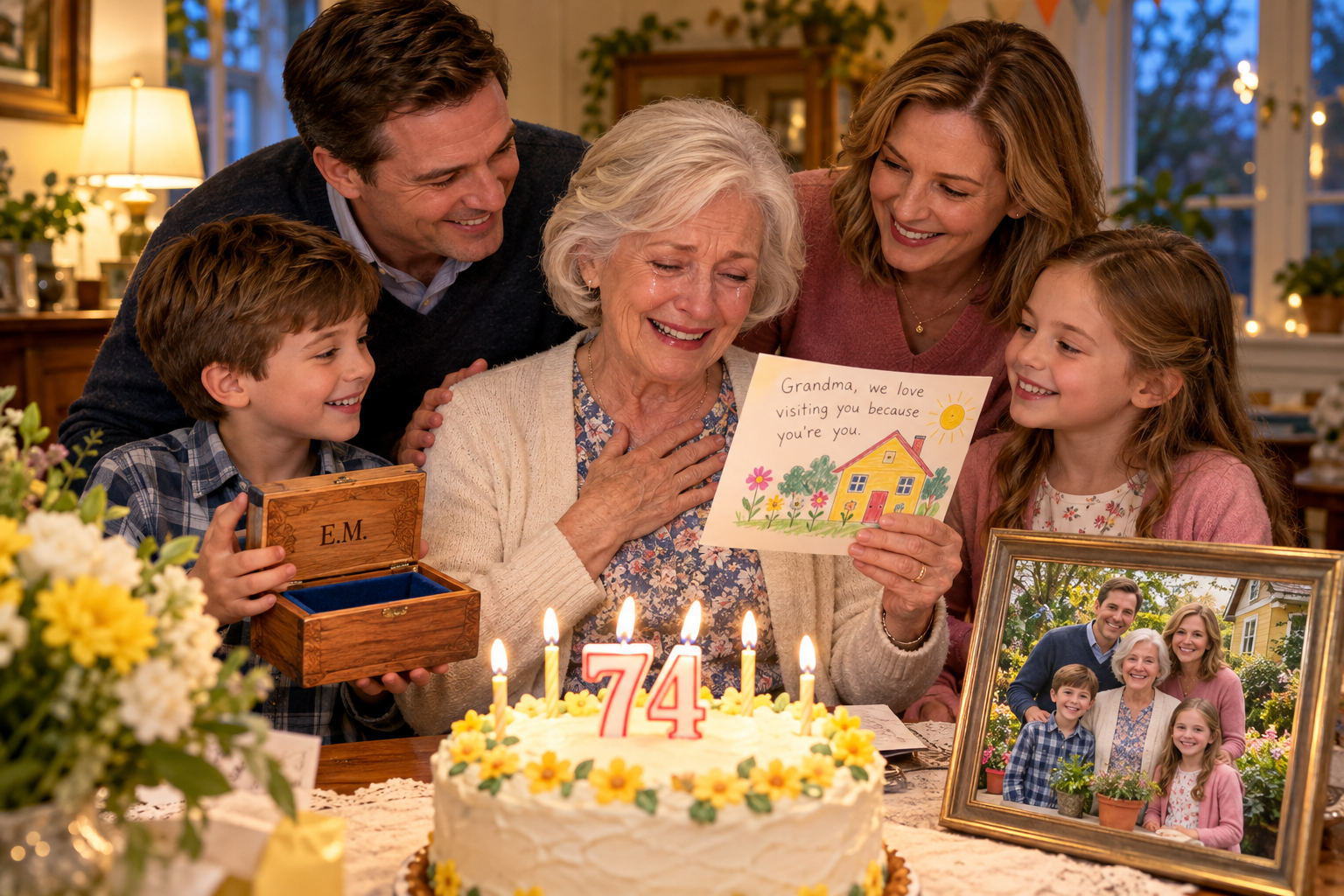
There had been no extravagant presents. No expensive jewelry or elaborate celebration. Instead, my family had given me things that showed they had been paying attention: a photograph of us together, Owen's handmade wooden box, Chloe's drawing, and Paige's thoughtful card. Graham had prepared dinner, and for once I had spent my birthday simply enjoying being celebrated.
I went downstairs in my dressing gown and found the wooden box resting on the dining table. I opened it and touched the blue felt lining. Inside were Graham's letter, Paige's card, and Chloe's drawing. The box was small, but it contained evidence of changes I had once been afraid would never happen.
Beside it lay Ruth's leather-bound notebook.
I picked it up and opened to the first blank page.
For all the plans you haven't made yet.
I had smiled when I read those words the previous morning. Now they seemed like an invitation.
I sat at the table with my coffee and considered what I wanted from the coming year.
For so long, planning had meant anticipating the needs of other people. I had kept track of school holidays, appointments, groceries, laundry, and birthdays. Even after Thomas died, I had continued organizing my days around Graham's household. I had rarely asked myself what I wanted to do with an afternoon, much less an entire year.
Now the question felt both simple and unfamiliar.
I took out a pen.
At the top of the page, I wrote, Things I would like to do.
I sat for a moment, listening to the rain.
Then I began.
I wanted to continue working with the historical society. I wanted to improve the garden and perhaps add a small bench beneath the tree near the back fence. I wanted to spend more time with Ruth, not only over coffee but on outings we had postponed for years. I wanted to visit the coast again, where Thomas and I had once spent quiet holidays walking along the water.
And I wanted to keep seeing Graham, Paige, Owen, and Chloe without returning to the old arrangement in which my usefulness determined my place in the family.
I stopped writing and looked at the list.
Nothing on it was particularly extravagant.
Yet the sight of those plans made me feel unexpectedly excited.
Later that morning, Ruth telephoned.
"Well?" she asked. "How does it feel to be seventy-four?"
"Remarkably similar to seventy-three."
She laughed.
"Any wisdom to share?"
"Yes. Never underestimate the value of a birthday cake someone else has baked."
Ruth laughed again.
I told her about the gifts and the evening at Graham's house. She listened warmly, especially when I described Chloe's card.
"That child has always had a way of saying exactly what matters," Ruth said.
"She has."
"And Paige?"
"She was lovely."
Ruth was quiet for a moment.
"I'm glad."
"So am I."
I told her about the notebook and the list I had started.
She sounded delighted.
"Then we should plan something."
"I was thinking about a trip to the coast."
"Just the two of us?"
"Why not?"
Ruth didn't hesitate.
"Let's do it."
We agreed to choose a few days in the spring, when the weather would be pleasant and the historical society's winter program had finished. Neither of us wanted a complicated holiday. A comfortable room near the water, good food, and time to walk would be enough.
After we ended the call, I wrote Coastal trip with Ruth in the notebook.
Then I underlined it.
The following week, I attended a meeting at the historical society. Margaret had invited volunteers to discuss the winter lecture series, and the room was filled with familiar faces. Helen brought biscuits, someone made coffee, and we spent the morning reviewing possible speakers.
I was asked to introduce a lecture about family businesses and the changing character of local shopping streets.
I accepted.
A year earlier, I might have refused, convinced that speaking in front of an audience was beyond me. But after helping prepare the exhibition, I had begun to trust my abilities again.
Margaret noticed my smile.
"You're becoming quite comfortable here."
"I am."
"You've made a real difference."
I looked at the notes in front of me.
"Thank you."
She leaned closer.
"I hope you know we value your judgment, not just the hours you volunteer."
I felt a familiar warmth.
"That means a great deal."
On the way home, I stopped at the bakery and bought a small loaf of bread. The streets were damp from the previous night's rain, and shop windows were beginning to fill with holiday decorations.
I passed a display of winter coats and paused to examine one in a deep green color. It was practical, warm, and rather more expensive than the coats I had usually bought for myself.
I tried it on.
It fit beautifully.
For a moment, I heard the old voice in my head telling me that I didn't need it, that the money could be put toward something more useful.
Then I smiled.
I had spent decades being careful with money. That habit had helped Thomas and me build a stable life, and I had no intention of becoming careless now.
But I could afford a good coat.
And I wanted it.
I bought it.
When I reached home, I hung it beside the front door and admired it for a moment.
The purchase was small compared with the lottery winnings. Yet it gave me more pleasure than many larger decisions had.
I had chosen something simply because I liked it.
That evening, Graham called.
He wanted to thank me again for coming to dinner and to ask whether I would join them for a family outing before Christmas.
I told him I would be happy to consider it.
Then I mentioned the trip Ruth and I were planning.
"That sounds wonderful, Mom."
"I think so."
"Where will you go?"
"Somewhere along the coast. We haven't chosen the exact place yet."
He sounded pleased.
"You should do that."
I smiled.
"I intend to."
There was a brief silence.
Then he said, "Dad would have loved knowing you're traveling again."
I looked toward Thomas's photograph.
"Yes."
Graham hesitated.
"I hope you don't feel you have to stay close because of us."
The words surprised me.
"No, sweetheart. I don't."
"Good."
He sounded relieved.
"We'll always want to see you, but I know you've got your own life."
I felt tears rise.
"Thank you."
After we ended the call, I sat in my reading chair and thought about the conversation.
A year earlier, Graham and Paige had planned to move me into Pine Harbor Senior Living without asking what I wanted. They had decided where I should live, when I should move, and how my absence would benefit their household.
Now my son was encouraging me to travel.
He wasn't asking whether I would be available to collect the children or cook dinner while he and Paige worked.
He was asking about my plans.
And he seemed genuinely pleased that I had them.
The difference was difficult to measure, but I felt it deeply.
Several days later, Paige telephoned to ask whether I would like to join her and Chloe at a local craft market. She explained that Chloe wanted to choose materials for a school project and thought I might enjoy looking at the handmade decorations.
I checked my calendar.
Saturday morning was free.
"I'd love to come."
Paige sounded pleased.
We arranged to meet at ten.
At the market, Chloe hurried between stalls displaying pottery, knitted scarves, wooden toys, and painted ornaments. Paige followed with a shopping bag, while I stopped to examine a collection of handmade notebooks.
Chloe eventually chose colored paper, ribbons, and small wooden shapes for her project.
Then she spotted a stall selling birdhouses.
"Grandma, look!"
I joined her.
The birdhouses were painted in cheerful colors, with small roofs and neat round openings.
Chloe picked up a yellow one.
"It looks like your cottage."
I laughed.
"It does."
She turned toward Paige.
"Can we get it for Grandma's garden?"
Paige smiled.
"That's a lovely idea."
I began to protest, but Chloe had already decided.
She carefully counted out some money from her small purse, and Paige contributed the remainder.
Then Chloe handed me the birdhouse.
"For your garden."
I bent to hug her.
"Thank you, sweetheart."
Paige watched us with a warm expression.
There was no mention of what I could afford to buy for myself.
No comparison between my money and theirs.
It was simply a child choosing a gift for her grandmother.
Afterward, we stopped at a café.
Chloe ordered hot chocolate, Paige had tea, and I chose coffee.
We sat near the window while people passed outside carrying shopping bags.
Paige asked about the historical society's winter lectures.
I told her about the program and the introduction I had agreed to give.
She looked impressed.
"Evelyn, that's wonderful."
"I'm a little nervous."
"You'll do well."
I smiled.
"Thank you."
She hesitated.
"Would you mind if I came?"
I looked at her.
"Of course not."
"I'd like to hear you speak."
I felt unexpectedly moved.
For years, Paige had known me mainly through the work I performed in her household. Now she wanted to attend an event that mattered to me.
"I'd be glad to have you there," I said.
Chloe looked up from her hot chocolate.
"Can I come too?"
I laughed.
"It might be a little boring for you."
She considered that.
"Will there be pictures?"
"Some."
"Then maybe."
We laughed together.
On the drive home, I looked at the yellow birdhouse resting on the seat beside me.
It was a small object, inexpensive and cheerful.
Yet it represented something important.
My family was beginning to enter my life as guests, companions, and supporters rather than people who assumed my time belonged to them.
When I returned to the cottage, I placed the birdhouse on the kitchen table until the weather improved enough to hang it outside.
Then I opened Ruth's notebook.
I added another line beneath the plans I had already written.
Keep making room for the people I love, without giving away the life I've built.
I read the sentence twice.
It seemed right.
The winter ahead would bring ordinary responsibilities, family gatherings, volunteer work, and quiet evenings.
There would still be misunderstandings.
There would still be occasions when someone asked more than I wanted to give.
But I no longer feared those moments as I once had.
I knew I could answer honestly.
I knew my family could hear the word no without treating it as rejection.
And I knew that being loved didn't require me to become indispensable.
Outside, the rain had stopped.
A narrow band of sunlight crossed the garden, touching the bare branches of the roses.
I stood beside the window, holding my coffee.
For the first time in many years, I wasn't waiting for someone else to tell me what the next chapter of my life would contain.
I had begun writing it myself.