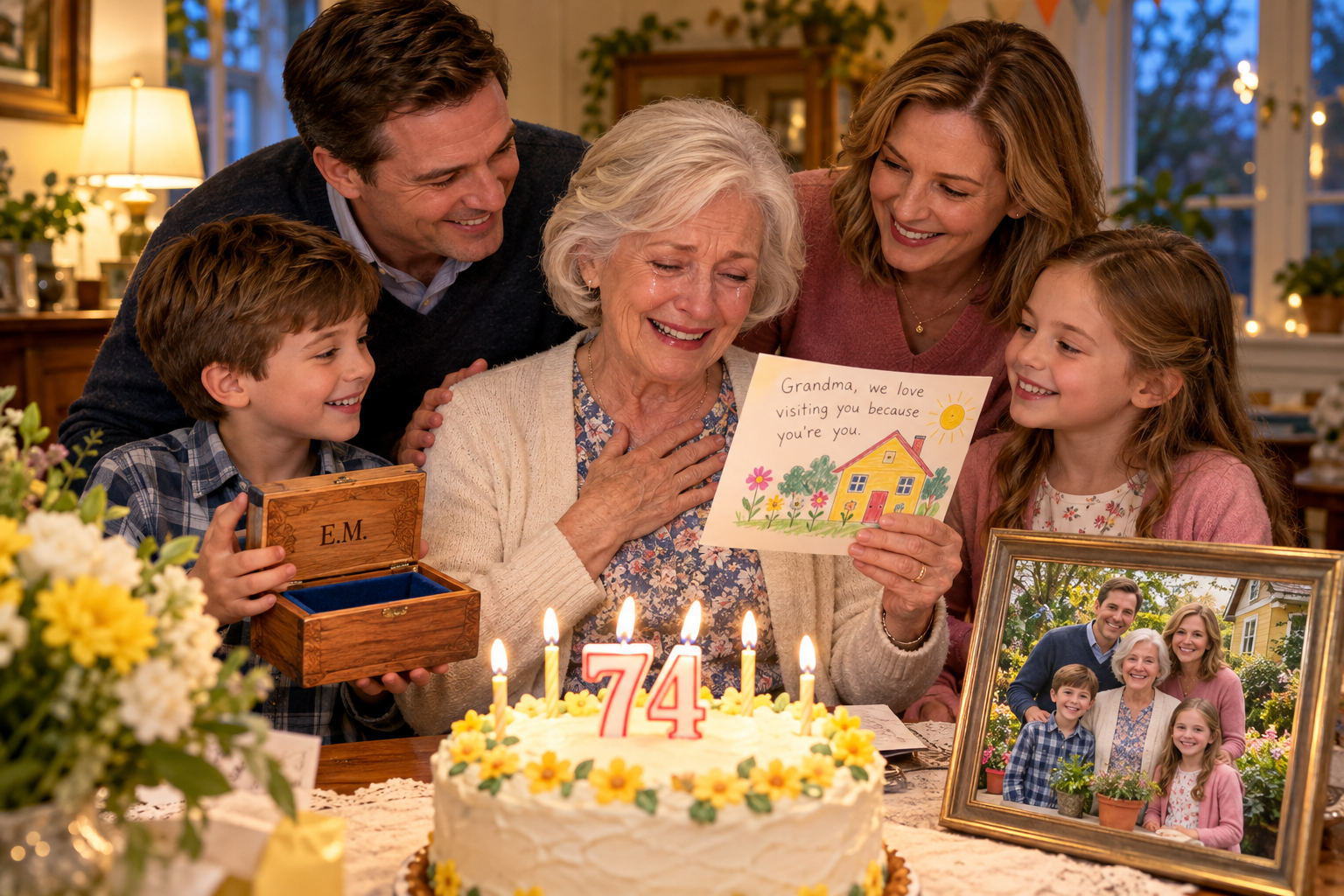
The letter from Martin arrived on a Tuesday afternoon, nearly three weeks after Graham and Paige moved into their new rental house. I had spent the morning at the historical society, helping catalog a collection of family photographs, and returned home carrying a loaf of bread from the bakery. The envelope was waiting on the hall table, where the postman had left it beneath a small stack of advertisements.
I recognized Martin's handwriting on the return label and opened it immediately.
Inside was a copy of correspondence from Paige's attorney. After reviewing the available evidence and discussing the matter with his client, the attorney had advised that the ownership claim would not be pursued further. The letter confirmed that no formal action would be filed concerning the lottery ticket.
I read the paragraph twice.
For months, the possibility of a legal dispute had remained in the background of nearly every family conversation. Even when Graham and I spoke about ordinary things, I knew Paige's claim had not been resolved. Now the uncertainty was finally beginning to lift.
I telephoned Martin to confirm that I understood the letter correctly.
He explained that Paige's attorney had communicated the decision in writing and that, absent some new development, the matter appeared concluded. He reminded me to retain all relevant records, including the birthday card and correspondence, but said there was no immediate action required.
I thanked him.
After we ended the call, I stood in the kitchen holding the letter.
I had expected to feel triumphant.
Instead, I felt tired.
The dispute had consumed months of attention and placed strain on relationships that were already fragile. Paige had not received the money she demanded, but neither of us had emerged untouched. The legal question was settled for now. The emotional damage remained.
I placed the letter in the wooden box beside the birthday card.
Then I made tea.
Ruth arrived later that afternoon. I showed her the correspondence, and she read it carefully.
"Well," she said, "that's one less thing to worry about."
"Yes."
She looked at me.
"You don't sound relieved."
"I am. But I wish it hadn't come to this."
Ruth folded the letter and returned it to the envelope.
"Of course you do. Nobody wants a family disagreement to become a legal matter."
I sat across from her.
"Do you think Paige will ever forgive me?"
Ruth raised her eyebrows.
"For what?"
"For refusing to help them the way she wanted."
Ruth considered the question.
"Perhaps. But I think you're asking the wrong thing."
"What should I be asking?"
"Whether you can forgive her without pretending nothing happened."
I looked down at my hands.
The distinction was difficult.
I wanted peace. I wanted family dinners where nobody measured affection against money. I wanted Owen and Chloe to visit without worrying about what their parents might say afterward. I wanted Graham to feel comfortable calling me simply because he wished to talk.
But I couldn't return to the old arrangement.
Forgiveness, I was beginning to understand, would have to exist alongside boundaries.
That evening, Graham called.
He sounded lighter than he had in weeks.
"Mom, I assume Martin told you."
"Yes."
"Paige agreed to stop."
"I'm glad."
He hesitated.
"She isn't happy about it."
"I imagine not."
"But she understands the attorney doesn't think there's a good basis to continue."
I appreciated that Graham didn't try to disguise the situation as a sudden reconciliation.
"How are things at home?" I asked.
"Better, actually. The kids are settling in. Owen likes his room more than he expected, and Chloe has already made friends with a girl next door."
"That's wonderful."
He told me Paige had begun taking on additional work from home, using a small desk in the corner of their bedroom. The arrangement wasn't ideal, but it was manageable. They were reviewing their expenses and following the plan developed with the financial counselor.
I felt genuinely pleased.
For the first time, Graham and Paige seemed to be addressing their financial difficulties through practical decisions rather than hoping my winnings would solve everything.
Then Graham asked whether Paige could visit the cottage.
I was silent for a moment.
"Does she want to talk?"
"Yes."
"About the lottery?"
"About everything, I think."
I looked toward Thomas's notebook beside my reading chair.
I wanted to believe that Paige was ready for an honest conversation. But I also knew that the previous discussions had often turned into demands or accusations.
"I'll speak with her," I said. "But I want us to be respectful. If the conversation becomes another argument about money, I'll end it."
Graham agreed.
We arranged for Paige to visit the following Saturday afternoon.
After we hung up, I sat quietly for a long time.
I thought about the first years of Graham and Paige's marriage. She had been energetic, ambitious, and affectionate with the children. I remembered her excitement when Owen was born and the way she had cried when Thomas held him for the first time.
There had been genuine love in our family.
I didn't want to forget that simply because the recent months had been painful.
Saturday arrived with clear skies and a sharp wind.
I spent the morning tidying the cottage, although it was already clean. I arranged fresh flowers on the dining table and prepared a pot of tea. I didn't make an elaborate meal. I wanted the visit to feel ordinary, not ceremonial.
Paige arrived shortly after two.
She stood on the porch wearing a dark coat and carrying a small handbag. Her expression was guarded, but she greeted me politely.
"Hello, Evelyn."
"Hello, Paige. Come inside."
She stepped into the living room and looked around.
For a moment, she seemed surprised by the cottage.
"It's lovely," she said.
"Thank you."
She examined the photographs, the bookshelves, and the blue sofa.
"You've made it very comfortable."
"I enjoy living here."
She nodded.
We sat at the dining table with tea.
For several minutes, we spoke about the children and the new rental house. Paige said Chloe loved her yellow curtains and Owen had finally arranged his desk the way he wanted. She mentioned that the kitchen was smaller than the old one but easier to clean.
I listened.
Then she set down her cup.
"Evelyn, I owe you an apology."
I looked at her.
She took a breath.
"I handled the lottery situation badly."
I waited.
She continued.
"When Graham told me you'd won, I was shocked. Then I started thinking about all the things we were struggling with. The debts, the house, the move. I convinced myself that because I'd bought the ticket, I had some right to the money."
She looked down.
"I know that wasn't fair."
I felt a small release of tension.
"Thank you for acknowledging that."
Paige nodded.
"I also shouldn't have involved an attorney."
"That was painful."
"I know."
She looked toward the window.
"I was angry that you hadn't told us. I thought you were hiding something because you didn't trust us."
"I was protecting my independence."
She nodded slowly.
"I understand that better now."
I studied her face.
She seemed sincere, but I wanted to hear more.
"What about Pine Harbor?" I asked.
Paige looked uncomfortable.
"We should have asked you before making arrangements."
"Yes."
"We thought if we found somewhere nice, you'd be pleased."
"But you had already paid a deposit."
She nodded.
"I know."
"And you had chosen a date."
"Yes."
I took a breath.
"Paige, I need you to understand that the problem wasn't the community itself. It might be a wonderful place for someone who chooses to live there. The problem was that you and Graham treated my future as something you could organize without me."
She looked down at her hands.
"I understand."
I wasn't certain she fully did, but I believed she was trying.
We spoke for nearly an hour.
Paige admitted that she had become overwhelmed by work, parenting, and financial pressure. She had relied on me more heavily than she realized, then grown resentful when the household still felt crowded and difficult to manage.
"I started thinking of you as another responsibility," she said quietly. "And that wasn't fair."
The admission hurt, but I appreciated its honesty.
"I knew you felt that way," I answered. "I heard you tell Graham I was becoming a burden."
Her face changed.
"You heard that?"
"Yes."
She covered her mouth with one hand.
For several seconds, she couldn't speak.
Then she said, "I'm sorry."
I looked at her.
"I believe you regret saying it. But I need you to understand what it felt like to hear."
She nodded, tears gathering in her eyes.
"I do."
We sat quietly.
I didn't reach across the table to comfort her immediately. I wanted to allow the apology to remain what it was: an acknowledgment of harm, not an invitation for me to make the other person feel better.
After a while, Paige wiped her eyes and looked toward the living room.
"I don't expect you to move back," she said.
I smiled faintly.
"Good. Because I won't."
She gave a small, embarrassed laugh.
"I know."
We spoke about the children, the new house, and the possibility of future visits. I told her I wanted Owen and Chloe to feel welcome at the cottage, but I didn't want them caught between adult disagreements.
Paige agreed.
"I shouldn't have said things about you in front of them."
"No."
"I've apologized to Chloe."
I felt relieved.
"Thank you."
She hesitated.
"Would you be willing to come to dinner sometime?"
I considered the invitation.
There was a time when I would have accepted immediately, grateful for any sign that the family wanted me included. Now I understood that I could take time to decide.
"Yes," I said finally. "I'd like that. But I want us to build a different kind of relationship."
Paige nodded.
"So do I."
When she left, I walked her to the porch.
She paused beside the rose bushes.
"I really am glad you're happy here, Evelyn."
I looked at her carefully.
"Thank you."
She hesitated, then hugged me.
The embrace was brief and slightly awkward, but it felt genuine.
After her car disappeared, I returned inside and closed the door.
The cottage was quiet.
I stood beside the fireplace, looking at Thomas's photograph.
For months, I had wondered whether my decision to leave would permanently damage the family.
Now, for the first time, I could imagine a future in which we remained connected without returning to the old expectations.
But I also knew that reconciliation would require consistency.
Paige's apology mattered.
Graham's efforts mattered.
The children's happiness mattered.
And my independence mattered too.
I sat in the blue chair beside the window and opened Thomas's notebook.
The sentence about finding somewhere I could sit in the sun remained on the page.
I smiled.
Then I closed the notebook and looked out at the garden.
The roses were beginning to show the earliest signs of spring.
There was still work to be done, both in the garden and within the family.
But the hardest winter seemed to be passing.
Click here to continue reading: PART 17: The First Family Dinner in Their New House Revealed How Much Had Changed and How Much We Still Needed to Learn
On My Seventy-Third Birthday, a Two-Dollar Gift Revealed a Secret That Would Change Everything I Believed About My Family
Part 16 of 31