The morning after Graham told me about Paige's demand, I woke to the sound of rain striking the bedroom window. It was barely six, and the cottage was still dark. I lay beneath the blankets, listening to the steady tapping against the glass, remembering the hesitation in my son's voice when he repeated the amount his wife wanted. One million dollars. She had spoken of it as though she were proposing a reasonable compromise, a price that would allow everyone to return to being a family.
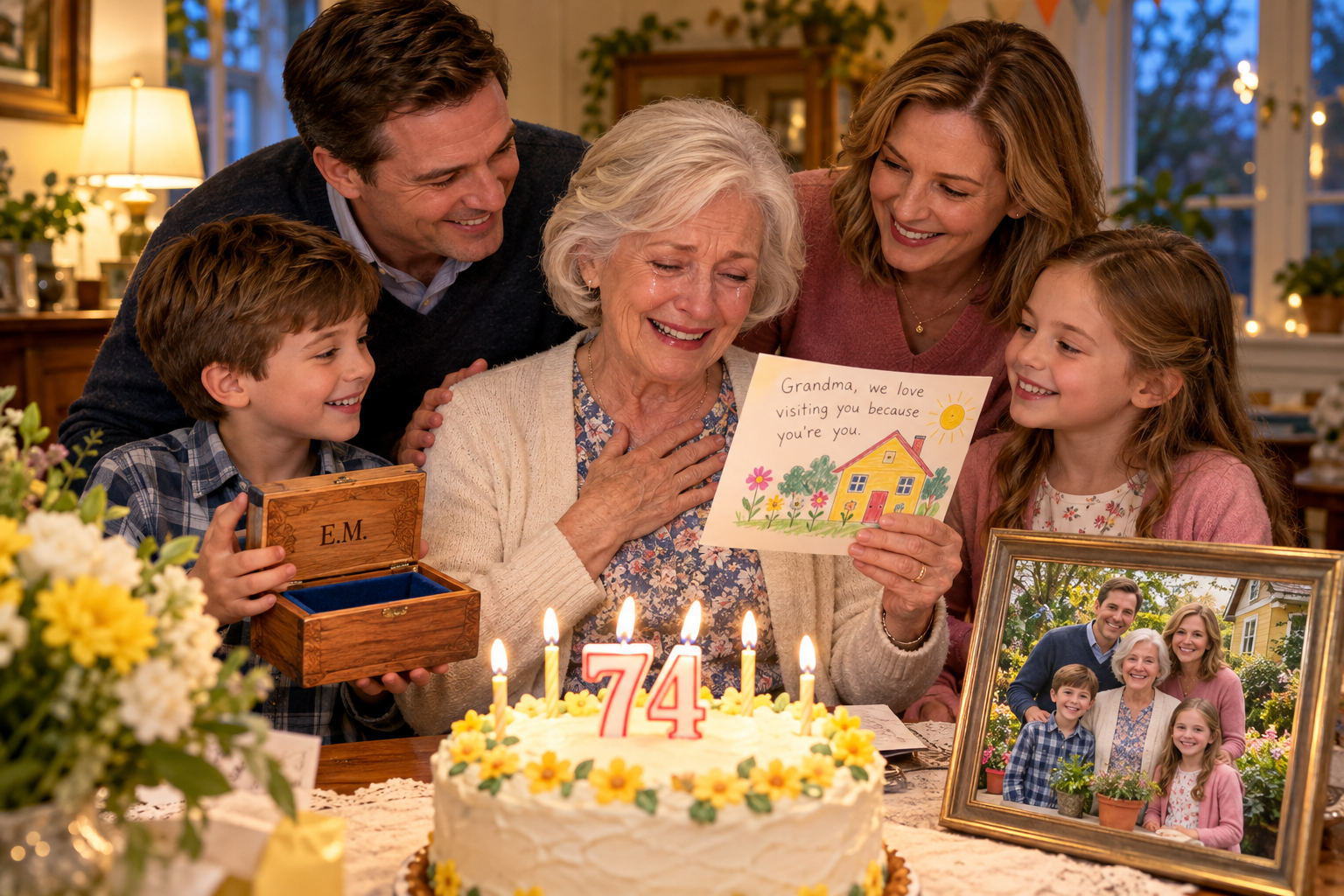
I went downstairs and made coffee. The kitchen was cold, so I turned up the heating and stood beside the window while the kettle warmed. Chloe's drawing remained on the refrigerator, held in place by a small blue magnet. I looked at the crooked yellow house and the dog with six legs, then turned away. I didn't want to begin another day wondering whether my granddaughter's visits would become part of a financial negotiation.
At eight-thirty, I called Martin Hale. His receptionist transferred me almost immediately. I explained Paige's proposal as carefully as I could, repeating Graham's words without adding my own interpretation. Martin asked whether Paige had communicated the demand directly or whether Graham had simply reported what she intended to propose. I told him it had come through Graham. He made a note and asked me not to respond to Paige about the amount.
"If her attorney wants to discuss settlement, the proposal needs to come through the proper channel," he said. "We shouldn't assume that what your son relayed is a formal offer."
I appreciated the distinction. Graham had sounded embarrassed, and I didn't want to make him responsible for legal statements he hadn't prepared. Martin explained that Paige's attorney had not yet filed a claim or supplied evidence establishing ownership of the ticket. The correspondence remained an inquiry and an assertion of possible rights, not a court determination. We would continue preserving the records and responding only where appropriate.
After we finished discussing the lottery, I asked about the rental house. Martin confirmed that Graham and Paige were still expected to leave before the termination date and that the property manager had received their proposed moving schedule. The repairs needed before listing were minor. Once the house was vacant, an agent could prepare photographs and begin marketing it. There was no need for me to visit or supervise the process personally.
I hung up feeling steadier. The legal matters had procedures, deadlines, and professionals responsible for handling them. My family relationships were less orderly. There was no document Martin could prepare that would make Paige understand why I had refused to surrender my independence, and no signed agreement that could guarantee Graham would stop treating my boundaries as a temporary inconvenience.
Around noon, Ruth arrived with groceries. She had noticed that I was running low on milk during her previous visit and had added a carton to her shopping. I told her about the million-dollar demand while she unpacked a bag of vegetables. She placed a bunch of carrots on the counter and looked at me for several seconds.
"Did Graham actually ask you to pay it?"
"No. He said Paige wanted to propose it."
"That's an important difference."
"I know."
Ruth washed her hands and sat across from me. "You keep trying to protect Graham from the consequences of his own household's decisions. I understand why. But he has to work through this with his wife."
I looked at the rain moving across the garden. "I'm afraid their marriage is suffering because of me."
"Their marriage may be suffering because they disagree about money and responsibility. That doesn't mean you caused the disagreement."
Her words were sensible, but I found them difficult to accept completely. I had known Graham since the moment he was born. His unhappiness still reached me in a way few other things could. Even now, after everything that had happened, I wanted to make his life easier. That instinct had guided so many of my decisions that I sometimes struggled to recognize when it was leading me back toward the same arrangement I had escaped.
We spent the afternoon making vegetable soup. Ruth chopped onions while I peeled potatoes, and the kitchen filled with the smell of celery and thyme. She told me about Margaret, the woman I had met at the library, and reminded me that the Wednesday coffee gathering was approaching. I promised I would attend. I needed ordinary conversations with people who didn't know about the lottery, the rental property, or my son's marriage.
Graham called that evening. I answered from the living room, where I had been reading beside the fireplace. He sounded tired, but there was something different in his voice. He wasn't calling to persuade me to reconsider the sale or to ask whether I might give Paige some money. He asked whether I had time to listen.
"Of course," I said.
He told me that he and Paige had argued after their conversation about the million-dollar proposal. He had asked her to stop pursuing the lottery claim and concentrate on moving into their new rental. She had accused him of choosing me over her, then reminded him of several expenses they had postponed because money was tight. The argument had continued until the children came downstairs and asked them to stop shouting.
I felt a familiar tightening in my chest. "Were Owen and Chloe frightened?"
"They were upset. I apologized to them."
"Good."
Graham paused. "Mom, I need to tell you something I haven't said before."
I set my book aside. He explained that their financial problems were more serious than he had admitted. They had credit-card balances, an expensive car payment, and a personal loan taken out after a series of household expenses. None of those obligations had been created by the lottery dispute, and none would disappear simply because they moved into a smaller house.
I listened without interrupting. Graham had always been reluctant to discuss money when he was struggling. As a young man, he preferred to present himself as capable and independent, even when Thomas and I could see that he needed advice. I had admired that determination once. Now I wondered whether pride had prevented him from addressing problems before they became difficult to manage.
"Does Paige know how much you owe?" I asked.
"Most of it. We both know the numbers."
"Have you made a plan?"
"We're trying."
He hesitated before continuing. "When we started talking about Pine Harbor, part of the reason was that we thought having more space would make the house easier to manage. Owen wanted the downstairs room, and Paige thought we could use his old room as an office. She hoped to take on additional work from home."
I sat very still. Until that moment, I had understood the Pine Harbor plan primarily as an effort to make room for Owen. Now I realized that the proposed rearrangement had also been connected to Paige's employment and their financial pressures. It didn't excuse their decision to make arrangements without consulting me, but it helped explain why they had been so determined to move me out.
"Why didn't you tell me that at dinner?" I asked.
"Because it sounded terrible."
"It was terrible to make the arrangements without asking me. The financial difficulty is something you could have discussed honestly."
He sighed. "I know that now."
I looked toward Thomas's photograph. "Your father and I had difficult years, Graham. We weren't ashamed of needing to make adjustments. We were ashamed only when we pretended a problem didn't exist and allowed it to become worse."
Graham gave a tired laugh. "Dad used to say that ignoring a bill didn't make it smaller."
"He did."
We were quiet for a moment. Then I asked whether he and Paige had considered speaking with a qualified financial counselor. Graham admitted that he had been thinking about it but worried about the cost. I suggested he look into reputable nonprofit counseling services and compare their options carefully. I didn't offer to pay their debts, and he didn't ask.
The conversation lasted nearly an hour. We discussed the move, the children, and the strain he was experiencing at home. I told him that I cared about Paige even though we disagreed. I also made it clear that I wouldn't participate in negotiations about my winnings outside the legal process. Graham accepted that without arguing.
After we ended the call, I remained in the living room. I felt compassion for my son, but I also felt the weight of information he had withheld. He and Paige had been struggling financially while I performed much of the household labor that allowed their schedules to function. They had planned to move me into Pine Harbor partly to reorganize their living space around new financial needs. Yet they had never asked whether I might prefer to move independently or whether I had plans of my own.
The next morning, I attended the coffee gathering Margaret had invited me to. Four women were seated around a table near the bakery window when I arrived. Margaret introduced me to the others, and within minutes we were discussing books, local history, and the difficulty of finding a reliable gardener. Nobody asked about my finances. Nobody needed me to collect children or solve a housing problem. I ordered a small pot of tea and listened to their stories.
The gathering lasted nearly two hours. Margaret described her work at the historical society, and another woman, Helen, recommended a walking route along the river. They invited me to join them the following week. I accepted without checking anyone else's calendar. Walking home afterward, I noticed how light I felt. My life was beginning to contain relationships that weren't defined by what I could provide.
That afternoon, Martin sent me a brief update. Paige's attorney had acknowledged the latest correspondence but had not submitted a formal settlement proposal. Martin advised that we continue waiting for a concrete legal development rather than responding to secondhand demands. I placed the message in my records and returned to the book I had borrowed from the library.
Just before dinner, Graham called again. His voice was quieter than it had been the previous evening. He said he had scheduled an appointment with a financial counselor and had begun reviewing their expenses. Then he told me Paige had made another decision.
"She's going to stay with her sister for a few days," he said.
I put down the saucepan I was holding. "Is everything all right?"
"We're not separating. At least, I don't think we are. She says she needs some space."
I heard the uncertainty beneath his words. Graham had always feared conflict, often trying to smooth over disagreements before anyone could examine what caused them. Now he was facing a problem he couldn't resolve simply by asking everyone to be patient.
"Have you spoken to the children?" I asked.
"Not yet. Paige wants to tell them together."
"Then that's a good place to start."
He was silent for several seconds. "Mom, I don't know how we got here."
I thought about the years of small compromises, the debts, the household expectations, and the lottery ticket that had exposed so much. There was no single answer that would explain everything.
"You and Paige have some difficult conversations ahead," I said. "But those conversations belong to the two of you. I can listen, Graham. I can't make the decisions for you."
He thanked me before hanging up. I stood beside the stove, watching steam rise from the saucepan. The cottage was quiet, and the evening light had faded from the garden. For the first time, I understood that refusing to solve my son's problems might be the most loving thing I could do for him.
Later that night, I received a message from Paige. It contained only one sentence: I hope you're satisfied with what you've done to this family.
I read it once, then placed the telephone facedown on the table. I didn't reply. The accusation hurt, but I knew that answering immediately would only pull me into another argument. Instead, I opened the wooden box, found Thomas's photograph, and held it for a moment.
I had not wanted Graham and Paige to suffer. I had wanted to live in a home I chose, manage money that belonged to me, and remain part of my grandchildren's lives without being treated as a permanent household resource. Those wishes were not unreasonable. Yet the consequences of asserting them were unfolding in ways I couldn't control.
Before going to bed, I sent Graham a short message asking him to let me know how the children were doing. Then I switched off the lights and went upstairs.
I didn't know whether Paige's absence would give her and Graham time to think or push them further apart. I knew only that their marriage had reached a point where my money could no longer serve as an imaginary solution to everything they had avoided discussing.
Click here to continue reading: PART 14: While My Son Packed for a Smaller House, an Unexpected Conversation With Owen Revealed How Deeply Our Family Had Changed
On My Seventy-Third Birthday, a Two-Dollar Gift Revealed a Secret That Would Change Everything I Believed About My Family
Part 13 of 31