The legal proceedings lasted more than a year.
During that time, my life became quieter in ways I had never expected.
The house remained mine.
But it no longer felt like a fortress.
The cameras stayed.
The gate stayed.
Yet I stopped looking at them as symbols of fear.
They were simply boundaries.
Michael changed the most.
He sold his business.
He paid back what he could.
He began volunteering with a legal aid organization that helped families facing property disputes.
He never asked for money again.
Jennifer separated from her husband.
She found work she enjoyed and slowly rebuilt her finances.
She still apologized sometimes.
I still told her she didn't need to.
Lisa became the one who visited most often.
She started bringing dinner.
Sometimes she stayed for hours.
Sometimes we sat silently.
Our relationship was never the same.
But different did not always mean worse.
Sometimes it meant more honest.
The grandchildren grew older.
They asked fewer questions about the old conflict.
I never told them the entire story.
They didn't need to carry it.
But I told them one thing.
"If you love someone, don't assume they will always be there."
They remembered that.
One spring morning, Thomas arrived with a final packet.
"It's finished."
I knew what he meant.
"The settlement?"
He nodded.
"The Ellis family has title to the property."
I looked toward the window.
After decades, Willow Creek would no longer belong to the Harris family.
It was the right ending.
It still hurt.
Thomas sat down.
"There is one more matter."
"What?"
"The protected account."
I had almost forgotten about it.
The money Richard had accumulated.
The money that had started the family conflict.
The money he had hidden to protect me.
I looked at Thomas.
"What happens to it?"
"It's yours."
"All of it?"
"Yes."
I thought about Michael.
Jennifer.
Lisa.
The children.
The Ellis family.
The people whose homes had been lost generations ago.
I made my decision.
"How much is left?"
Thomas told me.
It was still a considerable sum.
I divided it into three parts.
One portion funded scholarships.
One supported housing for elderly people who had been displaced from their homes.
The final portion went into a charitable legal fund for families fighting fraudulent property transfers.
Thomas listened.
"You don't have to give it away."
"I know."
"Why do it?"
"Because I don't want the money to become another family curse."
He nodded.
"Richard would approve."
"Maybe."
I smiled.
"But this is my decision."
That mattered.
More than I could explain.
The final documents were signed in early summer.
Afterward, I went home.
I walked through every room.
The kitchen.
The dining room.
The hallway.
The study.
Then I went downstairs.
The wall where the hidden compartment had been opened had been repaired.
You could barely see the seam.
I touched it.
The house no longer held a secret.
At least not one that belonged to me.
That evening, Michael came over.
He carried two cups of coffee.
"Dad's favorite."
I smiled.
"He would have complained that it's too strong."
"Definitely."
We sat on the porch.
After several minutes, Michael asked, "Do you hate him?"
I knew he meant Richard.
"No."
"After everything?"
I looked at the garden.
"No."
"But he lied to you."
"Yes."
"He kept things from you."
"Yes."
"He made mistakes."
"Yes."
Michael looked at me.
"Then how can you still love him?"
I thought for a moment.
"Because people aren't only their worst decisions."
He listened.
"But loving someone doesn't mean pretending their mistakes didn't matter."
Michael nodded.
"I think Dad understood that."
"I think he learned it."
We sat quietly.
Then Michael said, "I'm glad you changed the will."
I laughed.
"That's not what I expected you to say."
"I deserved to lose it."
"You did."
He smiled.
"I know."
I looked at him.
"But you didn't lose your mother."
His eyes filled with tears.
"Thank you."
We hugged.
Not because everything had been repaired.
Because enough had been repaired to make the embrace honest.
Later that week, Clara sent me a photograph.
The Willow Creek property had been restored.
The old house stood beneath a clear sky.
Her family had placed a small plaque near the entrance.
It named the original owners.
And beneath their names was a simple line:
Returned at last.
I stared at the photograph for a long time.
Then I placed it beside Richard's picture.
For years, I had believed inheritance was about what remained after someone died.
Money.
Property.
Objects.
Documents.
I understood differently now.
An inheritance could also be guilt.
Fear.
Silence.
Secrets.
Or a responsibility to correct what previous generations had done.
Richard had left me all of those things.
But he had also left me a choice.
I could hide the truth to protect his memory.
Or I could tell it and allow his better choices to stand beside his worst ones.
I chose the truth.
Not because it was easy.
Because it was necessary.
One evening, Jennifer, Michael, and Lisa came over together.
They stood in the kitchen.
Jennifer brought dessert.
Lisa brought flowers.
Michael brought nothing.
"You forgot something," I teased.
He smiled.
"I brought myself."
"That will have to do."
We ate together.
For the first time, no one mentioned the estate.
No one asked about the house.
No one asked about accounts.
We talked about the grandchildren.
About vacations.
About Lisa's new job.
About Michael's volunteer work.
About Jennifer's plans.
Ordinary things.
Beautiful things.
Things I had once taken for granted.
After dinner, they helped me clean the kitchen.
When they left, I stood at the door and watched their cars disappear.
The house became quiet.
But this time, the quiet didn't frighten me.
I went into Richard's study.
The room was almost empty now.
I had removed most of his belongings.
Only the photograph remained.
I sat in his chair.
"I wish you'd told me," I said.
There was no answer.
"I wish you'd trusted me with the truth."
Still nothing.
Then I smiled.
"But I understand why you didn't."
I looked at the photograph.
"You were trying to protect me."
My voice trembled.
"You just didn't understand that sometimes protection requires telling someone what they're up against."
I sat there for another few minutes.
Then I placed the photograph in a drawer.
Not hidden.
Not forgotten.
Just put away.
I didn't need to speak to him anymore.
The past had finally stopped demanding my attention.
Months later, I received a letter from Clara.
She wrote that the Ellis family had decided to preserve part of the Willow Creek property as a community garden.
They wanted people to gather there.
To remember what had happened.
But also to remember that something taken could sometimes be returned.
I cried when I read it.
Then I called my children.
They came over.
We read the letter together.
Michael smiled.
"That sounds right."
Jennifer nodded.
Lisa wiped her eyes.
I looked at all three.
"Your father would have liked that."
Michael said, "I think so."
For once, none of us needed to say anything else.
Years earlier, my children had told me they had their own lives.
They had been right.
They did.
So did I.
My life was not an extension of theirs.
My home was not their inheritance before I was gone.
My money was not proof of my love.
And my silence was not something they were entitled to.
I had learned that at seventy-one, when I was lying alone in a hospital bed wondering whether anyone would come.
I learned it again when my own children stood outside my gate demanding entry.
And I learned it for the final time when I discovered that the man I loved had spent his life carrying a truth he believed he had to hide.
The greatest change wasn't that I altered my will.
It wasn't that my children apologized.
It wasn't even that the Ellis family received the property that had been taken from them.
The greatest change was that I stopped measuring love by what I was willing to surrender.
I could love my children and still say no.
I could forgive them and still remember.
I could love Richard and still tell the truth about him.
And I could protect the future without sacrificing myself to do it.
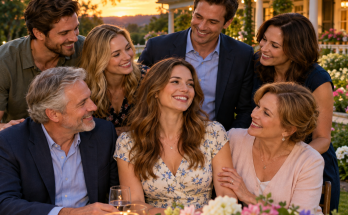
On my seventy-fourth birthday, my children surprised me.
They decorated the backyard.
The grandchildren hung paper lanterns between the trees.
Someone brought a cake far too large for the number of people there.
I stood in the middle of the garden and watched everyone laughing.
For a moment, I thought of the hospital.
The fear.
The unanswered calls.
The gate.
The documents.
The hidden wall.
The ledger.
The truth.
All of it seemed impossibly far away.
Michael raised his glass.
"To Mom."
Everyone followed.
I smiled.
"To choices," I said.
Jennifer looked at me.
"Choices?"
I nodded.
"Yes."
I looked around at the people gathered in my yard.
"Because love means more when it is freely chosen."
No one argued.
No one asked what I meant.
They understood.
And when the evening ended, I locked the front door myself.
Not because I was afraid.
Because it was my home.
My life.
My choice.
And for the first time, I understood that protecting what belonged to me had never meant closing the door on the people I loved.
It meant making sure that when I opened it, I was doing so because I wanted them there.
Not because I was afraid they would leave.