
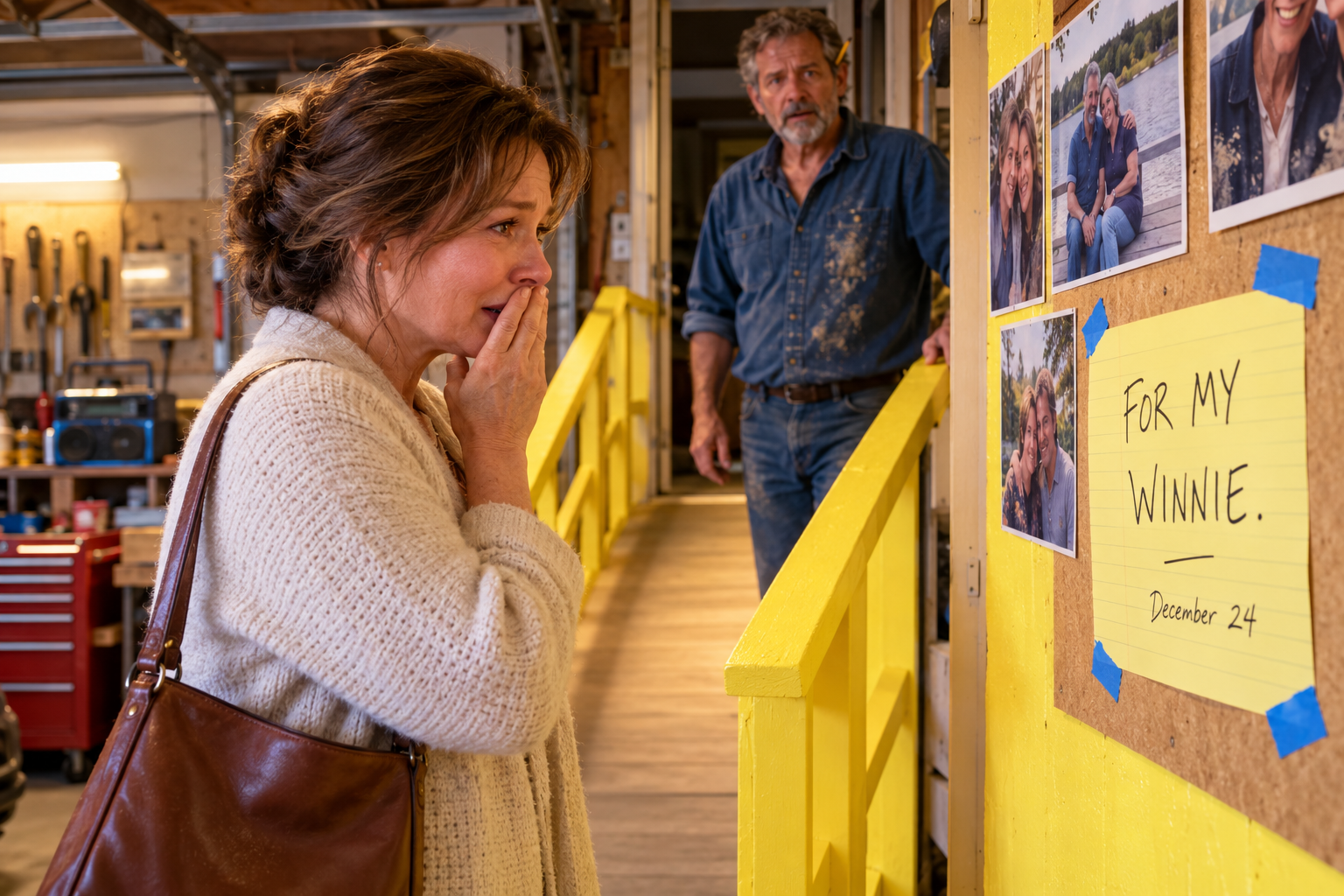
I kept thinking about the yellow paper.
Not every minute of every day, but often enough that I could no longer pretend it was just a piece of paper in a garage.
Three words had changed the way I looked at Wendell.
For my Winnie.
I had read them so many times in my mind that they almost seemed to belong to me now.
Still, I didn't know why he had written them.
I didn't know what December 24 meant to him, either.
And I was trying to learn the difference between being patient with someone and making excuses for him.
That difference wasn't always easy to see.
Sometimes, it was only a feeling in my chest when I went home alone.
Sometimes, it was the question I wanted to ask and decided to save for another day.
I had done that for weeks.
Maybe longer.
I had told myself Wendell needed time.
I had told myself that a man could have private things without those things being a sign of trouble.
Both statements were true.
But neither one answered the question I had been carrying.
Why had he never let me see his house?
I tried not to turn that question into a judgment.
I knew what it felt like to have a life people thought they understood.
After Dwight died, people had looked at me with sympathy and assumed they knew what I needed.
They brought food.
They offered help.
They told me to stay busy.
Some spoke as if grief were a room I could leave whenever I was ready.
Others seemed afraid to mention Dwight's name, as though saying it aloud might hurt me all over again.
I had learned that people could mean well and still fail to understand what another person was going through.
That was one reason I had tried to be careful with Wendell.
I didn't want to decide what his silence meant before I understood it.
But I also didn't want to spend another year guessing.
The thought stayed with me as I went about my ordinary days.
I made coffee.
I washed dishes.
I folded clothes and put them away.
I answered the telephone when it rang.
The small routines continued, even when my mind wandered back to that garage.
I could still picture the two pieces of blue painter's tape holding the yellow sheet in place.
I could see the photographs nearby.
I remembered the ramp and the buttercup-yellow paint.
And I remembered Wendell standing at the top of it, looking as if he had been caught in the middle of something he wasn't ready to explain.
He had gone pale when he saw me looking.
That reaction had stayed with me more than the words themselves.
If the paper meant nothing, why had he looked so frightened?
If the photographs were ordinary, why had he seemed so unprepared for me to see them?
I didn't know.
I had no right to pretend I did.
The only person who could answer those questions was Wendell.
So I decided I would stop trying to solve the mystery without him.
That didn't mean I would stop noticing things.
It meant I would let the facts remain facts until he gave me something more.
The next time we spoke, I paid attention to the conversation instead of searching every word for a hidden meaning.
Wendell asked how I had been.
I told him I was doing all right.
He listened, as he usually did, without rushing me toward a happier answer.
Then he asked what I had been doing.
I told him about the ordinary things that had filled my day.
He asked a few questions.
I answered them.
Nothing remarkable happened.
Yet I found myself appreciating that ordinary exchange.
It was good to talk to someone without feeling I had to make every sentence important.
For a while, I let myself enjoy it.
Then the silence between us reminded me of the things we hadn't discussed.
I wondered if he was thinking about the garage, too.
I wondered if he was waiting for me to ask.
I could have asked right then.
The question was ready.
All I had to do was say his name and tell him I needed to understand.
Instead, I took a breath and gave him room to speak first.
I wasn't trying to test him.
At least, I didn't think I was.
I simply wanted to know whether he understood that the paper had changed something between us.
He had let me see a piece of his life without explaining it.
Now he needed to decide what to do with that moment.
I couldn't make that decision for him.
And I couldn't keep making every difficult decision for both of us.
That evening, I thought about Dwight.
I remembered how familiar our life together had once felt.
There had been years when I could tell what Dwight was thinking by the way he set something down or looked toward a window.
We had shared enough ordinary days to develop our own language.
Not every part of marriage had been easy.
We had misunderstood each other.
We had disagreed.
We had both said things we wished we could take back.
But the years had given us time to learn each other's habits.
After his death, I had sometimes missed even the smallest things.
The sound of another person moving through the house.
A voice from another room.
Someone asking whether I wanted anything from the store.
I had missed the ordinary interruptions that once seemed so unimportant.
That was part of what made Wendell's attention matter to me.
He made room for me in his day.
He remembered what I said.
He asked questions and waited for answers.
I didn't want to overlook those things simply because he had one part of his life he hadn't explained.
But I also knew that kindness could not replace honesty.
A person could be thoughtful and still leave someone feeling shut out.
I could appreciate Wendell without pretending that I had no concerns.
That was the balance I needed to find.
I wanted to be fair to him.
I also wanted to be fair to myself.
When I thought about the yellow paper again, I tried to remember exactly what I had seen rather than what I feared it might mean.
The words were clear.
The date was clear.
The photographs were there.
The paint was there.
And Wendell had been working in the garage.
Those were the facts.
Everything else was a question.
I reminded myself of that whenever my imagination started filling in the empty spaces.
I didn't need to invent an answer before he had a chance to give me one.
Nor did I need to convince myself that the answer would be pleasant.
I only needed to be willing to hear it.
The next time I thought about December 24, I felt a small tightening in my chest.
Christmas had always carried memories for me.
Some were warm.
Some hurt more than I expected.
Since Dwight died, I had learned that a holiday could hold both feelings at once.
I could remember what I had lost and still look forward to something new.
That didn't make the old love smaller.
It only meant my life hadn't ended when one chapter did.
I hoped Wendell understood that.
I hoped he knew I wasn't asking him to erase my past.
I was asking him to let me know his.
I didn't say all of that to him.
Not yet.
I was learning that the right words mattered, but so did the right moment.
And the moment would have to come soon enough.
I wasn't going to spend Christmas Eve standing outside the life of a man who called me his Winnie.
If those words meant what I hoped they meant, then he would need to show me.
Not with a perfect house.
Not with a grand speech.
With the truth.
For now, I let the thought settle.
I had given Wendell time.
I had tried to understand him.
The next step belonged to him.
And I was ready to listen when he finally took it.
Click here to continue reading: PART 14: The More I Thought About Christmas Eve, the More I Realized That What I Wanted Was Not a Surprise but a Place Beside Him
I Thought the Hardest Thing About Losing My Husband Was Learning to Sleep Alone Until Another Man Made Me Question Everything
Part 13 of 20


One Comment on “PART 13 – I Had Spent So Much Time Wondering What Wendell Was Hiding That I Almost Forgot to Notice What He Was Trying to Tell Me”