The next few days were not dramatic.
That was what made them important.
Noah went to school.
Lily went back to her usual routines.
I went to work, came home, made dinner, and tried to keep the house running without treating every quiet moment like a warning.
But I paid attention to things I had once overlooked.
I noticed when Noah watched me put on my work boots.
I noticed when he asked what time I'd be home.
I noticed when Lily became upset and Noah immediately stopped whatever he was doing to check on her.
Neither child had changed overnight.
I had simply begun to see what had been there.
On Thursday, my phone rang during my morning break.
Noah's name appeared on the screen.
I answered immediately.
“Hey, buddy. What's going on?”
There was a pause.
“Are you busy?”
“I'm taking a break. You can talk to me.”
He breathed into the phone.
“I wanted to know when you'll be home.”
“About five thirty, if everything goes as planned.”
“Okay.”
I waited.
He didn't hang up.
“Is something wrong?”
“No.”
Then, after a moment, he added, “Lily's sad.”
I sat down on a stack of unopened supplies.
“What's happened?”
“She wanted to show me a picture she made, but I said I had to finish my game first.”
“And now she's upset?”
“Yeah.”
I almost smiled.
It was such a small problem compared with the fear of the previous afternoon.
But to Noah, small problems could still feel urgent when someone he loved was crying.
“Have you asked her what she needs?”
“No.”
“Would you like to try that?”
He went quiet.
Then I heard him call his sister's name.
A muffled exchange followed.
“Dad?”
“I'm here.”
“She says she wants me to look at the picture.”
“Then you can look at it.”
“But I was playing.”
“You can finish your game later.”
He seemed surprised by that answer.
I understood why.
Children often treat a choice as a rule when nobody has explained that they can make a different choice.
“It's okay to stop and help her for a minute,” I said. “And it's okay to tell her you need a little time, too. You don't have to fix every feeling she has.”
Noah considered that.
“Can I call you again if she gets upset?”
“Absolutely.”
“Even if it's not an emergency?”
“Even then.”
I heard him move away from the phone.
“I'm going to look at it now.”
“Good plan, buddy.”
He ended the call.
I sat there for another minute.
The building around me was full of noise.
A saw started somewhere across the floor.
Robert called for another bundle of lumber.
A delivery truck backed toward the loading area.
Yet the thing I kept hearing was Noah's question.
Are you busy?
He hadn't called because he was in danger.
He had called because he wasn't sure whether his worry was important enough to interrupt me.
That was a lesson I didn't want him carrying into adulthood.
I returned to work, but I kept my phone where I could hear it.
At lunchtime, I called home.
Lily answered.
“Dad!”
“Hey, sweetheart.”
“Noah looked at my picture.”
“Did he?”
“He said the house needs a bigger window.”
I laughed.
“That sounds like something he'd say.”
“I made the window yellow.”
“Then it's a very sunny house.”
She giggled.
I could hear Noah in the background telling her that houses didn't have windows that big.
Lily told him it was her picture and she could make the window any size she wanted.
Their voices overlapped.
For a moment, I closed my eyes.
It sounded like home.
Not a perfect home.
Not one where nobody cried or got frightened.
Just a home where two children could disagree about a drawing and still be safe enough to laugh.
That evening, I asked Noah how he felt about calling me.
“Fine,” he said.
“Was it hard to do?”
“A little.”
“Why?”
He shrugged.
“I thought you might say you were working.”
I leaned forward.
“I might sometimes be working when you call, but that doesn't mean you shouldn't call.”
“What if you can't answer?”
“Then you follow the plan we made.”
He nodded.
I wanted to promise I would always answer on the first ring.
But that wouldn't have been honest.
There could be times when I was operating equipment, speaking with someone, or working somewhere I couldn't safely reach the phone.
A promise I couldn't keep would only create another problem.
So I gave him something more useful.
“If I don't answer, you don't assume you're bothering me. You try the next person on the list.”
“Mr. Robert?”
“That's right.”
“And Mrs. Alvarez?”
“That's right.”
“And emergency services if someone is in danger.”
“Yes.”
He looked relieved to hear the plan again.
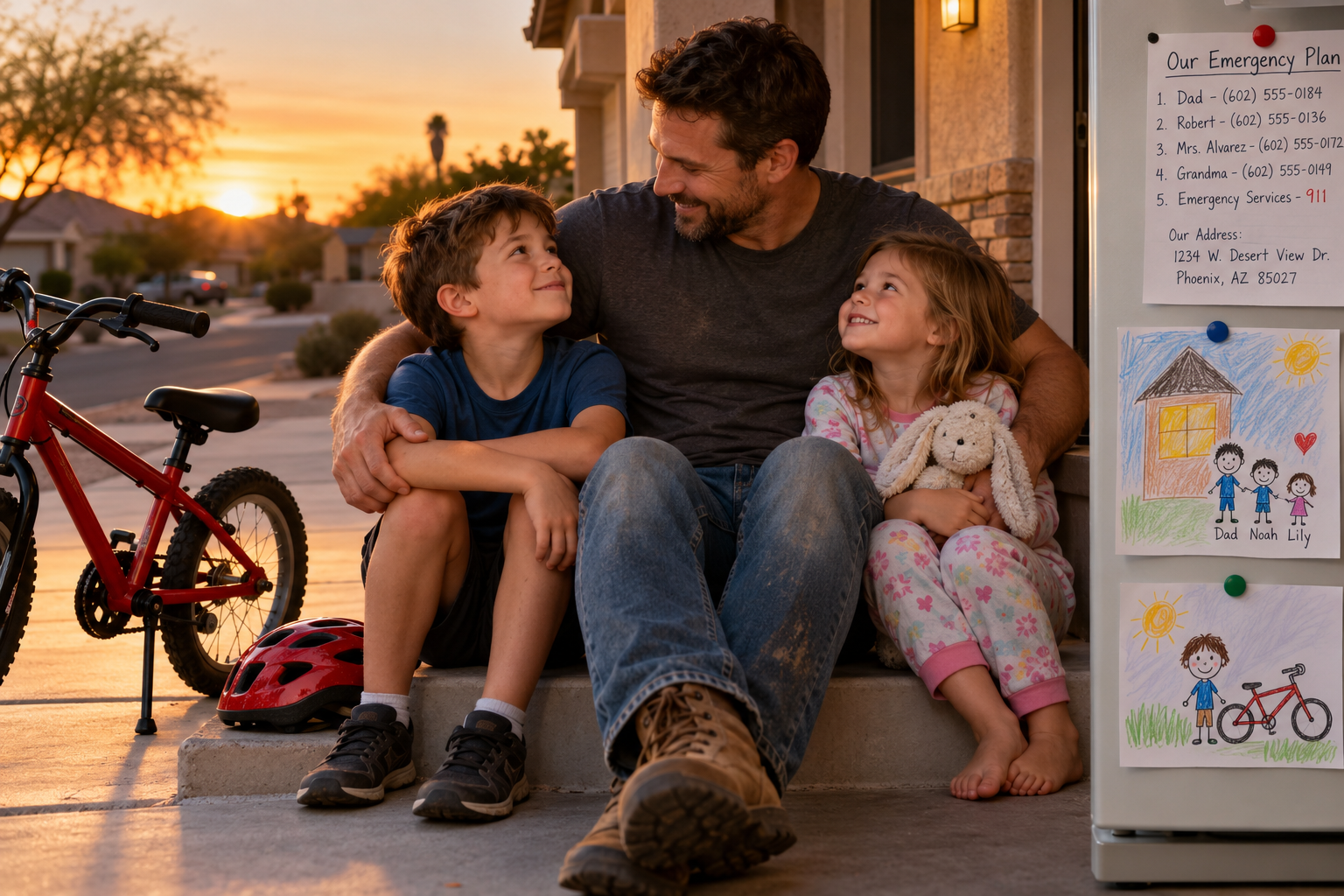
I put the paper on the table between us.
“You don't have to remember everything perfectly. We'll keep practicing.”
He traced the names with one finger.
“Can we add Grandma?”
His grandmother lived farther away, but she was someone he trusted.
“Of course.”
I added her name and phone number.
We checked the numbers together.
Then I asked Noah to tell me the plan in his own words.
He stumbled through the first attempt.
He forgot what to do if I didn't answer.
We tried again.
The second time, he remembered.
I praised him for practicing, not for being fearless.
Lily wanted a turn, too.
She couldn't read every name, but she recognized mine and Grandma's.
We talked about what she should do if she couldn't find me at home.
I told her not to go outside looking for me.
I told her to stay somewhere safe and use the phone if she could.
We kept the instructions short enough for her to understand.
Afterward, she drew another picture.
This one showed three people standing beside a house.
One person had a square body.
Another had a round head.
The third was holding a red object that might have been a bicycle.
“Who's this?” I asked, pointing at the smallest figure.
“That's Noah.”
“And the red thing?”
“My brother's bike.”
She looked at me as if the answer should have been obvious.
“Where are you in the picture?”
She pointed to the tallest figure.
“You're home.”
I looked at the drawing again.
The house had a yellow window.
All three people stood close together.
I pinned it to the refrigerator beside our emergency plan.
Neither belonged there because they reminded me of a frightening day.
They belonged there because they reminded me what I was trying to build.
A family where the children could ask for help.
A family where fear could be spoken aloud.
A family where love didn't require anyone to take a dangerous journey to prove it.
Click here to continue reading: PART 19: What Noah Was Trying to Tell Me
The Afternoon My Son Arrived at the Worksite Alone, Carrying a Fear No Seven-Year-Old Should Have Had to Explain
Part 18 of 20