Robert came over as I stood beside Noah.
He had a rag tucked into his back pocket and dust on one knee.
He glanced at the floor, then at the bicycle.
"Do you want me to lock up the tools?"
I looked toward the unfinished section.
For the first time that afternoon, I considered the practical details without feeling pulled away from my son.
"Yes, please. I'll take care of the rest later."
Robert nodded.
He didn't ask when I planned to return.
He didn't remind me that we had already lost time.
He simply went back to work.
I watched him for a moment and felt grateful that he understood enough to leave the decision with me.
Then I sat beside Noah again.
I was beginning to understand that I needed to be careful about the promises I made.
It was easy to tell a child that everything would be fine.
It was harder to know whether that was true.
I couldn't promise that no frightening thing would ever happen again.
I couldn't promise that every decision would be easy.
What I could promise was that I would listen when he came to me.
I could promise to take his concerns seriously.
And I could promise not to punish him for telling me something difficult simply because hearing it frightened me.
I looked at his face.
"There's something I want you to understand."
He waited.
"You can always ask me for help."
He nodded.
I continued.
"You don't have to solve a problem by yourself just because you're scared."
He looked down at his hands.
I wasn't sure how much of that he understood.
At seven, the world was still a place where adults seemed to know what they were doing.
A parent could open a jar, fix a broken toy, reach a shelf, or answer a question.
Children didn't always understand that adults were frightened too.
They didn't see all the uncertainty behind our decisions.
They saw what we did.
I wanted Noah to know that asking for help was not a weakness.
It was something he could do before fear made him believe there was only one choice left.
I also needed him to understand that riding alone through the city had put him in danger.
I didn't want to avoid that conversation.
I simply didn't want to begin it by making him feel ashamed.
We could talk about the ride after I had made sure he understood why I was glad he had reached me.
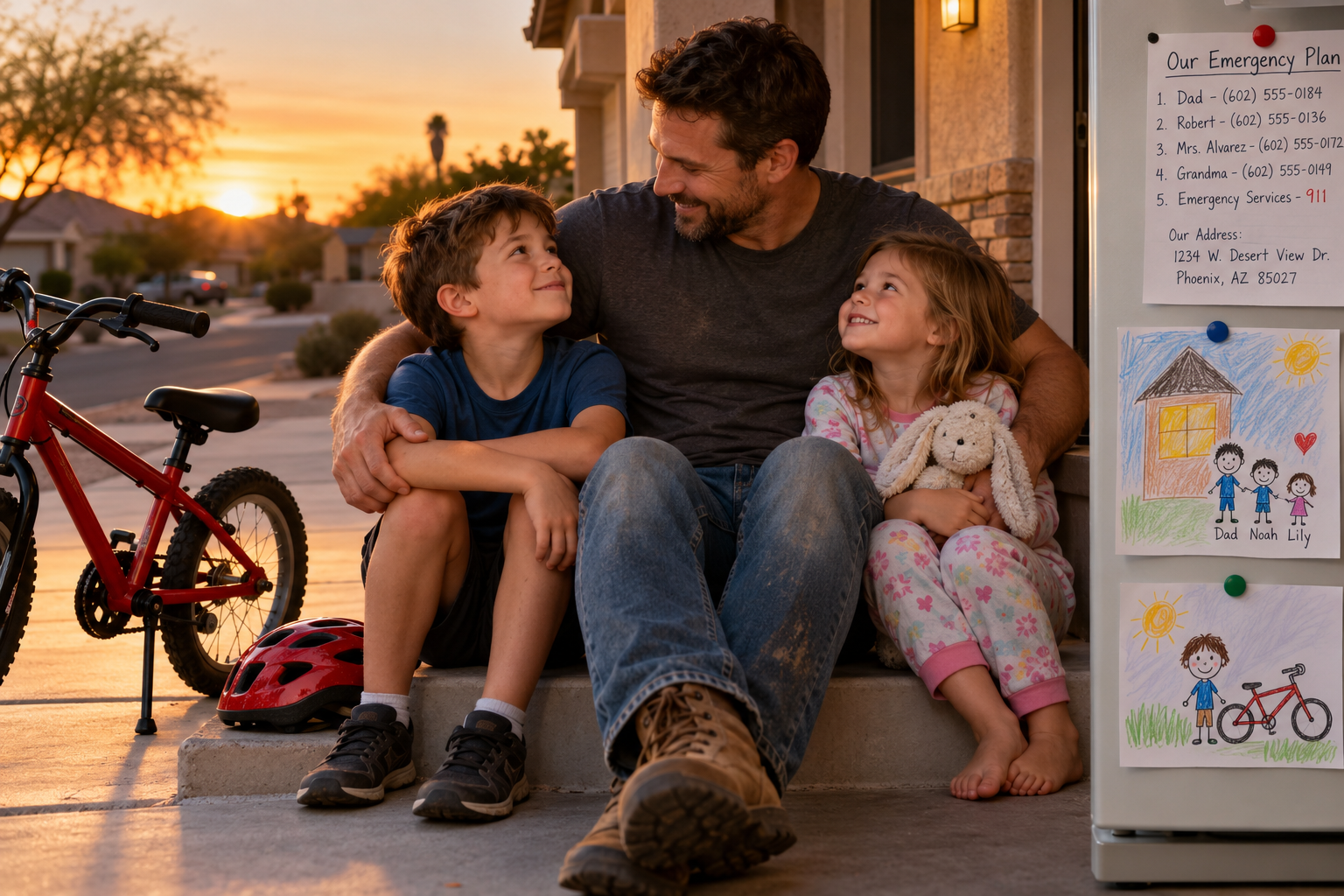
I glanced toward the red bicycle.
Its front tire was turned slightly inward.
The dusty frame looked almost painfully ordinary.
I imagined how different the afternoon might have been if I had never seen him arrive.
I would have kept working.
I would have watched the adhesive.
I would have worried about the cost of replacing spoiled material.
I might have finished the section before lunch and considered the day a success.
I would have had no idea what my son had been carrying.
That thought settled heavily inside me.
I had been measuring the day according to what I could see.
The floor.
The tools.
The materials.
The hours.
I had not known what was happening beyond the walls of the worksite.
No father could be everywhere at once.
I understood that.
But I could choose how I responded when something important reached me.
I could put down the trowel.
I could stop checking the clock.
I could listen.
I leaned back in the chair.
"Are you still worried?"
Noah took a moment.
Then he nodded.
I didn't tell him not to be.
That would have been unfair.
Whatever had frightened him had been real enough to make him ride across the city.
I couldn't expect the fear to disappear simply because he had found me.
I rested my hand on his shoulder.
"We'll take this one step at a time."
He looked at me.
I repeated the words more quietly.
"One step at a time."
That was all I could offer without pretending to know the ending.
Robert finished organizing the tools and began clearing the area around the doorway.
The sound of metal being set into a toolbox carried through the room.
I thought about how much time we had already lost.
Then I let the thought go.
We could return to the job.
We could calculate the materials.
We could decide how to finish the floor without wasting more adhesive.
Those problems belonged to a part of my life I understood.
The problem in front of me required something different.
It required me to accept that I couldn't control every part of my son's world.
I couldn't keep him from ever feeling frightened.
I couldn't make every difficult choice disappear before he encountered it.
But I could make sure he knew where to turn when he needed help.
I could make sure my attention was not always divided.
And I could learn to listen before I tried to fix everything.
Noah sat quietly beside me.
The afternoon was still difficult.
Nothing about the heat had changed.
The worksite remained unfinished.
But the way I looked at my responsibilities had changed.
I had once believed that a good father was the man who kept working until everything was taken care of.
Now I was beginning to understand that sometimes the most important thing a father could do was stop working long enough to find out what needed taking care of in the first place.
Click here to continue reading: PART 11: When Robert Finished Securing the Worksite, I Realized That the Hardest Part of the Afternoon Was Not Knowing How to Make My Son Feel Safe Again
The Afternoon My Son Arrived at the Worksite Alone, Carrying a Fear No Seven-Year-Old Should Have Had to Explain
Part 10 of 20