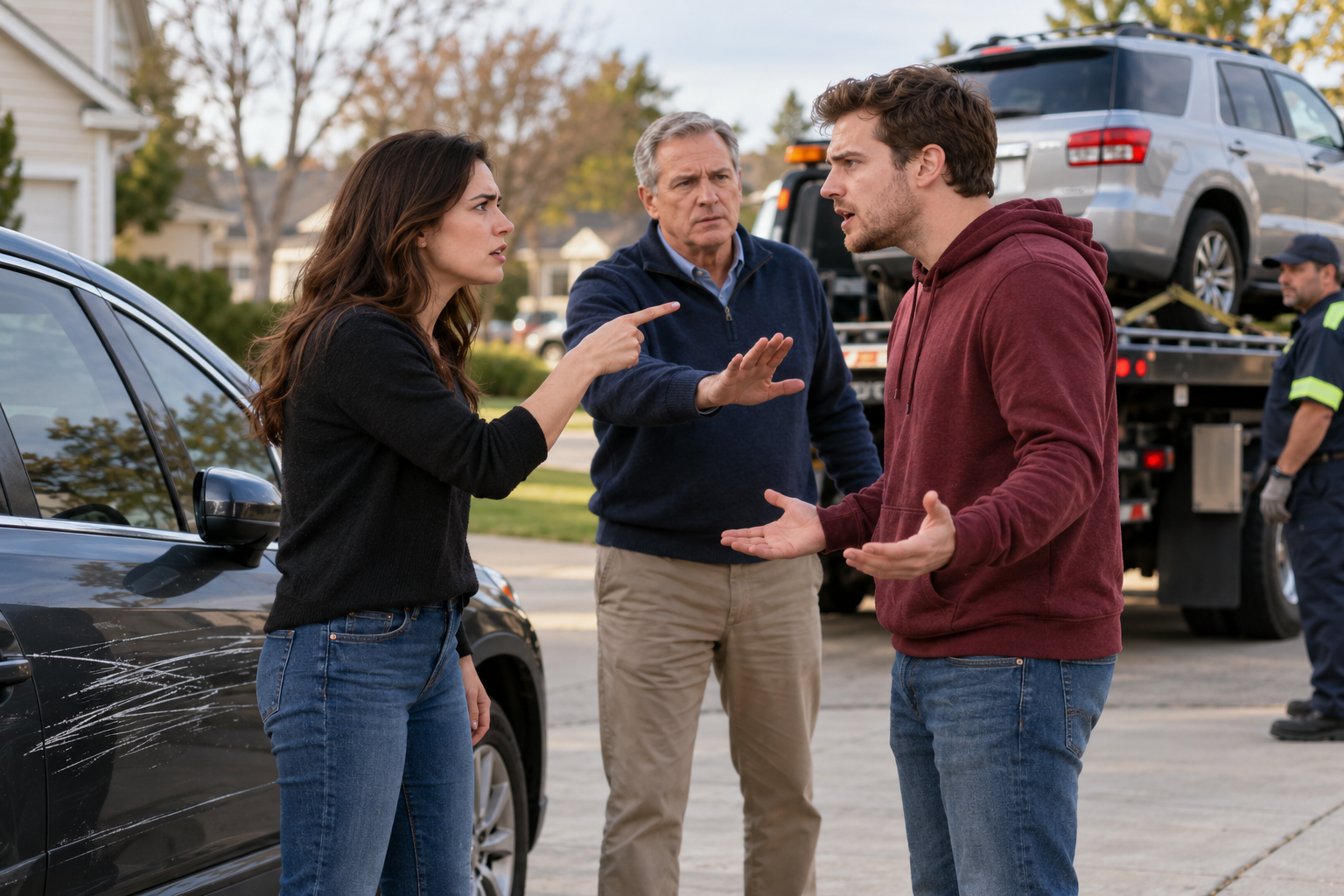
I didn't feel like I had won anything.
That was the strange part.
I had taken back control of a car that belonged to me.
I had refused to reverse the decision when Dad told me to.
And I had stopped expecting Mitch to accept what the recording showed.
But none of that felt like a victory.
My SUV was still scratched.
My brother still hadn't admitted responsibility.
Dad had still tried to get me to unload the car.
And I was still standing inside a family disagreement I hadn't wanted.
I wasn't relieved about all of it.
Only one part.
I no longer had to keep arguing to justify my decision.
That was enough for the moment.
I thought about the amount Mitch had asked for.
Fifteen thousand dollars.
It was a large request.
I had refused.
That refusal should have been the end of the matter.
It wasn't.
My SUV became part of the conflict.
And suddenly I was dealing with damage to something worth forty thousand dollars.
I couldn't pretend that didn't matter.
I couldn't pretend the scratches were harmless simply because the person involved was my brother.
If anything, the family relationship made it harder.
I had trusted him enough to let him drive my car for two years.
I had continued that arrangement because he was family.
Then I found myself confronting him over damage to another vehicle I owned.
It wasn't the kind of conversation I had ever wanted to have.
I wondered whether he understood that.
Then I stopped myself.
I couldn't keep making his understanding the center of everything.
That had been my mistake from the beginning.
I kept waiting for him to recognize my position.
I wanted him to admit the damage.
I wanted him to understand why his reaction to being refused money was unacceptable.
I wanted him to see that taking back the car wasn't something I had done for entertainment or revenge.
But those were things I couldn't decide for him.
I could only decide what I did.
I thought about the recording again.
Ninety seconds.
A key against the paint.
Mitch standing there.
Those were the details I had confronted him with.
He hadn't accepted them as proof.
He had questioned the angle.
Then he had failed to explain his own actions.
I wasn't going to replay the argument in search of a better outcome.
The exchange had already happened.
I had heard his answers.
And I had heard the absence of an answer when I asked the question that mattered.
There wasn't anything useful left to recover from that conversation.
I remembered Dad stepping between us.
He had tried to stop the argument.
I didn't resent the desire to end a confrontation.
I wanted it over too.
But I couldn't accept that stopping the argument required me to undo my decision.
That was where we differed.
Dad had pointed toward the flatbed and told me to have the car taken down.
I had turned to the driver instead.
I asked whether everything was secure.
He confirmed it.
I thanked him.
Those few words had become important to me.
They were ordinary words.
Nothing dramatic.
But they showed that I had made a choice.
I hadn't shouted another accusation at Mitch.
I hadn't demanded that Dad agree.
I hadn't turned the driver into a participant in our family argument.
I had simply confirmed the car was ready.
And left the decision in place.
That was something I hadn't always been able to do.
I had spent a long time believing that firmness required anger.
If I was going to stand my ground, I thought I had to argue harder.
Speak louder.
Find the perfect explanation.
Make everyone see why I was right.
But standing beside the flatbed taught me something different.
I didn't need another speech.
I didn't need to repeat the amount of money Mitch had demanded.
I didn't need to describe the scratches again.
The facts weren't changing.
I had made a decision based on those facts.
And I could let it stand.
I thought about the car Mitch had been driving.
Two years.
I had given him access to it for that long.
That had been my choice.
Taking it back was also my choice.
The first decision didn't cancel the second.
I hadn't lost ownership because I had helped him.
I hadn't agreed to endless use because I had been generous before.
And I didn't have to continue simply because ending the arrangement made people uncomfortable.
I knew Mitch could disagree.
I knew Dad had disagreed.
Those things were already clear.
But disagreement wasn't the same as authority.
Neither of them owned the decision.
I did.
I was beginning to understand how much of my frustration came from forgetting that.
I had treated Mitch's objections as problems I had to solve.
I had treated Dad's demand as something I needed to answer.
I had treated my own discomfort as a warning that perhaps I was doing the wrong thing.
But none of those reactions changed ownership.
None changed the recording.
None changed the scratches.
And none changed the fact that I had decided the arrangement was finished.
I didn't know whether Mitch would ever admit what he had done.
I didn't know whether he would ever apologize.
I couldn't know whether Dad would eventually understand why I refused to unload the car.
I wasn't going to create answers where I had none.
That was another thing I needed to learn.
I could live with unanswered questions.
I didn't have to manufacture certainty about another person's thoughts.
I didn't need to know exactly what Mitch felt when he saw the flatbed.
I didn't need to know why Dad chose that moment to intervene.
I knew what they had said.
I knew what I had done.
And I knew why I wasn't changing my mind.
That was enough.
I thought once more about the difference between a consequence and revenge.
Revenge would have meant making the situation about hurting Mitch.
That wasn't what I wanted.
I wanted the use of my property to stop.
After what had happened to my SUV, I no longer trusted the arrangement.
I couldn't justify continuing it simply to avoid conflict.
That was the boundary.
It wasn't complicated.
It was difficult.
Those were different things.
I could feel sad that my brother and I had reached this point.
I could feel angry about the scratched paint.
I could feel disappointed that Dad hadn't addressed the unanswered question before demanding the car be unloaded.
And I could still stand by my decision.
One feeling didn't cancel the others.
I had spent too long waiting to feel completely certain before acting.
I had wanted every question answered.
Every objection settled.
Every family member satisfied.
That wasn't possible here.
Mitch had made that clear when he disputed the recording.
Dad had made it clear when he demanded the car be taken down.
I wasn't going to get agreement from everyone.
So I stopped making agreement a requirement.
The car was secured.
I had checked.
The driver had answered.
I had thanked him.
And I hadn't given any instruction to undo the recovery.
That was where things stood.
The scratches remained.
The argument remained unresolved.
But the decision about my car was no longer waiting on Mitch.
For the first time, I understood that I could leave a disagreement unfinished without leaving my own decision unfinished too.
Click here to continue reading: PART 13: My Father Wanted the Confrontation Finished, but I Was Finally Learning That Ending an Argument Did Not Mean Giving In
I Thought Catching My Brother on Camera Would Finally Make Him Admit What He Had Done to My SUV
Part 12 of 16