I had reached the point where I had nothing left to explain.
That should have felt easier.
It didn't.
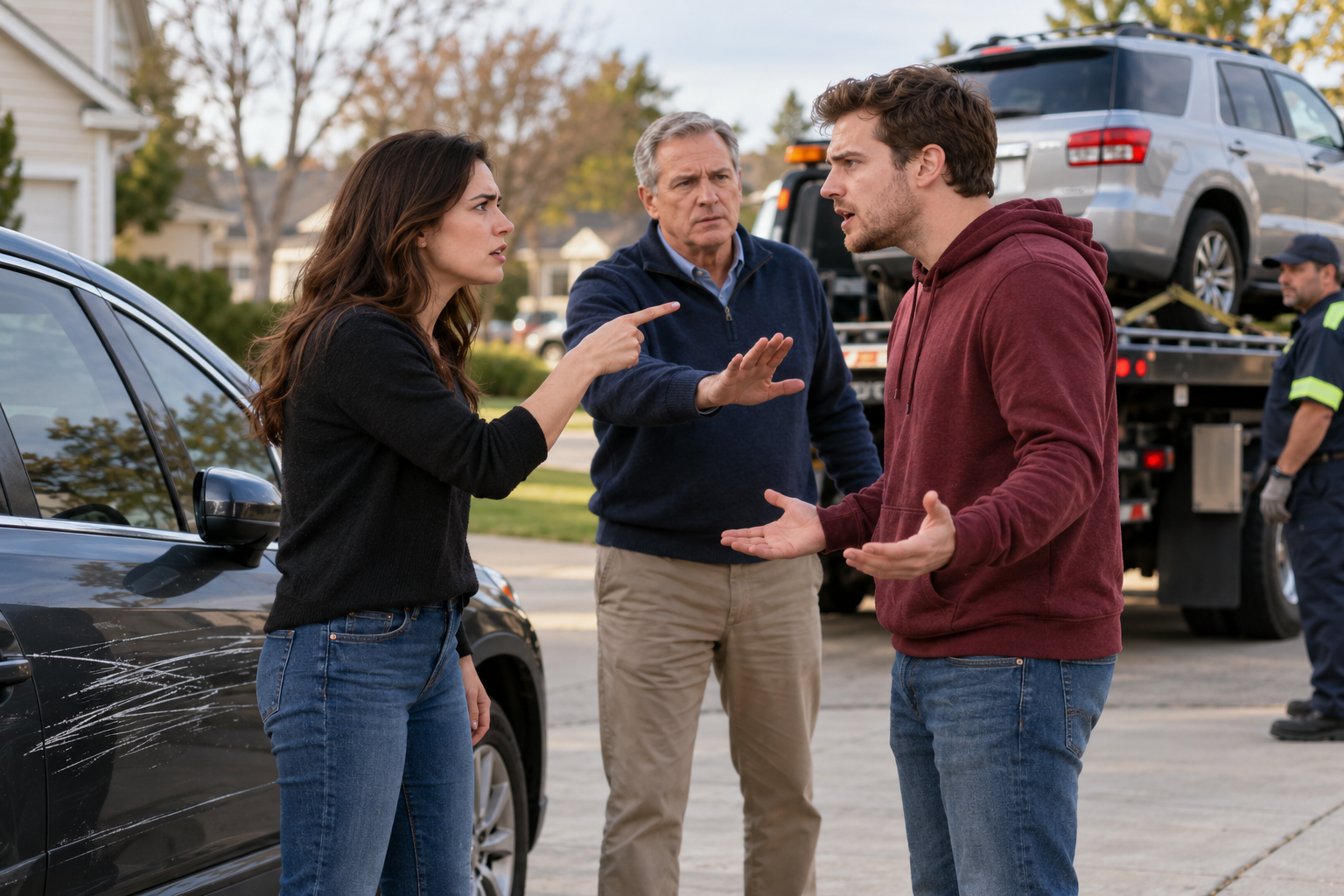
The car was secured on the flatbed.
The driver had answered my question.
And I had made it clear through my actions that I wasn't asking him to unload it.
Dad had wanted the opposite.
Mitch had wanted to avoid responsibility for what happened to my SUV.
And I was caught between the two of them, trying not to let either man's reaction change what I already knew.
I owned the car.
That was the simplest fact in the entire situation.
For two years, I had allowed Mitch to drive it.
I had never stopped being its owner.
I hadn't surrendered the right to take it back.
Yet I had spent more time defending that right than I should have needed to.
I looked at the flatbed again.
The car hadn't become more or less mine because Mitch was angry.
It hadn't changed ownership because Dad wanted the argument over.
And it hadn't become a permanent gift simply because Mitch had used it for a long time.
I understood those things.
The harder part was accepting that I could act on them without everybody agreeing.
I had always disliked that kind of family confrontation.
It made ordinary decisions feel much bigger than they were.
A refusal became an insult.
A disagreement became a personal attack.
And a decision about my own property became something I was expected to defend to the entire family.
At least, that was how this confrontation felt.
I couldn't speak for what Dad intended.
I couldn't know what Mitch believed.
I only knew how I had responded.
I had kept explaining.
And explaining.
And explaining.
As if the next sentence might finally settle things.
It hadn't worked.
Mitch had watched the same evidence I had seen.
He knew the recording existed.
He knew I believed it showed him damaging my SUV.
But he chose to challenge what could be proved instead of explaining his actions.
I couldn't make him choose differently.
That frustrated me.
Not because I expected him to welcome an accusation.
Nobody enjoys being confronted.
I understood that.
But there was a difference between defending yourself and refusing to answer a direct question.
I had asked him what he was doing with the key.
He hadn't answered.
That moment kept returning to me.
I remembered the way he began to speak.
Then stopped.
No explanation.
No alternative account.
Just the same refusal to accept what I believed the recording showed.
For a while, I had treated that silence as unfinished business.
I kept thinking I should ask again.
Maybe use different words.
Maybe start with a smaller question.
Maybe describe the ninety seconds one more time.
Then I realized what I was doing.
I was preparing another argument with someone who had already heard me.
He understood the question.
He simply hadn't answered it.
Asking it again wouldn't change that.
I thought about the fifteen thousand dollars.
I had refused to give Mitch that money.
There had been no misunderstanding about the refusal.
He wanted it.
I said no.
Whatever disappointment he felt afterward belonged to him.
I could care about my brother without financing every request he made.
That was something I wished I had understood without so much difficulty.
I hadn't denied him money to hurt him.
I hadn't invited him to damage anything.
I had made a financial decision.
His reaction didn't change the nature of that decision.
The scratches on my SUV were a separate act.
An act he was responsible for, regardless of what he thought about my refusal.
I couldn't erase those scratches by changing my mind about the money.
And I couldn't repair the situation by giving him continued access to my car.
That was the connection I kept returning to.
I had been trying to keep two things separate.
My brother's disappointment.
And my responsibility for his disappointment.
The first was real.
The second wasn't automatically mine.
I had been so accustomed to dealing with his reactions that I sometimes forgot the difference.
Standing near the flatbed made it impossible to ignore.
Dad had told me to take the car down.
I had heard him clearly.
But doing so would have meant reversing the one decision I still controlled.
I couldn't force Mitch to admit the damage.
I couldn't force him to apologize.
I couldn't force Dad to agree with me.
But I could stop providing my car to someone I no longer trusted with it.
That choice didn't require a unanimous family decision.
I had made it.
I felt uncomfortable.
That didn't mean it was wrong.
I felt guilty for a moment.
That didn't mean I owed Mitch the vehicle.
I felt disappointed that Dad wanted me to undo the recovery.
That didn't mean I had to obey.
I was learning that feelings could be present without deciding the outcome.
It was an uncomfortable lesson.
I had wanted certainty.
I had wanted the kind of ending where everyone admitted what happened and accepted the consequences.
But real disagreements didn't always work that way.
Sometimes the person who caused the problem never acknowledged it.
Sometimes other people focused on ending the confrontation instead of dealing with the original issue.
Sometimes the person making the difficult decision had to accept being misunderstood.
That was the situation I faced.
I couldn't change the past ninety seconds captured on camera.
I couldn't change the argument that followed.
But I could decide what happened next with my property.
I thought about how I had addressed the driver.
I hadn't shouted.
I hadn't demanded that he take sides.
I had asked whether the car was secure.
He had confirmed it.
I had thanked him.
A simple conversation.
It had accomplished more than all my arguing with Mitch.
Not because the driver agreed with my reasons.
I didn't know what he thought.
He had simply answered the question I asked.
And I had accepted the answer.
I wished things with my brother could have been that straightforward.
But wishing didn't make them so.
The car remained secured.
I wasn't giving a different instruction.
And I wasn't going to keep defending the same decision simply because Mitch refused to accept it.
For the first time, ending the argument meant something different to me.
It didn't mean surrendering.
It meant I could stop talking.
And still stand by what I had decided.
Click here to continue reading: PART 14: I Kept Returning to the Scratches on My SUV Because They Explained Why I Could No Longer Treat My Brother’s Anger as Harmless
I Thought Catching My Brother on Camera Would Finally Make Him Admit What He Had Done to My SUV
Part 13 of 16