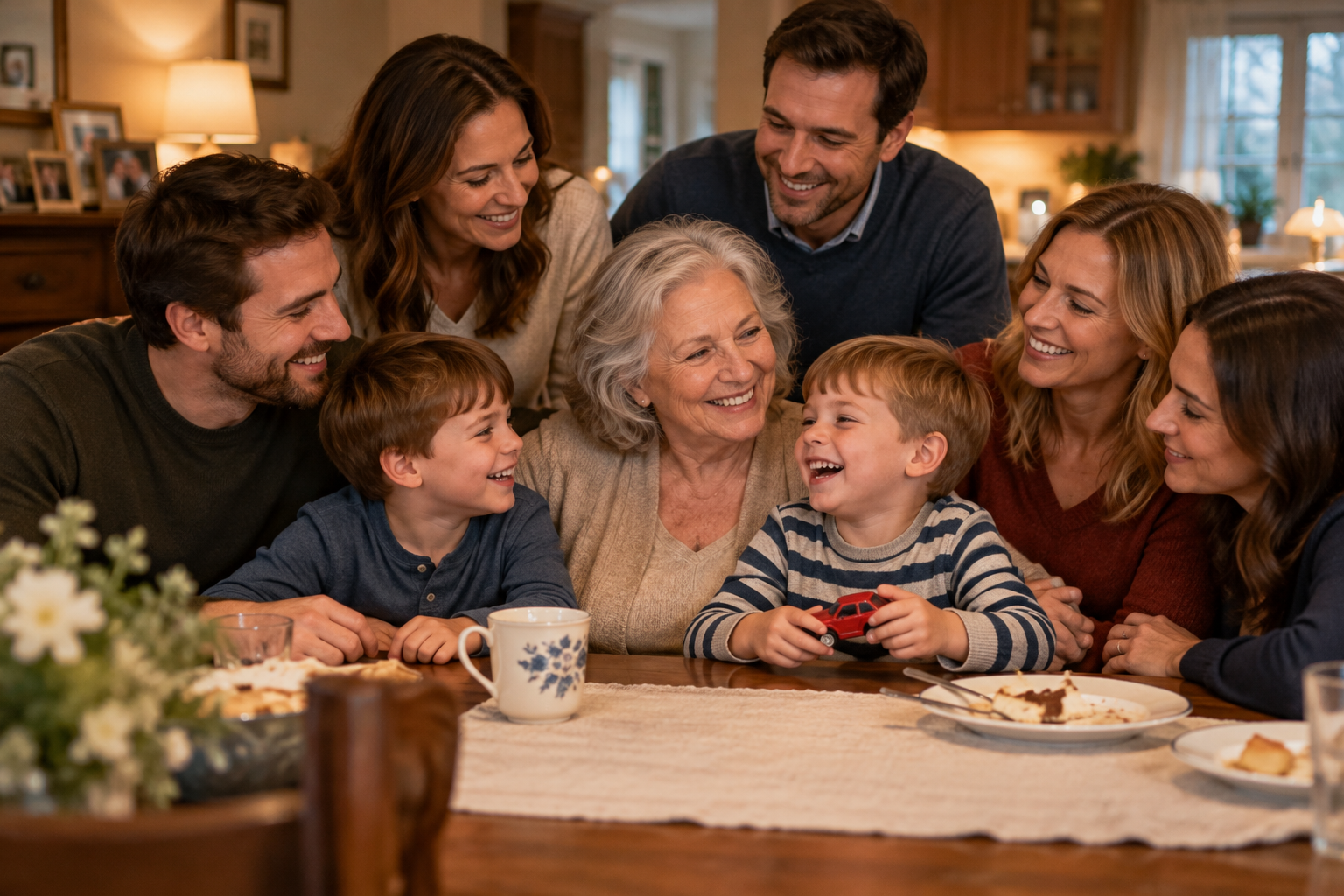
After the family dinner, I began thinking about Walt differently.
Not because I loved him less.
Because I had finally allowed myself to admit that love did not make a person easy to understand.
I had spent forty-two years beside my husband.
I knew his habits.
I knew his moods.
I knew the sound of his footsteps on the stairs.
I could tell when he was worried by the way he held his coffee mug.
But I did not know everything he had thought about our family.
That realization left me with a strange kind of grief.
It was not the grief of losing him.
I had already begun learning how to carry that.
It was the grief of discovering that there had been conversations we never had while we still had time.
I thought about the years when the children were growing up.
Walt worked hard.
He wanted them to have opportunities he had not enjoyed.
He believed that responsibility was a form of love.
If Michael needed help with a school project, Walt stayed up late to work on it.
If Stephanie had a problem, he listened, although he sometimes tried to solve it before she had finished explaining.
If Danny wanted to learn something, Walt usually showed him how to do it.
He loved them.
I had never doubted that.
But he did not always know how to say what he felt.
Neither did I.
We had built a marriage around practical things.
Bills.
Meals.
Appointments.
Repairs.
We showed love by doing what needed to be done.
When the children were upset, I made them food.
When Walt was tired, I left him alone.
When something troubled me, I waited until the right moment to bring it up.
The right moment did not always arrive.
Looking back, I could see how easily a family could become very good at functioning while remaining poor at talking.
One afternoon, I took a walk through the house.
I stopped in the doorway of the bedroom.
Walt's side of the closet was still partly filled with his clothes.
I had not known what to do with them.
Some people told me I should donate everything.
Others said I should take my time.
I had chosen to take my time.
Now I understood that I had been waiting for a feeling that would tell me when I was ready.
There was no such feeling.
I opened the closet and looked at his shirts.
One was blue.
Another was gray.
A third had a small tear near the cuff that I had promised to repair but never had.
I touched the fabric.
Then I closed the door.
Not today.
I was learning that not every problem had to be solved the moment I noticed it.
That evening, Michael called.
He wanted to check the list of expenses we had made together.
We went through the figures over the telephone.
He asked whether I had received a particular statement.
I found it in the folder.
We discussed what needed to be clarified.
Then, after a pause, he asked how I was feeling.
I looked toward the window.
"Better than I was."
"I'm glad."
He sounded sincere.
I wondered whether he had begun to understand that asking how I felt was not an interruption to the practical conversation.
It was part of it.
Before we ended the call, he said something I had not expected.
"Mom, I don't think I ever asked Dad enough questions."
I sat still.
"What do you mean?"
"I always assumed I understood him. I thought if he wanted to tell me something, he would."
I felt a familiar ache.
"Your father wasn't always good at explaining himself."
Michael gave a short laugh.
"Neither am I."
"No," I said gently. "You aren't."
He laughed again.
This time, I laughed with him.
It was a small moment.
But it felt honest.
After the call, I found myself thinking about Danny.
He had spent much of his childhood trying to understand his father.
He had followed Walt around the house, asking questions.
Sometimes Walt answered patiently.
Sometimes he told Danny to stop asking and pay attention.
I wondered how many times Danny had mistaken that impatience for disappointment.
I wondered how many times I had done the same thing.
I could not ask Walt now.
I could only listen to the people who were still here.
The next day, Danny visited with Kayla and the boys.
Ethan wanted to show me a drawing he had made.
It was a picture of a house with a large tree beside it.
Four people stood in front.
He had drawn himself taller than Noah.
I complimented the picture.
Then he pointed to the tallest person.
"That's Daddy."
He pointed to the woman beside him.
"That's Mommy."
Then he showed me two smaller figures.
"That's me and Noah."
I smiled.
"Where am I?"
He thought about it.
Then he drew a little figure beside the house.
"You're here, Grandma."
I felt my throat tighten.
"Thank you, sweetheart."
He handed me the drawing.
I placed it on the refrigerator with a magnet.
Later, while the boys were playing, Danny and I sat at the kitchen table.
I asked whether he had been thinking about his father.
He nodded.
"More than usual."
"Do you miss him?"
Danny looked at me as though the question was almost too simple.
"Every day."
I reached for his hand.
"Me too."
He stared at the folder he had brought with him.
The letters were inside.
He had not opened his again.
I asked whether he thought he ever would.
"Probably."
"What's stopping you?"
He considered the question.
"I think I'm afraid that I'll read something and wish I'd asked him about it while he was alive."
I understood.
I had been living with that same fear.
There were questions I would never get to ask Walt.
Why had he kept certain worries to himself?
Why had he believed the letters needed to be read after his death?
Why had he not told me more about what he was thinking?
I could imagine possible answers.
But imagination was not the same as knowing.
I squeezed Danny's hand.
"You may wish you had asked him things. I do, too."
He looked at me.
"But we can't go back."
"No."
I took a breath.
"We can only decide what we do with what we have now."
Danny nodded.
For a moment, neither of us spoke.
Then he told me that Ethan had been asking about his grandfather.
He wanted to know why Grandpa wasn't coming over anymore.
Danny had explained that Grandpa had died.
Ethan had asked whether that meant he could never see him again.
Danny had not known what to say.
I looked toward the refrigerator.
The child's drawing was held in place by a small red magnet.
I wondered what I would tell my grandchildren about their grandfather when they were old enough to ask more difficult questions.
I wanted them to remember his kindness.
His patience.
The way he taught them to fix small things.
I also wanted them to know that grown people could make mistakes, keep secrets, and fail to say what mattered.
They could love someone deeply and still leave things unfinished.
That was not a reason to stop loving them.
It was a reason to speak while we could.
When Danny left, I took Ethan's drawing down from the refrigerator and looked at it more carefully.
The house had a crooked roof.
The tree had branches that reached across the page.
The little figure he had drawn for me stood beside the front door.
I put the drawing back.
Then I went to the desk and opened my notebook.
I wrote down something I wanted to remember.
Ask the question while the person is still here to answer it.
I read the sentence twice.
Then I closed the notebook.
For the first time, I understood that Walt's letters were not only about the children.
They had forced me to look at the way I had lived beside him.
I had loved him.
I still did.
But I had sometimes allowed my love to become an excuse for not asking difficult questions.
I did not want to make that mistake with my children.
Not again.
Click here to continue reading: PART 12: When My Children Started Calling Without Needing Anything From Me, I Began to Wonder Whether the Family We Wanted Had Been Waiting for Us All Along
After Forty Years of Marriage, I Discovered Which of My Three Children Would Stand Beside Me When I Had Nothing Left
Part 11 of 20