
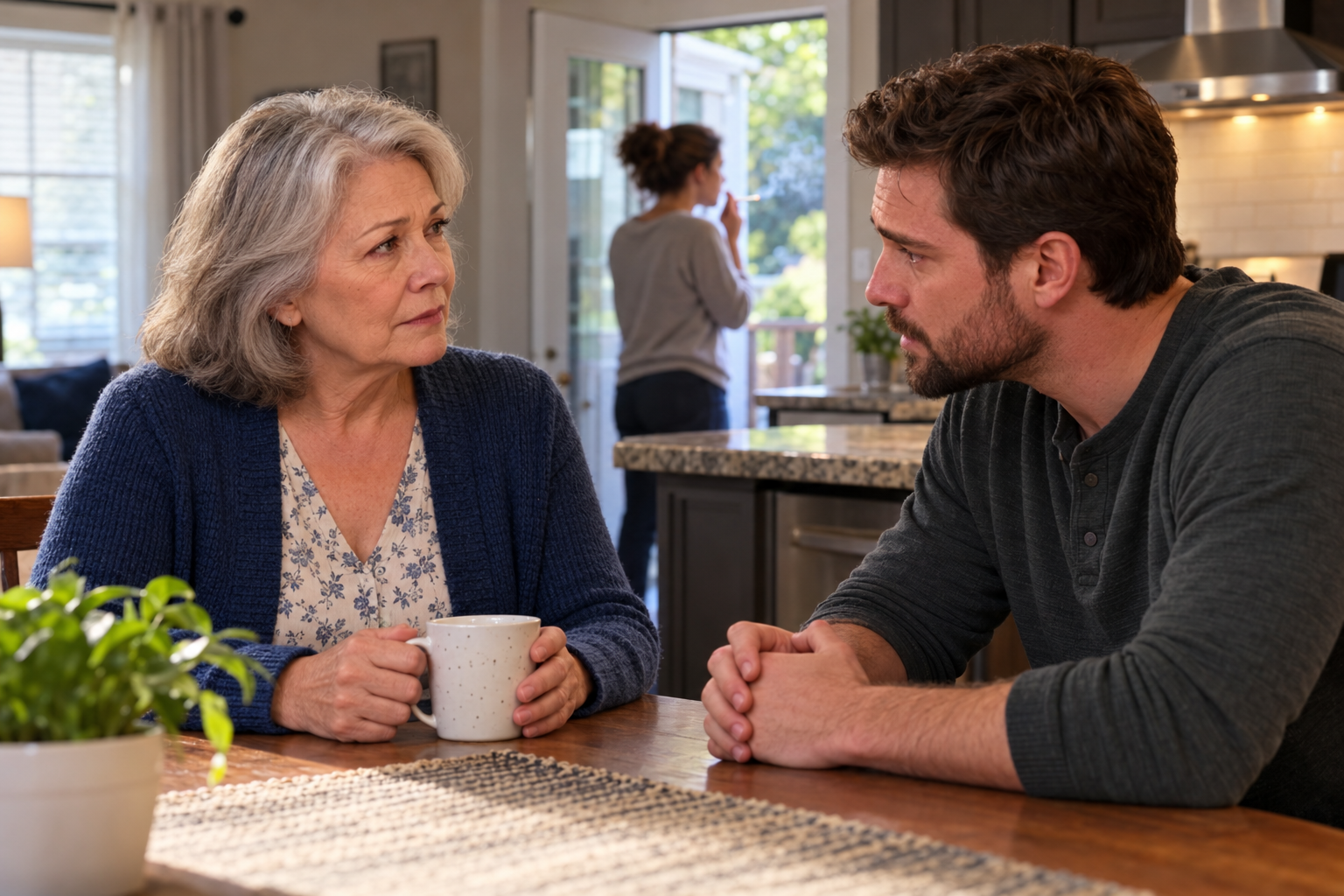
A week passed after our meeting.
Deacon and I spoke a few times.
The conversations were brief, but they were calmer than the ones we had shared immediately after the slap.
He asked about my health.
I asked how he was doing.
We talked about ordinary things without turning every pause into an argument.
I appreciated the change.
I also reminded myself that I was still learning how to trust what I saw.
One morning, I was making breakfast when my phone rang.
Deacon's name appeared on the screen.
I answered.
"Hi, Mom."
"Hello."
He asked whether I had a few minutes.
I told him I did.
He said he had been thinking about our relationship and wanted to know whether we could try to move forward.
I turned off the stove and sat down.
"What do you mean by moving forward?" I asked.
He paused.
"I mean getting back to being a family."
I looked at the kitchen table.
For years, I would have accepted that phrase without asking what it meant.
I would have assumed that being a family required me to put the argument aside.
I would have told him that I loved him and that we could forget the whole thing.
But I no longer wanted to confuse closeness with pretending.
"I want us to have a relationship," I said. "But I don't want to go back to the way we handled problems before."
"What does that mean?"
"It means we need to be able to disagree without anyone being frightened or hurt. It means I need to be able to talk about my health without being treated as though I am causing trouble."
He listened.
I continued.
"And it means that when something serious happens, we have to be able to talk about it honestly."
He said he understood.
I asked whether he could accept that I might still need time.
He said he could try.
I appreciated the answer because it was not a promise that everything would suddenly be easy.
We talked for a few more minutes.
Then he asked whether I would consider meeting him again.
I agreed, provided we met somewhere comfortable and did not rush the conversation.
He accepted.
After we hung up, I felt a cautious sense of hope.
It was not the same as the relief I had once felt when an argument ended.
This hope had room for uncertainty.
It allowed me to believe that things might improve without insisting that they already had.
I spent the rest of the morning taking care of my apartment.
I straightened the counter.
I folded the clean dish towels.
I checked my calendar and made sure I had enough time to rest before the next day.
The simple tasks helped me remain grounded.
I did not want my entire life to revolve around whether Deacon was becoming more considerate.
His behavior mattered.
But my well-being mattered, too.
The following afternoon, we met again.
Deacon arrived a few minutes after I did.
He greeted me and asked how I was feeling.
I told him I was doing reasonably well.
We sat down and ordered something simple.
At first, we spoke about ordinary matters.
Then Deacon said he wanted me to know that he had been thinking about the cigarette smoke and my health.
I looked at him.
He said he had not taken my request seriously enough that day.
He said he should have listened instead of becoming angry.
I let him finish.
"Thank you," I said.
He nodded.
"I don't want you to feel like you can't come over."
"I don't want that either."
"Then I hope you will come back sometime."
I took a breath before answering.
"I may be ready one day. But I need to know that I can tell you when something is wrong without being punished for it."
He looked down.
"I know."
I wanted to ask whether he truly knew.
Instead, I gave him room to respond.
After a moment, he said he could not change what had happened, but he could try to make different choices in the future.
That was a better answer than the ones he had given me before.
I told him that was what I needed to see.
We continued talking.
I did not demand that he agree with every feeling I had.
I did not expect him to become perfect.
I expected him to take responsibility for his own behavior.
Those were different things.
When the conversation ended, we stood outside for a moment.
Deacon asked whether I wanted him to walk with me.
I said I would be fine, but thanked him for asking.
He nodded.
We said goodbye.
I went home feeling tired but steady.
I had not promised to forget.
I had not demanded that he prove his remorse in a single afternoon.
I had allowed the conversation to be what it was.
That evening, I made tea and sat at the kitchen table.
The table remained firm beneath my hands.
I thought about how many times I had tried to repair my relationship with Deacon by making myself smaller.
I had swallowed words.
I had accepted explanations.
I had worried that any boundary might make him feel unloved.
I could see now that I had been trying to protect the relationship from discomfort rather than helping it become healthier.
Real relationships could survive honest conversations.
They could survive a mother saying no.
They could survive an adult son hearing that his actions had caused harm.
What they could not safely depend on was one person doing all the work while the other person avoided responsibility.
I did not know whether Deacon would always remember that lesson.
I could only keep living by it myself.
Later, I called someone I trusted and talked about ordinary things.
I did not spend the entire conversation discussing my son.
We laughed about something small.
We exchanged news.
When the call ended, I felt grateful for the reminder that my world was larger than one family conflict.
I washed my cup and turned off the kitchen light.
Before going to bed, I checked my phone.
There was a message from Deacon thanking me for meeting him.
I replied that I was glad we had talked.
Then I placed the phone on the nightstand.
I was beginning to understand that rebuilding a relationship did not mean returning to the exact place where it had broken.
It meant deciding whether something healthier could be built from what remained.
I still loved my son.
I hoped we would find our way toward a better relationship.
But I no longer believed that love required me to ignore the truth.
I turned off the lamp and settled into bed.
Tomorrow would bring its own questions.
I did not need to answer them tonight.
Click here to continue reading: PART 20: I Still Loved My Son After Everything That Happened, but I Finally Understood That Loving Him Could Not Mean Giving Up My Right to Feel Safe
I Thought My Son Would Protect Me, Until I Asked His Wife for One Small Favor in Their Kitchen
Part 19 of 20


One Comment on “PART 19 – When My Son Asked Whether We Could Try Again, I Realized That Rebuilding Our Relationship Would Require More Than Remembering How Much We Loved Each Other”