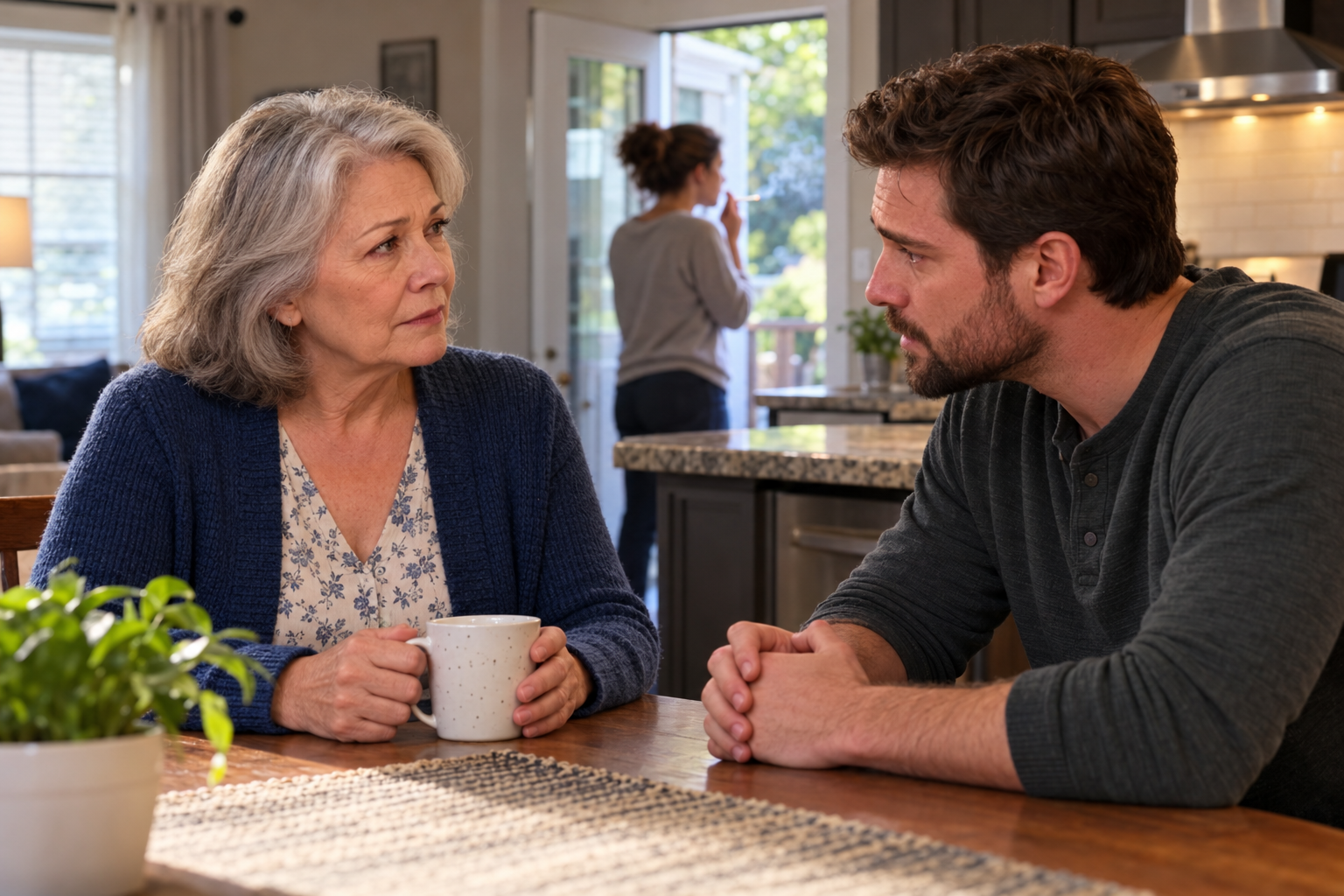
I did not decide to see Deacon because I suddenly felt ready to forget what had happened.
I decided to see him because I wanted to find out whether we could speak honestly without falling back into the same old pattern.
For several days, I had thought about his question.
He wanted to know whether I could forgive him.
I had no simple answer.
I loved my son, and I wanted our relationship to survive.
But I also wanted to recognize myself when I looked in the mirror.
I did not want to become a woman who agreed to anything simply because she was afraid of losing her child.
On the morning I made my decision, I sat at the kitchen table with a cup of tea.
The table stood firmly now that I had replaced the worn piece of cardboard beneath its leg.
I pressed my palm against the surface and felt no movement.
It was a small repair, but I liked knowing that I had taken care of something that needed attention.
My phone lay beside the cup.
I picked it up and opened Deacon's messages.
His last message was still there, asking whether I thought I could forgive him.
I read it once more.
Then I wrote that I was willing to meet him somewhere quiet and talk.
I made it clear that I was not ready to visit his house.
I also told him that I wanted us to speak calmly and honestly.
I sent the message before I could start rewriting it.
His response came a few minutes later.
He said he was glad I had agreed.
He asked where I wanted to meet.
I suggested a public place where we could sit comfortably and leave whenever we needed to.
He agreed.
We settled on a time for the following afternoon.
After that, I put the phone down.
I felt nervous, but I did not change the plan.
I spent the rest of the morning taking care of ordinary things.
I washed my breakfast dishes.
I checked my medication.
I made sure I had enough groceries for the next few days.
I also took a little time to rest because I did not want to exhaust myself before the meeting.
My lungs had already taught me that pushing through discomfort was not always a sign of strength.
Sometimes it was simply a way of making things harder.
That afternoon, I thought carefully about what I wanted to say to Deacon.
I did not want to prepare a speech.
I did not want to list every disappointment from the past.
I wanted to speak about the incident that had brought us here and what it meant for our relationship now.
I took a small notebook from the drawer.
On the first page, I wrote three short sentences.
I had the right to protect my health.
I had the right to be treated without violence.
I had the right to take time before deciding what forgiveness would mean.
I read the sentences twice.
Then I closed the notebook and put it away.
I did not need to carry a written argument into the meeting.
I only needed to remember what I believed.
The next afternoon, I dressed carefully and checked my purse.
My keys were there.
My phone was charged.
My medication was in its usual pocket.
I also carried the small mirror I had used to check my cheek after the slap.
The mark had faded, and I no longer needed the mirror for that purpose.
Still, I had kept it in the purse.
It reminded me of the moment I had first looked at my face and stopped pretending that nothing serious had happened.
I locked my apartment and made my way to the meeting place.
I took my time.
When I arrived, Deacon was already there.
He stood when he saw me.
For a moment, I saw the little boy he had once been.
Then I remembered that I was meeting my adult son, not the child whose scraped knees I had cleaned and whose fears I had tried to soothe.
He came toward me.
"Hi, Mom."
"Hello, Deacon."
He leaned forward as if he might hug me, then stopped.
I was grateful he had noticed my hesitation.
We sat down.
For the first few minutes, we spoke about ordinary things.
He asked whether the trip had been difficult for me.
I told him it had been manageable.
He asked how my breathing was.
I said I was taking care of myself.
He nodded.
Then the conversation became quiet.
I could tell he had something he wanted to say.
I waited.
Finally, he looked at me and said he was sorry for hitting me.
The words were direct.
He did not immediately follow them with an explanation.
I felt my throat tighten.
I had wanted to hear that apology for days.
Now that it had come, I discovered that it did not erase the hurt.
It simply gave the hurt a name that we could both acknowledge.
"Thank you for saying that," I replied.
He looked down at the table.
"I shouldn't have done it."
"No," I said. "You shouldn't have."
He nodded.
For a moment, neither of us spoke.
Then he began explaining how frustrated he had been that day.
He mentioned the tension in the house and the way the conversation had escalated.
I listened, but I did not allow the explanation to replace the apology.
When he finished, I spoke.
"I understand that you were angry. But I need you to understand that your anger did not give you permission to hit me."
"I know."
"I also need you to understand why I asked Sloan to take her cigarette outside."
He looked at me.
"My lungs are damaged, Deacon. I have been warned to avoid smoke. I wasn't trying to tell Sloan how to live. I was trying to protect my health."
He nodded again.
"I understand that now."
I wanted to ask why he had not understood it before.
But I decided not to turn the meeting into a list of questions he might answer defensively.
Instead, I told him what mattered most to me.
"I need to be able to tell you when something is wrong without being afraid of what you might do."
He looked uncomfortable.
I could see that the conversation was difficult for him.
It was difficult for me, too.
But I had spent too many years treating his discomfort as a reason to stop speaking.
I continued.
"I love you. I want us to have a relationship. But I cannot return to the way things were if that means pretending this never happened."
He was quiet for a while.
Then he said he did not want me to be afraid of him.
"Then your actions have to show me that," I replied.
He looked at me for a long moment.
"I don't know how to make you trust me again."
"You cannot make me trust you. You can give me reasons to trust you."
He lowered his eyes.
I could tell he was thinking about that.
I did not demand an immediate answer.
We sat together for a little longer.
We spoke about the possibility of having another conversation later, once we had both had time to think.
I told him I was not ready to visit his house yet.
He accepted that without arguing.
That mattered to me.
It was not proof that everything had changed.
It was one moment in which he respected my answer.
When we stood to leave, he asked whether he could hug me.
I considered the question.
Then I agreed.
The hug was brief and a little awkward.
I did not force myself to feel more than I felt.
When we stepped apart, I looked at him.
"I love you," I said.
"I love you, too, Mom."
I believed that he meant it.
But love was only one part of what we needed.
We said goodbye, and I went home.
During the trip back, I thought about the meeting.
I had not left with every question answered.
I had not suddenly forgotten the slap.
But I had spoken without apologizing for my own needs.
I had listened without allowing his explanations to erase his responsibility.
And I had left when the conversation was finished, rather than staying until he was satisfied.
When I reached my apartment, I placed my keys on the counter.
Then I made tea.
I sat at the kitchen table and rested my hands beside the cup.
The table remained steady.
For the first time in a long while, I felt that I had handled a difficult situation without abandoning myself.
I did not know what Deacon would do next.
I knew what I would do.
I would pay attention.
Click here to continue reading: PART 18: After Our Conversation, I Wanted to Believe My Son Had Changed, but I Knew One Apology Could Not Answer Every Question
I Thought My Son Would Protect Me, Until I Asked His Wife for One Small Favor in Their Kitchen
Part 17 of 20