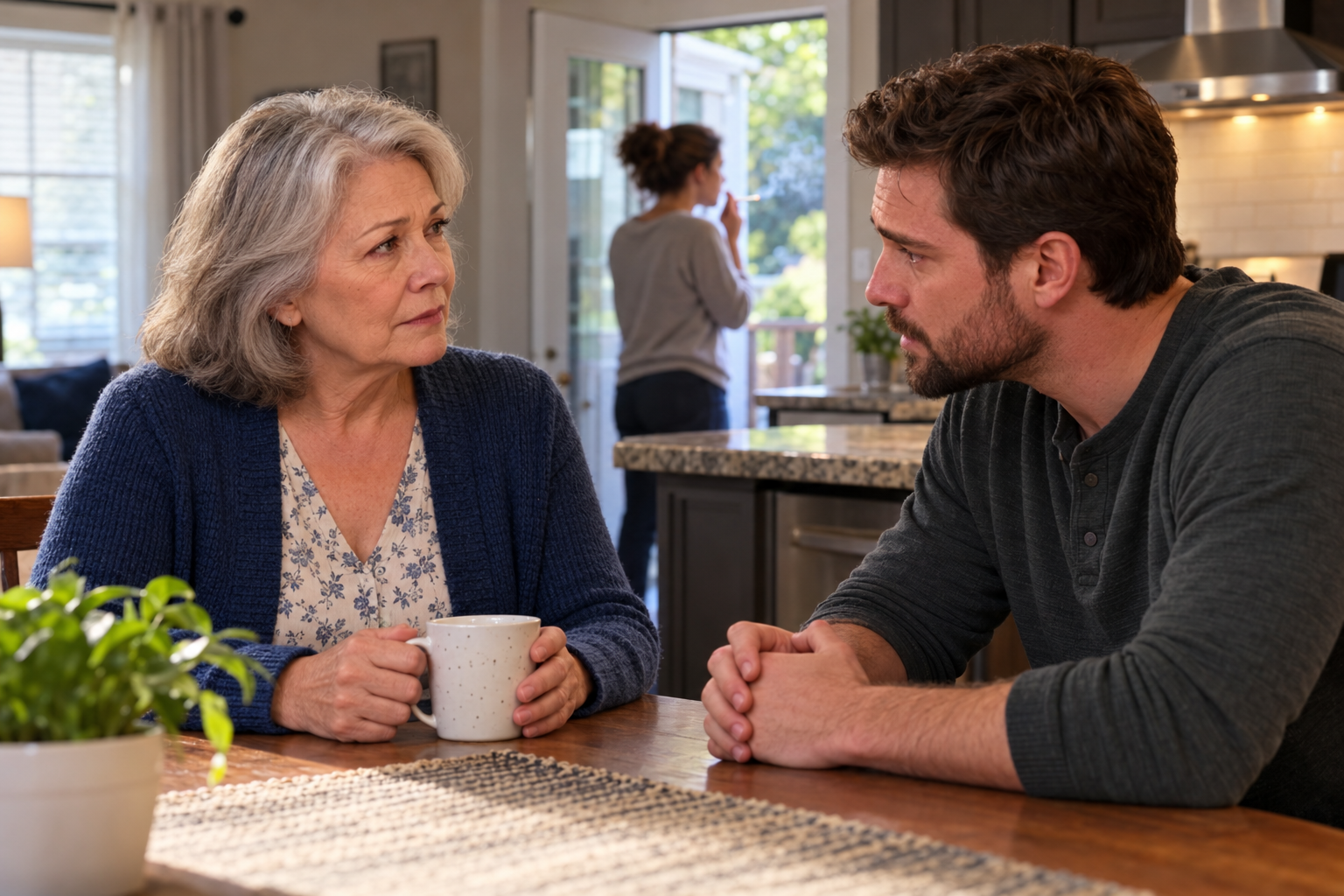
I didn't hear Deacon's reaction to the call.
Not immediately.
I was away from his kitchen, trying to settle my breathing and make sense of the afternoon.
The world around me remained ordinary.
People walked past.
Cars moved along the road.
Somewhere nearby, a door opened and closed.
I watched those small things because they were easier to understand than what had happened to me.
My cheek hurt whenever I moved my jaw.
I could feel the swelling beneath my skin.
Every time I remembered the slap, my body seemed to tense before my mind caught up.
I had never expected to be afraid of my own son.
That fact kept returning.
I thought about the little boy who had once fallen asleep against my shoulder after a long day.
I remembered carrying him when he was too tired to walk.
I remembered staying awake when he was sick, checking his forehead and listening to his breathing.
I had been responsible for him in ways he was too young to understand.
That was how parenthood worked.
You gave what was needed, often before anyone asked.
You did not keep a record of every sacrifice.
You hoped that one day your child would grow into someone who understood kindness without having to be taught it again.
I had hoped that for Deacon.
Perhaps I had hoped for too much.
Or perhaps I had simply failed to understand that growing older did not automatically make a person wiser or kinder.
I sat for a while and let my thoughts settle.
I didn't want anger to make decisions for me.
Anger could tell me that I had been wronged.
It could not tell me what to do with the rest of my life.
I needed something steadier than anger.
I needed to remember that I had a right to protect myself, even if the person I was protecting myself from was my own child.
That was a difficult truth to accept.
I had spent so many years putting Deacon first that I sometimes forgot where my responsibilities ended.
When he was young, putting him first had been necessary.
He depended on me.
He had no way to provide for himself, and every major decision rested on my shoulders.
But he was no longer a child.
He had his own home.
He had his own marriage.
He had built a life in which he expected to make his own decisions.
If that was true when he wanted independence, it had to be true when he was responsible for hurting someone.
I could not keep treating him like a helpless boy whenever his actions caused harm.
The thought made me sad.
It also made sense.
I looked down at my purse.
My phone was inside it, quiet now.
I wondered whether I would receive a call from Deacon.
I wondered whether he would demand to know why I had involved someone else.
I could imagine him saying that I had made him look bad.
That I had exaggerated what happened.
That family matters should remain private.
I had heard versions of those arguments before, even if I had never heard them from him about something this serious.
The problem with keeping everything private was that it often protected the person who caused the harm while leaving the injured person alone with it.
I understood that now.
I had spent years keeping Deacon's difficulties within the family because I believed that was what a good mother did.
If he made a poor decision, I tried to help him correct it.
If he was short of money, I looked for ways to assist him.
If he disappointed me, I told myself that every parent had to be patient.
I had never asked what all that protection was teaching him.
Perhaps he had come to believe that I would always absorb the consequences.
Perhaps he had mistaken my forgiveness for permission.
I couldn't know exactly what he thought.
I could only recognize the pattern I had helped maintain.
And I could decide not to continue it.
I stood up and took another careful breath.
My lungs still felt uncomfortable, but I was no longer struggling as badly as I had in the kitchen.
I knew I needed to take my condition seriously.
I had spent too many years ignoring my own limits because someone else needed something from me.
I would not make that mistake again if I could help it.
I thought about Sloan.
I wondered whether she had said anything to Deacon after I left.
Had she told him that he had gone too far?
Had she looked at my empty place in the kitchen and felt even a little shame?
I didn't know.
I remembered her expression as she smoked, and I found myself doubting that she had been troubled by what happened.
But I had no interest in guessing what she felt.
Her feelings were hers to examine.
My responsibility was to take care of myself.
That distinction was becoming clearer with every passing minute.
I had spent too much time trying to understand other people at the expense of understanding what I needed.
I needed safety.
I needed air that would not make my lungs work harder.
I needed to stop pretending that being a mother meant I had to accept mistreatment without complaint.
Those were not extravagant demands.
They were ordinary human needs.
And I was allowed to have them.
The afternoon seemed to stretch on.
I checked the time again.
Only a short while had passed since I made the call, yet I felt as though I had crossed a boundary I could never completely return from.
There would be questions.
There might be anger.
There might even be an apology, though I no longer wanted to build my decisions around the possibility of one.
I needed to see what Deacon did next.
Not what I hoped he would do.
Not what I could imagine him doing if he were the boy I remembered.
What he actually chose to do.
That was the only way I could begin to understand the man standing in front of me.
I took my phone from my purse and looked at the screen.
For a moment, I considered sending him a message.
I could have told him that I was safe.
I could have explained that I had not called because I wanted to hurt him.
I could have written a dozen sentences designed to soften the situation before he had even responded.
Instead, I put the phone away.
He knew I had been hurt.
He had watched it happen.
He had seen me struggle to breathe.
If he wanted to know whether I was safe, he could ask.
I did not need to chase him for concern.
That realization hurt more than I expected.
It forced me to admit that I had been doing much of the emotional work in our relationship for years.
I had been the one reaching out.
The one smoothing things over.
The one reminding him that we were family whenever distance began to grow between us.
I had called it love.
Some of it had been love.
But some of it had been fear.
Fear that if I stopped making the effort, he would stop caring.
Fear that if I demanded too much, he would decide I was no longer worth the trouble.
Fear that one day I would be left with no family at all.
I had allowed those fears to influence too many choices.
At seventy-three, I was finally beginning to understand that a relationship maintained only through one person's silence was not as secure as it appeared.
I wanted my son in my life.
I wanted to hear his voice without bracing myself for impatience.
I wanted to visit his home without wondering whether my presence annoyed him.
I wanted to grow older without becoming a burden he resented.
None of those wishes was unreasonable.
But I could not obtain them by accepting violence.
I had to let that truth stand on its own.
I looked toward the road and watched a car turn the corner.
Then I thought about the call I had made.
I had not made it impulsively.
I had not called because I wanted revenge.
I had called because I needed to stop handling Deacon's behavior as though it were a private inconvenience that I was expected to endure.
For once, I had allowed another person to know what he had done.
I didn't know how that information would change things.
I only knew that it could no longer be taken back.
And perhaps that was necessary.
For years, I had lived as though the most important thing was to preserve the life Deacon had built.
I wanted him to succeed.
I wanted his marriage to work.
I wanted him to feel that the difficult childhood he had experienced had led to something better.
But his success could not depend on my willingness to disappear whenever I became inconvenient.
His marriage could not require me to accept being struck.
His future could not be protected by pretending that his choices had no consequences.
I had to stop confusing his comfort with my responsibility.
The thought settled slowly.
I was still his mother.
I would probably always worry about him.
I would probably always remember the child he had been, even when the man he had become disappointed me.
But I was also a person.
A person with damaged lungs.
A person who could be frightened.
A person who deserved to live without being hit for asking someone to stop smoking around her.
That afternoon, I finally allowed those facts to exist together.
I could love Deacon.
And I could refuse to excuse him.
I could hope he would change.
And I could stop protecting him from the truth.
I could wish for reconciliation.
And I could still insist that my safety mattered.
For the first time in a long while, I didn't feel the need to choose between being his mother and respecting myself.
I had done enough choosing for him.
Now I had to make choices for me.
I adjusted my purse and began to move again, taking my time.
My face still hurt.
My heart hurt more.
But I no longer felt obligated to return to that kitchen and pretend everything was fine.
I had made the call.
Whatever happened next would have to begin with the truth.
And for once, I was willing to let that truth stand.
Click here to continue reading: PART 5: I Had Spent My Life Protecting My Son, but for the First Time I Refused to Carry the Shame of What He Had Done
I Thought My Son Would Protect Me, Until I Asked His Wife for One Small Favor in Their Kitchen
Part 4 of 20