The morning after I met Deacon, I woke feeling both relieved and unsettled.
I was glad we had spoken.
I was glad he had apologized directly.
But I could not shake the feeling that I was waiting for something I could not yet name.
I made tea and sat at the kitchen table.
The apartment looked the same as it had the day before.
The counter was clean.
The dishes were put away.
The small mirror was still in my purse.
Nothing in the room showed that I had finally heard the apology I had wanted.
I thought about how I had imagined that moment.
I had expected to feel a sudden release, as though the right words would lift the hurt from my shoulders.
Instead, I felt quieter.
The apology mattered, but I still remembered the slap.
I remembered how quickly the situation had changed.
One moment, I had been an older woman asking for clean air.
The next, I had been standing in a kitchen with my son looking at me as though I deserved what he had done.
That memory would take time to settle.
I did not expect it to disappear overnight.
I washed my cup and checked my phone.
There was a message from Deacon.
He thanked me for meeting him.
He said he had been thinking about what I told him.
I replied that I appreciated the conversation.
Then I put the phone down.
I did not ask him what he had decided.
I did not demand another promise.
I wanted to see whether his understanding would last beyond the moment when we were both trying to repair the relationship.
The next few days were ordinary.
I bought groceries.
I paid a bill.
I took time to rest when my breathing felt uncomfortable.
I also spent more time reading instead of checking my phone.
That small change made a difference.
I was beginning to understand how much of my attention had been tied to my son's moods.
If he sounded happy, I relaxed.
If he sounded angry, I worried.
If he went quiet, I wondered whether I had done something wrong.
I had treated his emotions as though they were instructions for how I should feel.
I did not want to continue doing that.
One afternoon, Deacon called.
He asked whether I would consider having another conversation soon.
I told him I would.
He then asked whether I might be ready to visit his house.
I looked toward the window.
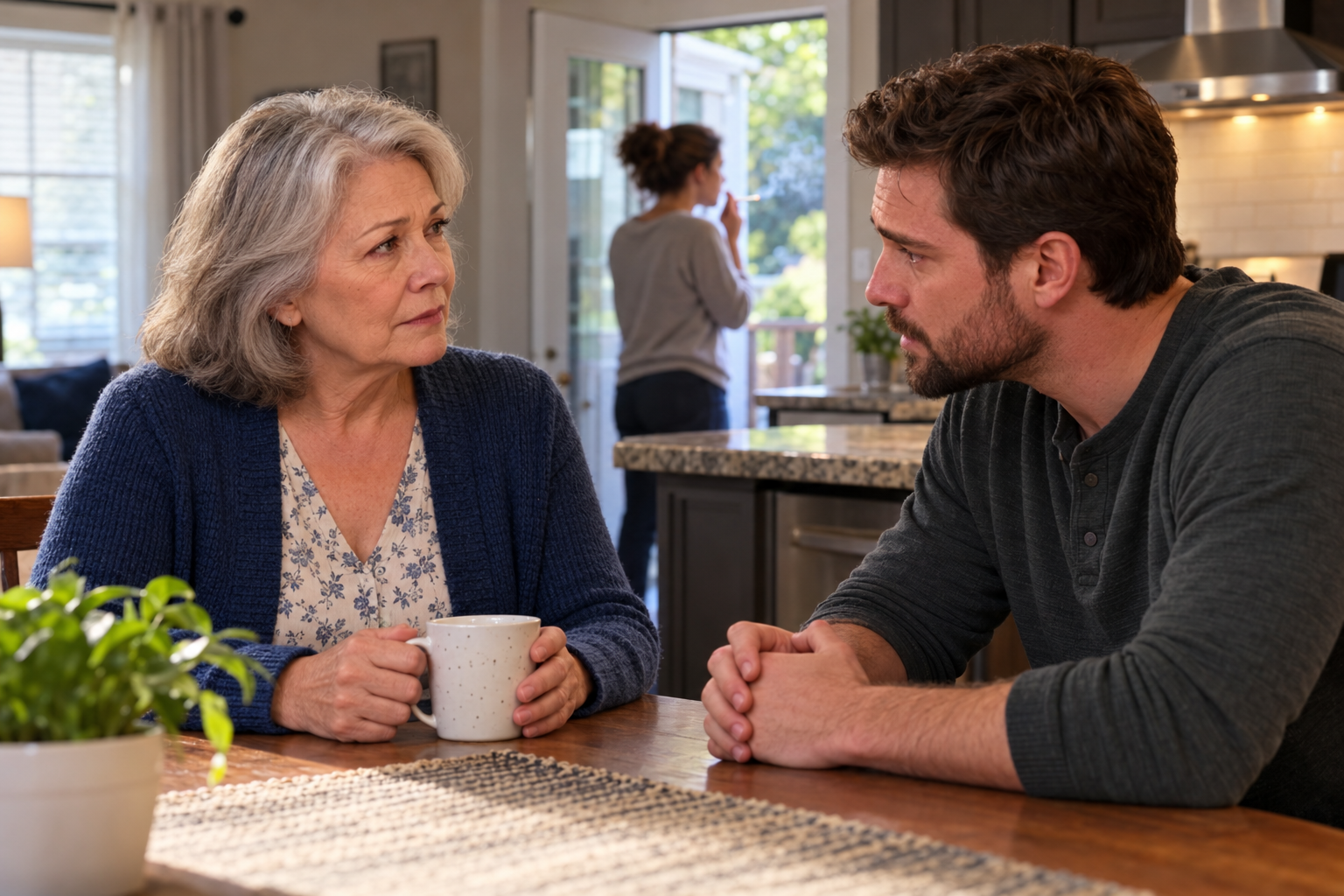
I still remembered the polished kitchen counter and the smoke rising from Sloan's cigarette.
I remembered the way the smell had settled in my throat.
I remembered how quickly Deacon had turned my request into a confrontation.
"I am not ready to come back to the house yet," I said.
He paused.
"Okay."
I waited, expecting him to ask why again.
He did not.
Instead, he said we could meet somewhere else if I preferred.
I felt a small sense of relief.
"That would be better for now," I replied.
We agreed that we could talk again another time.
After the call, I sat quietly for a few minutes.
It was a small change.
He had asked for something, and I had said no.
He had accepted the answer.
I did not need to turn that moment into proof that everything was different.
But I could recognize it as a good sign.
Later that week, I thought about Sloan.
I had not spoken to her since the day of the slap.
I did not know whether Deacon had told her about our conversation.
I did not know what she thought about my decision to leave.
I could guess, but guessing would not help me.
What I knew was that I had asked her to smoke outside because I had trouble breathing.
That request had been reasonable.
I had not demanded that she stop smoking altogether.
I had not insulted her.
I had not tried to control what she did in her own time.
I had simply asked for consideration while I was there.
I could not control how she interpreted that request.
I could control whether I continued to put myself in a situation where my health and dignity were treated as inconveniences.
That distinction gave me some peace.
On Saturday morning, I cleaned the kitchen.
I wiped the counter and rinsed the sink.
I washed the dish towel and hung it to dry.
Then I took the small mirror from my purse and placed it in the drawer beside the bed.
I no longer needed to carry it everywhere.
I stood for a moment looking at the drawer before closing it.
The mirror had served its purpose.
It had helped me see the mark on my cheek when I was still tempted to minimize what had happened.
I did not need to keep checking the injury to remember the truth.
The truth was already with me.
That afternoon, Deacon sent another message.
He said he hoped I was having a peaceful day.
I answered that I was.
We exchanged a few words about ordinary matters.
The conversation did not turn into an argument.
I was grateful for that.
Still, I watched myself carefully.
I did not want to interpret every polite message as a guarantee.
People could behave well in one conversation and poorly in another.
Trust was built through repeated choices.
I had learned that lesson slowly.
In the evening, I sat at the kitchen table with my notebook.
I opened the page where I had written my three sentences.
I read them again.
I had the right to protect my health.
I had the right to be treated without violence.
I had the right to take time before deciding what forgiveness would mean.
I added another sentence beneath them.
I had the right to enjoy the good parts of my life while the difficult parts remained unresolved.
I looked at the words for a moment.
Then I closed the notebook.
That was what I wanted to remember.
I did not have to spend every day thinking about the argument.
I did not have to wait for Deacon to become a different person before I could enjoy a quiet morning.
I could laugh at something on television.
I could call someone I trusted.
I could go for a walk when my health allowed it.
I could make plans that had nothing to do with my son.
None of those things meant I had stopped caring about our relationship.
They meant I was still living my own life.
Before bed, I checked the lock on the front door and placed my phone beside the lamp.
I thought about the next time Deacon might call.
I hoped we would speak calmly.
I hoped he would continue to acknowledge what happened without blaming me for it.
But I did not rehearse a conversation that had not yet occurred.
I turned off the light.
For the first time in many days, I fell asleep without wondering whether I had said enough to make my son understand.
I had told him the truth.
The rest would have to be shown through time.
Click here to continue reading: PART 19: When My Son Asked Whether We Could Try Again, I Realized That Rebuilding Our Relationship Would Require More Than Remembering How Much We Loved Each Other
I Thought My Son Would Protect Me, Until I Asked His Wife for One Small Favor in Their Kitchen
Part 18 of 20