
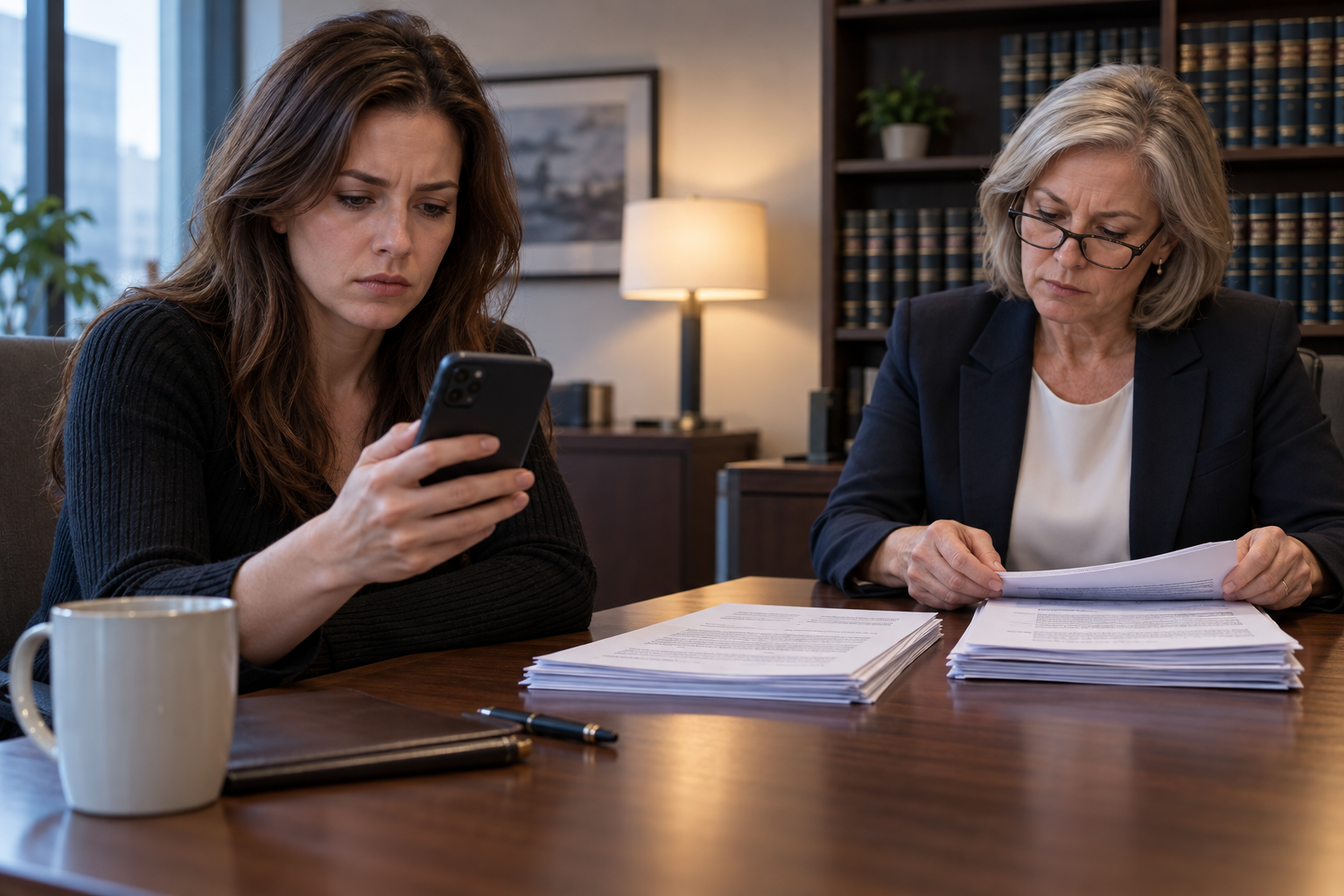
The first week after the notices were sent felt longer than it should have.
I kept expecting something to change.
A message that sounded different.
A phone call that began with a question instead of a demand.
Some sign that Logan had taken a moment to consider why I had reached this point.
Instead, the calls continued.
Sometimes he called twice within an hour.
Sometimes Chelsea tried after he had stopped.
I didn't know whether they were coordinating their efforts or simply reacting to the same uncertainty.
I knew only that the phone had become a reminder of everything I had tried to avoid.
I began leaving it in another room when I needed to concentrate.
At first, I felt guilty whenever I did.
Then I noticed something.
The world continued without my immediate response.
No one came to the door because I hadn't answered a message.
No crisis became worse simply because I took an afternoon for myself.
The fear of refusing had been larger than the refusal itself.
That realization stayed with me.
I had made myself available because I believed my availability was essential.
I had treated every request as urgent because Logan presented his problems that way.
I had accepted financial risk because I believed the alternative was letting him down.
But there had always been another option.
He could take responsibility for his own arrangements.
He could find other sources of financing.
He could make a repayment plan.
Those choices might be difficult.
They might even require sacrifices.
That didn't make them impossible.
And they had never been mine to make on his behalf.
I thought about the family loan again.
One hundred eighty-six thousand, four hundred dollars.
I could remember how the amount had grown through the conversations surrounding the renovations.
One expense led to another.
A necessary improvement became an additional cost.
A temporary shortfall became something that needed to be covered immediately.
Each request had arrived with a reason.
Each reason had sounded convincing in the moment.
I had agreed because I believed I was helping my family build something lasting.
I had not imagined that asking for the money back would become a source of conflict.
That was my mistake.
I had allowed affection to blur the difference between lending money and giving it away.
I had trusted assurances without insisting that the practical details remain clear.
And when the arrangement became uncomfortable, I had tried to solve the discomfort by being more patient.
More understanding.
More generous.
I told myself that time would settle everything.
It didn't.
Time only made the outstanding balance harder to ignore.
One afternoon, I opened the folder containing my own copies of the documents.
I checked the dates.
I reviewed the figures.
I read the terms again.
There was no satisfaction in it.
I wasn't looking for a reason to blame Logan.
I was checking that I had understood my own position correctly.
The papers made the situation easier to see because they didn't contain the history we had built around it.
They didn't remember the family dinners.
They didn't remember the promises made in the kitchen.
They didn't know how much I wanted Logan to succeed.
They recorded the arrangements as they were.
That was all.
For years, I had thought that written agreements made relationships colder.
Now I understood that clear agreements could protect a relationship from the resentment created when one person was expected to carry more than the other.
I wished I had understood that earlier.
Perhaps things would have turned out differently.
Perhaps they wouldn't have.
I couldn't know.
What I could do was stop making the same mistake.
When Fiona contacted me again, I asked whether there was anything else I needed to prepare.
She reviewed the status of the notices and explained that the next steps would depend on the responses received.
I listened carefully.
I didn't ask her to soften the language simply because the recipients were my family.
I didn't ask whether we could pretend the money was less important than it was.
I had already spent too long treating my financial security as the flexible part of every arrangement.
After we finished, I sat quietly for a while.
The office had a large clock on the wall.
I watched the second hand move.
It was an ordinary sound, almost too faint to notice.
I found myself thinking about how much of my life had been spent waiting for other people to decide what would happen next.
Waiting for Logan to repay what he owed.
Waiting for him to become more careful.
Waiting for the next explanation to be the last one.
Waiting for the day when helping him would no longer mean putting myself in a difficult position.
I had mistaken waiting for patience.
Sometimes it was.
Other times, it was simply a way to postpone a decision I didn't want to make.
I had reached the point where postponing it was costing me more than making it.
On the way home, I stopped to buy groceries.
I stood in the aisle longer than necessary, comparing two ordinary items.
The simplicity of the task felt reassuring.
There was no hidden obligation attached to it.
No family history to consider.
No complicated explanation about why one choice was more reasonable than another.
I chose what I needed and went home.
That evening, I received another message from Logan.
He wanted to know whether I was really prepared to let the bank proceed without my support.
I read the words slowly.
The message made me feel as if my withdrawal had been a personal act against him.
I wanted to remind him that the bank's requirements had not been invented by me.
I wanted to tell him that the arrangement had always depended on my willingness to accept the risk.
I wanted to ask when he had begun treating that willingness as permanent.
Instead, I put the phone down.
I was learning that not every question needed to be answered the moment it was asked.
Some questions were attempts to understand.
Others were attempts to move the conversation away from the issue that mattered.
I couldn't know which kind of question Logan believed he was asking.
I could only decide whether answering it would help.
The following morning, I reread the bank documents.
The thirty-day period was clear.
Logan had time to find replacement collateral or refinance the balance.
I hoped he would do what was necessary.
I wanted him to find a solution that didn't depend on my securities.
That was still possible.
The deadline was not a declaration that his business had to fail.
It was a requirement that he address the financing arrangement without relying on the support I had withdrawn.
I reminded myself of that whenever guilt began to creep in.
I was not choosing his outcome.
I was choosing my own limits.
Those were different decisions.
As the days passed, I became less afraid of seeing his name on the screen.
The calls still unsettled me.
But they no longer determined how I spent the rest of the day.
I could miss a call and continue cooking dinner.
I could read a message and wait before responding.
I could feel worried about Logan without immediately offering money or making a promise.
It wasn't that I had stopped caring.
I had stopped confusing care with responsibility for every consequence.
That distinction was beginning to change the way I saw our relationship.
I thought about the person I had been when the first request arrived.
I had wanted to be dependable.
I had wanted my family to know that I would help when things became difficult.
Those were not bad intentions.
But I had built my identity around being the person who could always fix things.
When I couldn't fix them, I felt as if I had failed.
That belief had kept me tied to arrangements that were no longer working.
It had made me afraid of disappointing Logan, even when disappointing him was the only way to stop disappointing myself.
I didn't like admitting that.
It meant some of the problem had been mine to recognize.
Not the debt.
Not the bank's requirements.
Not the decision Logan would make about his business.
My part was the pattern I had allowed to continue.
I had made it easy for everyone to assume that I would step in.
Now I had to accept that changing the pattern might make people angry.
They might misunderstand my motives.
They might tell themselves I had become difficult.
I couldn't control those reactions.
I could control whether I gave in to them.
A few days later, I arranged my papers again.
The bank documents went into one folder.
The loan demand went into another.
I kept the records together so I wouldn't have to search for them if Fiona needed anything.
Then I put the folders away.
I didn't keep opening them to reassure myself that the numbers were real.
They were real.
The obligations were real.
My decision was real.
For the first time, I could leave the papers in a drawer without feeling that I had to keep watch over the situation every minute.
I sat down with a cup of tea.
My phone was on the table beside me.
It remained silent for nearly an hour.
I found myself enjoying that silence.
Then Logan's name appeared.
I looked at it.
I felt the old urge to answer, to smooth things over before the conversation became worse.
But I no longer believed that answering immediately would solve anything.
I let the phone ring.
And when it stopped, I returned to my tea.
Click here to continue reading: PART 4: I Could Not Decide How Logan Would Handle the Consequences, but I Could Finally Decide What I Was No Longer Willing to Sacrifice for Him
I Thought Silence Would Protect My Family, Until Three Envelopes Forced Me to Face What I Had Been Carrying for Years
Part 3 of 4


One Comment on “PART 3 – The Money Had Never Been the Only Problem, and the Longer I Examined Our Arrangement, the Harder It Became to Ignore What Was Missing”