I used to believe that protecting your family meant making sure they never had to worry.
I thought that was what love looked like.
Pay the bills. Keep your promises. Step in when things went wrong, even when nobody asked you to.
I did those things for years.
Then I learned that the people you protect can become the people who hurt you most.
And sometimes, the hardest part isn't what they do.
It's deciding whether you will keep protecting them afterward.
By the time Logan started calling me, I had already made my decision.
I just wasn't ready to hear what he had to say about it.
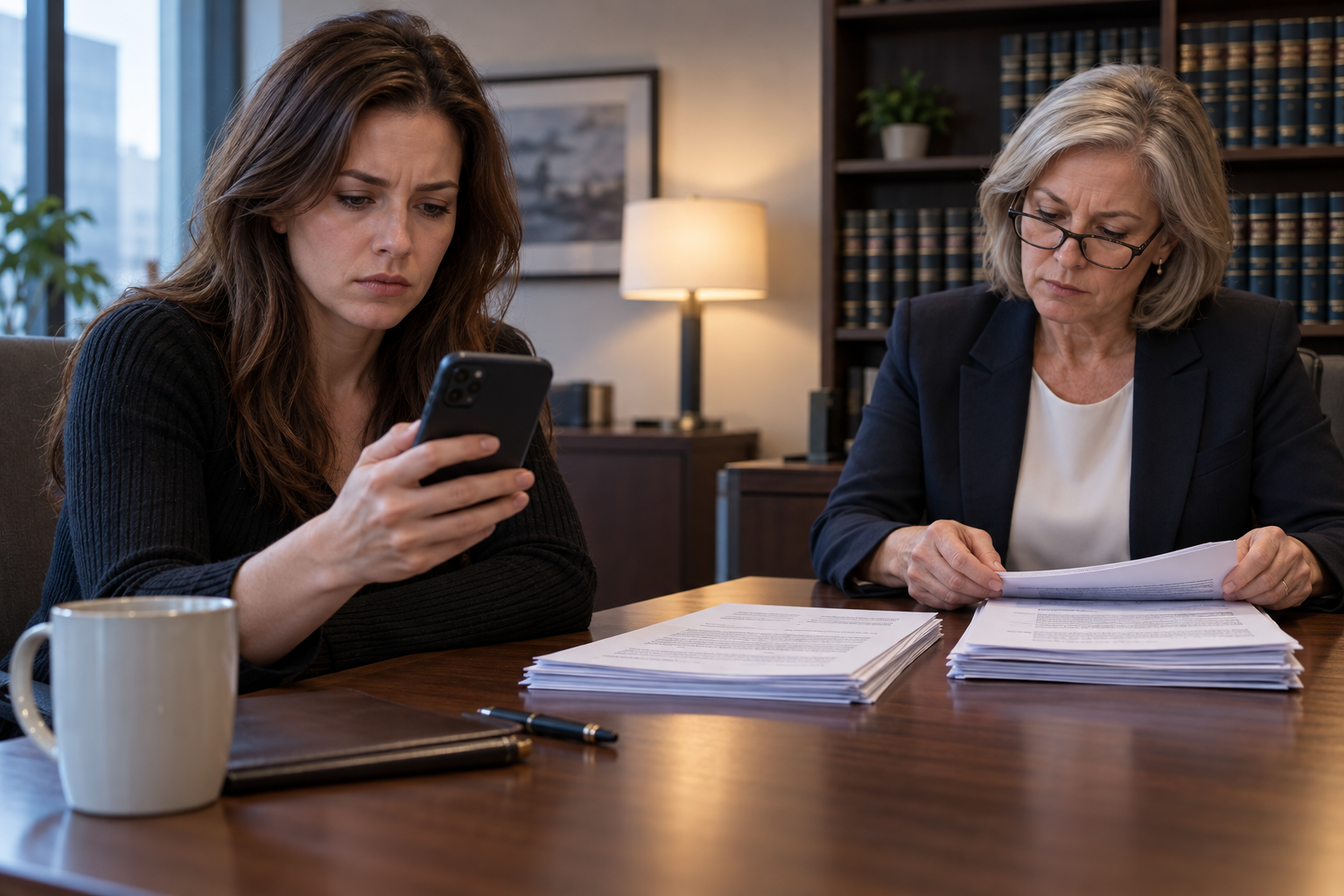
His name appeared on my phone while I sat across from Fiona Cartwright in her office.
I watched it ring.
I didn't touch the screen.
Fiona was arranging papers on the conference table, carefully aligning their edges.
She had a pair of reading glasses resting low on her nose.
She looked like someone who had spent a lifetime explaining difficult things to people who wished they were not true.
My phone stopped.
For a moment, I thought that was the end of it.
Then Logan called again.
I let it ring.
The third call came from Chelsea.
I recognized her number immediately.
She rarely called me without Logan being involved in whatever she wanted to discuss.
I watched the screen until it went dark.
Fiona didn't ask why I wasn't answering.
She had already heard enough to understand.
A few seconds later, Logan's name appeared again.
I turned the phone facedown.
That was when I realized my hands were shaking.
Not badly.
Just enough for me to notice.
Fiona finished sorting the documents and looked at me.
"You don't need to speak to either of them right now."
"I wasn't planning to."
She waited.
I knew what she was giving me.
Time.
I had spent so many years being available to everyone else that I had forgotten what it felt like to be unavailable without offering an explanation.
I wanted to say I felt relieved.
Instead, I sat there listening to the air-conditioning and wondering how many things I had agreed to simply because saying no seemed harder.
Fiona placed the first set of papers in front of me.
"We should go through what was sent."
I nodded.
She opened the envelope copies we had prepared and separated them into three groups.
Three envelopes.
Three different consequences.
All of them had been necessary.
None of them had been easy.
"The first package concerned the bank's security arrangement," she said.
I looked down at the documents.
I knew what they contained.
Still, seeing the details in black and white made everything feel more permanent.
For years, I had allowed securities belonging to me to support Logan's business credit line.
It had seemed reasonable when we first discussed it.
He had a business to build.
He needed financial backing.
I had the resources to help.
I told myself it was temporary.
I told myself that families were supposed to help one another.
And I believed him when he said he would never put me in a difficult position.
Looking back, that promise should have mattered less than the paperwork I signed.
But it didn't.
At the time, I trusted the person making the promise more than I trusted the documents describing the risk.
Fiona tapped the page in front of me.
"The bank has received confirmation that your securities are no longer available as collateral for Logan's credit facility."
I read the sentence twice.
There was nothing dramatic about it.
No accusation.
No angry declaration.
Just a formal statement confirming that I had withdrawn my support.
"What happens now?" I asked.
"The bank has given him thirty days to arrange replacement security or refinance what he owes."
Thirty days.
I pictured Logan sitting at his desk, reading the letter.
I imagined the way his jaw would tighten when he reached the deadline.
I knew how he handled problems.
First, he would insist that everything was under control.
Then he would become angry with whoever had made the problem impossible to ignore.
Eventually, he would look for someone who could make it disappear.
For a long time, that person had been me.
I had stepped in so often that I no longer noticed when help became an expectation.
The first time, I had considered it a favor.
The second time, I had called it family responsibility.
After that, I stopped giving it a name.
I simply paid attention whenever Logan said he needed something.
And I made sure he got it.
Fiona turned to the next group of papers.
"This is the repayment demand for the money you lent the family for the house work."
I looked at the figure.
One hundred eighty-six thousand, four hundred dollars.
The amount seemed almost absurd when printed in a formal document.
I remembered the conversations that had led to that loan.
The renovations had been described as necessary.
There had been practical explanations for the expenses, reassuring comments about the property's value, and repeated assurances that repayment would be handled properly.
I had listened.
I had believed.
I had transferred the money because I thought I was helping people I loved improve their lives.
I had not imagined sitting in a lawyer's office years later, looking at a demand for the return of that money.
Fiona adjusted her glasses.
"The amount includes the outstanding principal and the interest that has accumulated under the loan terms."
I ran my finger along the edge of the paper.
The number didn't change.
Neither did the memory of how easily I had agreed to help in the beginning.
"How long do they have to respond?" I asked.
"That depends on the terms of the demand and what happens next. We have set out what is owed and made your position clear."
I nodded slowly.
I was beginning to understand why Fiona had insisted that everything be documented.
For years, my family had relied on conversations.
A promise made over dinner.
An assurance during a phone call.
A quick explanation offered while everyone was busy with something else.
When I questioned a detail, I was told not to worry.
When I asked about repayment, I was reminded that we were family.
Those words had once comforted me.
Eventually, they became a way to avoid answering the question.
Fiona placed the third set of papers beside the other two.
I looked at it but didn't reach for it.
She noticed.
"We can review this one when you're ready."
I appreciated that she didn't push.
The first two documents were already difficult enough.
One dealt with the bank.
The other dealt with the money.
The third carried its own weight, and I knew I couldn't keep avoiding it simply because I disliked what it represented.
I took a breath.
"Let's finish."
Fiona opened the final folder.
I leaned forward.
For the first time that afternoon, I felt the full weight of what I had done.
I had not made a threat.
I had not called Logan names.
I had not tried to embarrass Chelsea.
I had simply stopped allowing my name, my money, and my financial security to stand between them and the consequences of their choices.
That should have been a straightforward decision.
Instead, it felt like stepping away from a role I had occupied for so long that I no longer knew who I was without it.
Fiona turned the first page toward me.
"Before we discuss the remaining documents, I want you to remember something."
I looked at her.
"You are not creating a new obligation by asking people to honor the obligations that already exist."
I stared at the paper.
I wanted to believe her.
More than that, I wanted to stop feeling guilty for wanting my own life back.
My phone vibrated against the table.
Another message had arrived.
I didn't turn it over.
Fiona waited until the vibration stopped.
Then she continued reviewing the documents with me.
We went through the dates, the amounts, and the terms.
She explained what had been sent and why each notice mattered.
I asked questions when I didn't understand something.
For once, I didn't pretend to understand just to keep the conversation pleasant.
It felt strange.
It also felt necessary.
When we finished, Fiona gathered the papers into their folders.
"Everything has been documented," she said. "From here, we wait for their response and deal with whatever comes next."
I looked at the three groups of papers.
They were ordinary sheets of paper.
No more than that.
Yet they represented something I had avoided for years.
A boundary.
A decision.
A refusal to keep paying for peace when the price was my own security.
I collected my phone and stood.
Logan had called several times.
Chelsea had called once.
Neither had left a message I was ready to hear.
Outside Fiona's office, the hallway was quiet.
I stopped beside the window and looked down at the street.
People were walking past the building with shopping bags and briefcases.
Cars moved through the intersection.
Somewhere, someone was probably having an ordinary afternoon without wondering whether a family member would forgive them for finally saying no.
I envied that person.
Then I corrected myself.
I didn't envy their life.
I wanted the freedom to live mine without being afraid of what my family might demand next.
I put the phone in my pocket.
For the first time in years, I had no immediate problem to solve for Logan.
I had only a decision to stand by.
And I was beginning to understand that those were two very different things.
Click here to continue reading: PART 2: Logan Kept Calling as the Bank Deadline Approached, but I Was Finally Learning Why His Emergencies Had Become My Responsibility
I Thought Silence Would Protect My Family, Until Three Envelopes Forced Me to Face What I Had Been Carrying for Years
Part 1 of 4