I had hoped there was a better explanation.
I kept hoping for one even after the subject of the tip came up.
That was the embarrassing part.
I could hear what was being said, but some part of me was still searching for a reason to make it sound less deliberate.
Maybe the room assignment had already been changed.
Maybe there had been a mistake in communicating it.
Maybe the manager was trying to describe something badly.
I wanted one of those possibilities to be true.
Because the alternative was simple.
Another couple had paid extra.
My parents had ended up beside the ice machine.
And the hotel apparently expected us to accept that as ordinary business.
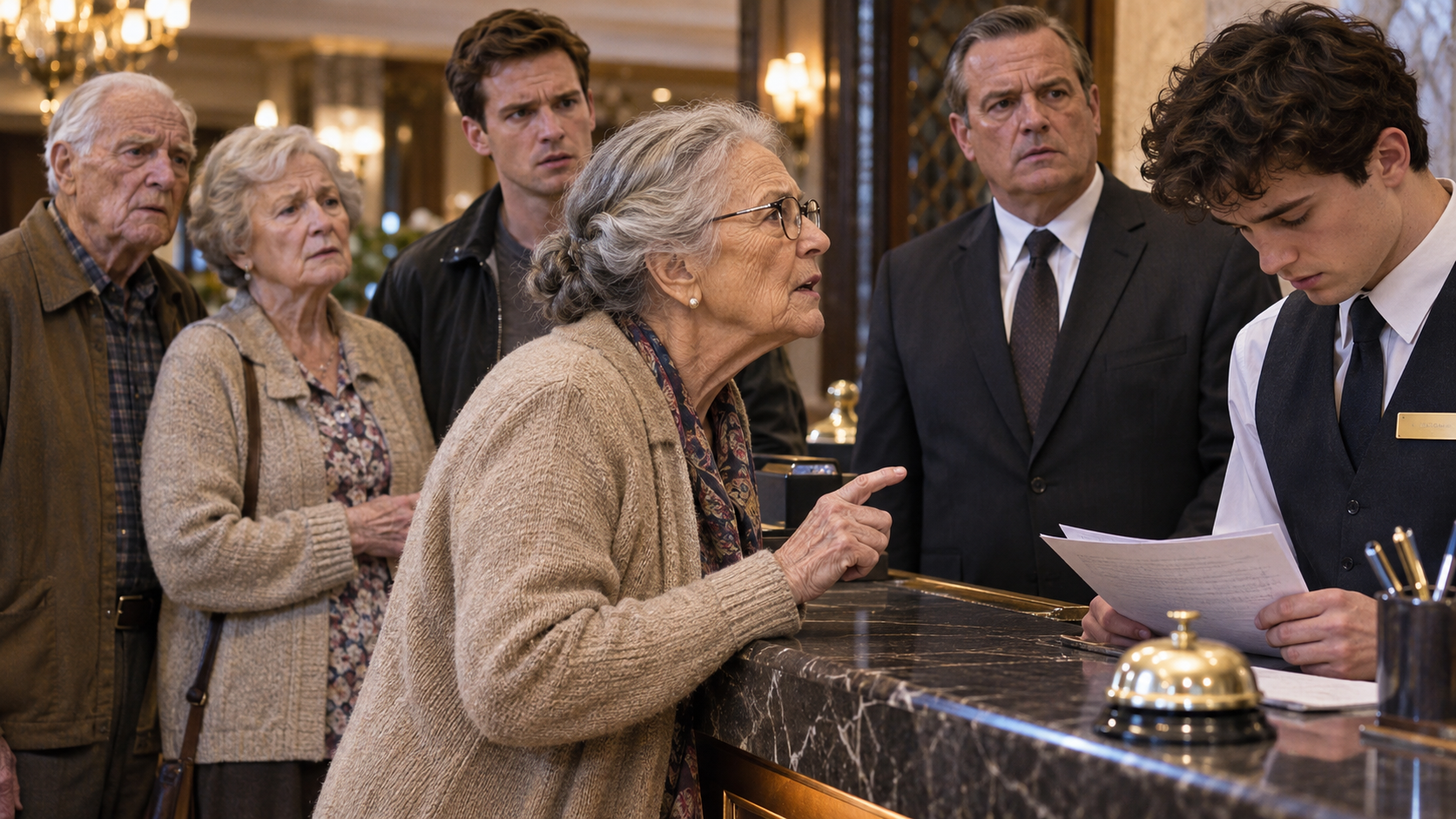
I looked toward the manager.
I wanted him to explain the connection.
Not with a rehearsed apology.
Not with a vague sentence about availability.
I wanted to know why a tip had anything to do with the treatment my parents received.
I could feel myself becoming more careful with every word.
That happens to me when I'm angry.
I don't always raise my voice.
Sometimes I become unusually precise.
I start listening for the exact point where somebody's explanation stops making sense.
That was where I found myself.
The manager had a responsibility to the guests.
The clerk at reception had a responsibility too.
Those responsibilities didn't disappear because somebody else had been generous.
I kept thinking about the difference between rewarding good service and buying priority over another person.
It was a difference the hotel should have understood without needing me to explain it.
Yet there I was.
Standing in front of a reception desk.
Trying to make sense of why my eighty-year-old parents had been treated as the less valuable guests.
I hated how much the situation had already affected our stay.
The room itself had become a reminder.
Every time I thought about the ice machine, I thought about the other couple.
Every time I thought about the other couple, I thought about the tip.
And every time I thought about the tip, I wondered whether my parents had been expected to offer more money simply to receive the consideration they should have had from the beginning.
That possibility made me ashamed.
Not because my parents hadn't tipped enough.
Because I had nearly accepted the consequences without questioning them.
I had allowed myself to think in terms of inconvenience.
A room beside a machine.
A little noise.
An unlucky assignment.
But those descriptions left out the reason we were being given.
They made the problem sound accidental.
And once money entered the explanation, it no longer sounded accidental to me.
My mother remained nearby.
I was aware of her presence even when I wasn't looking directly at her.
I wanted to keep the conversation from becoming humiliating for her.
There is a special kind of discomfort in watching somebody defend your right to basic courtesy.
You start feeling as though your presence is the problem.
I didn't want her to feel that.
I didn't want my father to feel it either.
Neither of them had done anything wrong.
I kept repeating that to myself.
They had not caused the problem.
They were not responsible for fixing it.
And they certainly should not have been expected to pay more to make it disappear.
Still, I could feel the old habit pulling at me.
Don't make a scene.
Don't make people uncomfortable.
Don't spoil the occasion.
Those thoughts sounded familiar because I had lived with them for years.
They weren't always bad advice.
There were times when letting something go was the right decision.
But this wasn't simply about hurt feelings.
It was about a choice somebody had made on behalf of people who had no reason to expect they were being treated differently.
That mattered.
I wondered how the manager would describe the same decision if he had to repeat it to the hotel's owner.
Would he use the same words?
Would he mention the tip?
Would he explain why two elderly guests had been placed near a machine that other guests might reasonably prefer to avoid?
Or would the explanation change once somebody with authority was listening?
I didn't know.
I only knew I wanted the truth to remain the truth no matter who was standing there.
The manager's position made the conversation difficult.
He represented the hotel.
He could explain decisions.
He could speak about room assignments.
He could give the impression that everything had happened according to some rule I simply didn't understand.
And I had to remind myself that confidence wasn't proof.
A person could sound certain and still be wrong.
I also had to remember that I hadn't heard every conversation leading up to the room change.
I knew the result.
I knew the reason that had surfaced.
I didn't know what had happened before that.
I didn't know exactly what the clerk had said to the other couple.
I didn't know who first suggested changing the rooms.
I didn't know whether the manager had approved it or was now trying to justify it.
Those details were still unclear.
They mattered because I didn't want to accuse the wrong person of doing something I couldn't prove.
But uncertainty about those details didn't erase the central fact.
My parents had been given the room beside the ice machine.
Another couple had apparently been favored because they had tipped more.
That was enough to ask why.
I could hear movement around the reception area.
Ordinary hotel sounds.
The sounds of people doing their jobs.
It made the whole situation feel strangely public.
A disagreement that should never have existed was unfolding in a place where guests expected to be welcomed.
I looked toward the clerk.
He was the younger man behind the desk.
I had no way of knowing how much he had personally decided.
But he was part of the conversation I needed to understand.
And I wanted him to be able to answer a simple question.
Who had made the decision?
That question mattered more than whether anyone could make the decision sound reasonable afterward.
There was a difference between responsibility and explanation.
I wanted both.
I thought about my parents again.
I could imagine how easily they might have accepted a quiet assurance that nothing could be done.
I almost understood why.
At eighty, you may not want to spend your energy arguing over a hotel room.
You may want the day to continue.
You may want your family to stop worrying.
You may decide an unpleasant sound is easier to endure than an unpleasant conversation.
But the ease of that choice doesn't make the original treatment right.
That was what I was finally beginning to understand.
I could be respectful without being silent.
I could question the decision without attacking everyone involved.
I could ask the hotel to explain itself without making my parents responsible for my anger.
I didn't need to shout.
I needed to stop pretending this was nothing.
The problem had started with a room.
It had become a question of whose money counted.
And now I wanted the manager to explain why that question had been allowed to decide where my parents would sleep.
Click here to continue reading: PART 3: I Thought the Conversation Was Only Between Me and the Manager Until Evelyn Heard the Part About the Better Tip
I Had Brought My Elderly Parents to a Hotel Where One Small Room Change Told Me How Little Respect They Were Given
Part 2 of 8