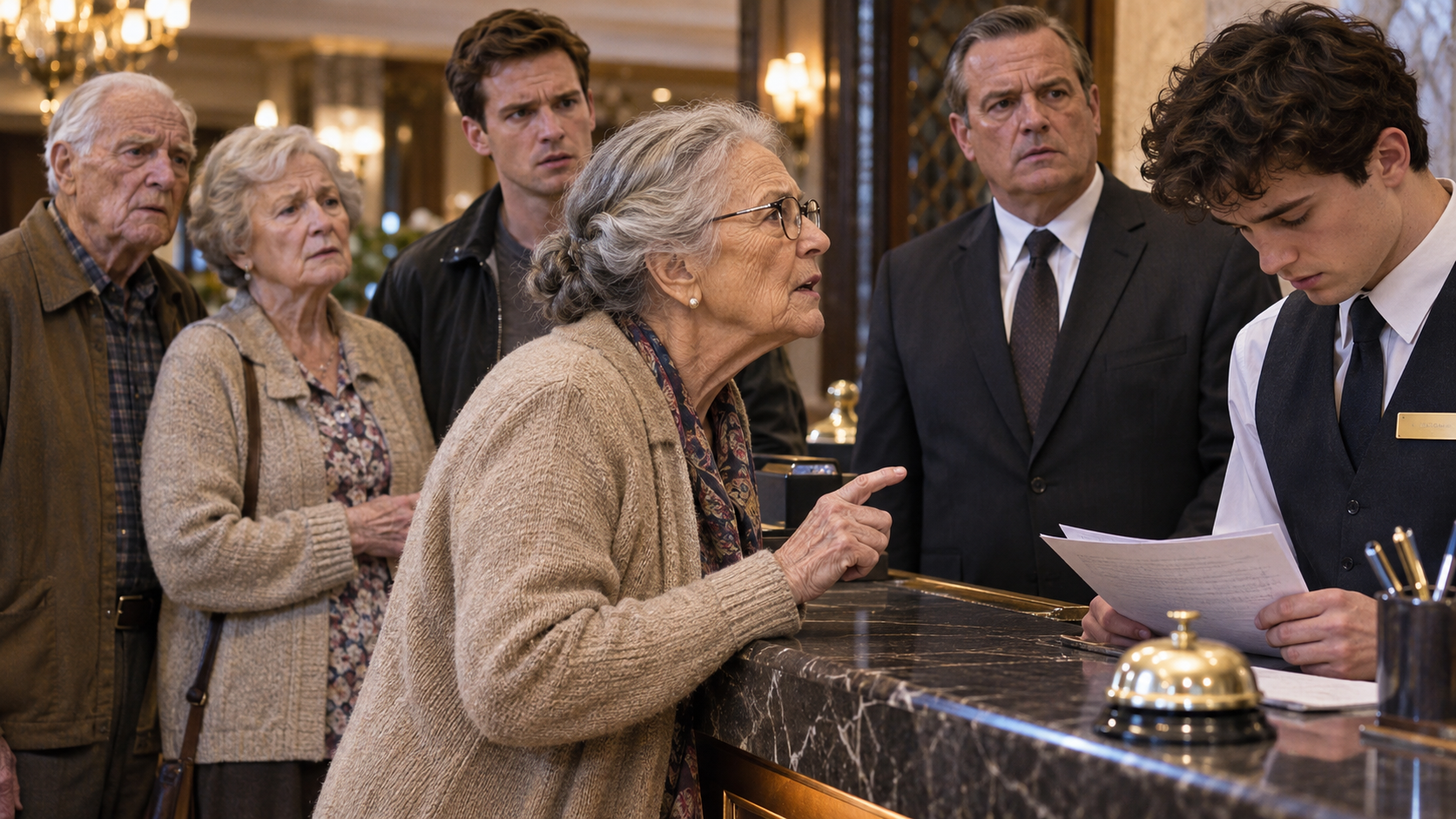
The manager didn't move.
That was the first thing I noticed after Evelyn reacted.
He had been speaking for the hotel.
Now he seemed unable to find anything useful to say.
I watched him because I still wanted an answer.
But Evelyn's attention had already moved elsewhere.
She looked toward the reception desk.
The clerk was behind it.
The same young man who had been standing there only a short time before.
He had papers in front of him.
And he appeared determined to give them all his attention.
I recognized the gesture immediately.
People do it when they hope a conversation will pass them by.
They look down.
They rearrange something.
They make themselves busy.
Sometimes they really do have work to finish.
Sometimes the work becomes a place to hide.
I couldn't know which was happening with him.
But the timing was difficult to ignore.
Evelyn had heard the explanation about the tip.
The manager had gone quiet.
And the clerk suddenly looked as though the stack of papers was the most important thing in the building.
I felt uncomfortable watching him.
He was young.
I didn't know what instructions he had been given.
I didn't know whether the decision had been his.
I didn't even know whether he had agreed with it.
Those things mattered.
I didn't want somebody blamed merely because he was the person standing behind the counter.
But I also didn't want everybody to avoid answering by pointing toward somebody else.
A hotel doesn't assign rooms without people making decisions.
Somebody had handled my parents' room.
Somebody had handled the other couple.
And somewhere in that process, a better tip had apparently been allowed to matter more than fair treatment.
That was what needed explaining.
Evelyn turned her attention fully toward the clerk.
She asked him to identify himself.
The question was short.
Ordinary.
Almost too simple for the tension surrounding it.
She wanted his name.
Nothing more at that moment.
I looked at the young man.
He didn't immediately become more helpful.
His attention remained on the papers.
I remember how strange that seemed.
A name is such a small thing.
Hotel clerks give their names every day.
Managers do too.
It's part of dealing with people.
But in that moment, even that simple request seemed difficult.
I could feel my own embarrassment returning.
Not embarrassment for my parents.
Embarrassment at the way the whole conversation had unfolded.
We had come to a hotel.
My parents had been placed beside an ice machine.
Another couple had apparently received preferable treatment because their tip had been larger.
The manager had been questioned.
Evelyn had heard the explanation.
And now the young clerk was avoiding the attention directed toward him.
The matter had become far more uncomfortable than it ever needed to be.
I thought about how easily it could have been avoided.
Fair treatment would have avoided it.
A clear explanation might have helped.
A willingness to admit a wrong decision might have changed the direction of the conversation before Evelyn became involved.
Instead, everybody seemed to be standing in the consequences of a choice nobody wanted to own.
That was how it looked to me.
I knew I had to be careful about assuming too much.
Silence can mean many things.
Fear.
Confusion.
Uncertainty.
Even the simple wish not to make a bad situation worse.
I couldn't read the clerk's mind.
But I could see the papers.
I could see his lowered attention.
And I could hear Evelyn waiting for an answer.
I looked toward my parents.
The entire situation had begun because of their room.
But I didn't want it to end with them feeling that they had caused a problem by being there.
They had not demanded anything unreasonable.
They had not asked for somebody to be punished.
They hadn't been trying to embarrass the staff.
They were simply the guests who had received the less desirable arrangement.
I kept returning to that because it was easy, in a tense conversation, to forget who had actually been inconvenienced.
The room was still beside the ice machine.
That hadn't changed.
The hum of the machine was still part of the problem.
The fact that my parents were eighty hadn't changed either.
But the conversation had moved beyond what could be heard through a hotel wall.
It was now about how the decision had been made.
And who would acknowledge it.
I watched Evelyn.
I didn't know everything she intended to do.
I didn't know what she knew about the clerk.
I didn't know whether the manager's silence had surprised her.
All I could say was that she had heard the part about the money and had not ignored it.
That was more than I had almost done.
I felt ashamed of that comparison.
Not because I had wanted to be cruel.
I hadn't.
I had wanted the situation to settle down.
I had wanted my parents to remain comfortable.
I had wanted an explanation that would let us move forward without anyone feeling humiliated.
Those weren't bad things to want.
But I had mistaken the absence of confrontation for the presence of fairness.
They are not the same.
I understood that now.
I thought about the young clerk again.
I still didn't want to assume he had caused the whole problem.
It was possible the manager had made the decision.
It was possible someone else had been involved.
The information in front of me didn't settle those questions.
But asking his name was a reasonable place to begin.
A person who had been part of the reception process could at least identify himself.
And the hotel could be expected to explain how the room assignment had occurred.
That wasn't revenge.
It wasn't a demand for special favors.
It was accountability.
I realized how much I had come to dislike that word when people used it carelessly.
Sometimes it sounded like a threat.
Sometimes it was used to make an ordinary mistake seem unforgivable.
But this time, it described exactly what was missing.
An explanation that belonged to somebody.
A decision that somebody was prepared to acknowledge.
A clear answer about why my parents had been placed near the ice machine while the other couple received better treatment.
I looked back toward the manager.
He had not recovered the confidence he'd shown before Evelyn's interruption.
The change stayed with me.
So did the clerk's papers.
Such a small object.
A stack of sheets on a reception counter.
Yet they had become the thing I watched while waiting for a young man to answer a simple question.
I didn't know what he would say.
I didn't know what the manager might say next.
And I didn't know how Evelyn intended to deal with either of them.
I couldn't honestly claim to know the outcome.
What I did know was that the explanation about the larger tip had been heard by someone who was not willing to treat it as an ordinary reason for disappointing two elderly guests.
That mattered.
I had spent too much of the encounter thinking about how to make the unpleasantness go away.
Evelyn was asking who had allowed it to happen.
The difference was uncomfortable.
It also felt necessary.
I looked once more toward my mother and father.
I still wanted them to have a quiet room.
I still wanted them to enjoy their stay.
I still wished we had never needed to discuss any of this.
But I no longer wanted the problem solved by pretending it had been a misunderstanding without first establishing whether it really was one.
The clerk remained at his counter.
The manager remained nearby.
And Evelyn had asked for a name.
That was where the conversation stood.
No explanation had yet made the decision fair.
No apology had yet erased it.
And the question I had nearly been too polite to pursue was finally being directed at the people who might be able to answer it.
Click here to continue reading: PART 5: The Young Clerk Kept His Eyes on the Papers While Evelyn Waited for an Answer Nobody at the Reception Desk Seemed Ready to Give
I Had Brought My Elderly Parents to a Hotel Where One Small Room Change Told Me How Little Respect They Were Given
Part 4 of 8