I wanted the story to end neatly.
I wanted somebody to admit what had happened.
I wanted the manager to explain the decision.
I wanted the clerk to answer Evelyn.
I wanted the hotel to acknowledge that another couple's larger tip had no proper place in deciding how my parents should be treated.
And I wanted my parents to receive the consideration they should have had without asking for it.
Those were the things I wanted.
But wanting an ending doesn't make it true.
I had learned that much.
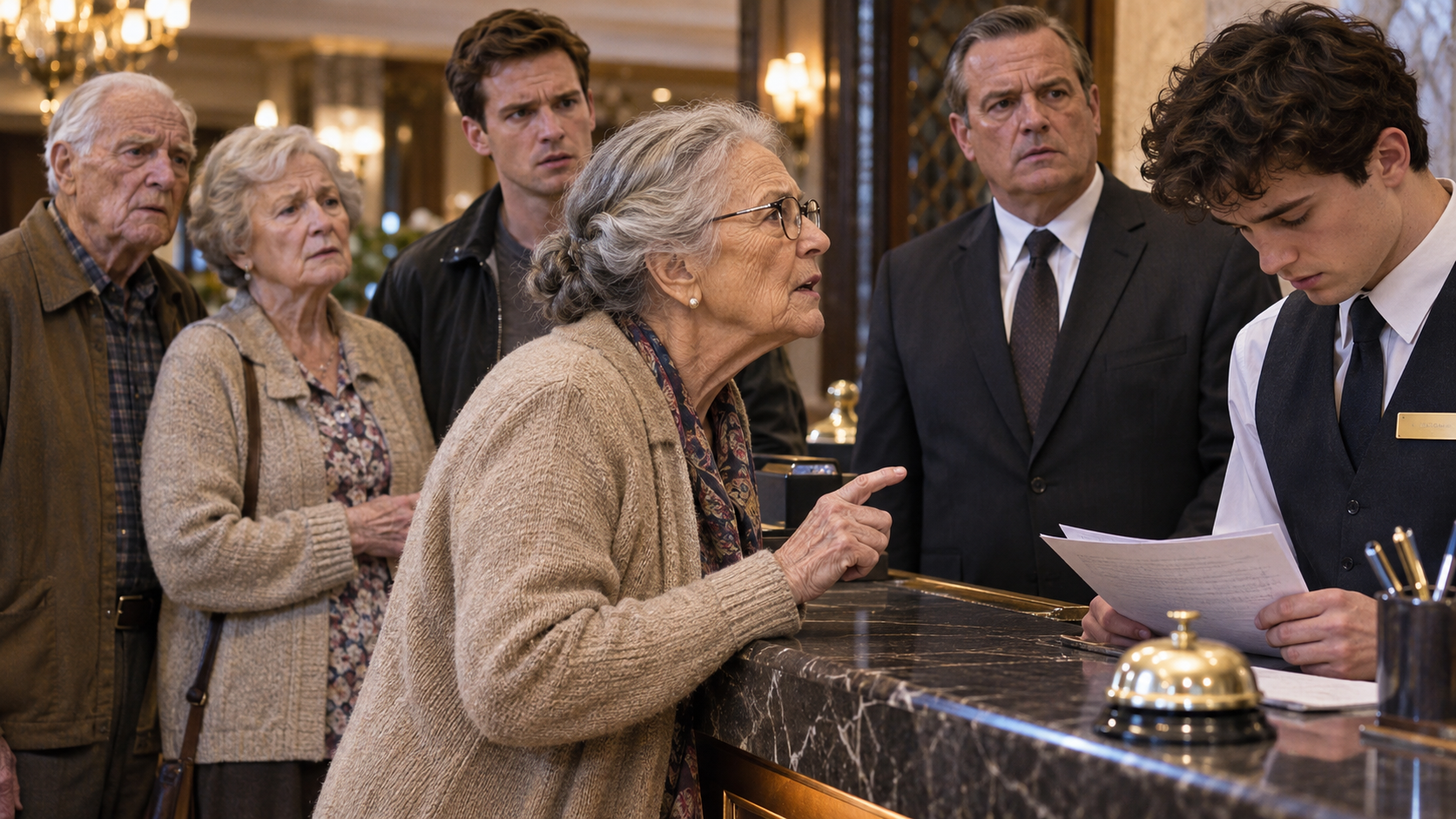
The last clear moment at reception was Evelyn addressing the young clerk.
She had heard the explanation about the better tip.
The manager had become still.
And the clerk had turned his attention toward the papers in front of him.
That was where the account of the conversation stopped.
I couldn't say what name he gave.
I couldn't say whether he answered immediately afterward.
I couldn't say whether the manager finally acknowledged the decision.
And I couldn't say what the hotel did to correct it.
The answers mattered.
Of course they mattered.
But I didn't have them.
I also couldn't explain why the owner recognized my father at the restricted piano.
I knew the recognition was part of the hotel visit.
I knew my father had sat at an instrument guests weren't supposed to use freely.
But the reason for the owner's reaction remained unknown to me.
I could imagine a dozen explanations.
None would be honest to present as fact.
That was frustrating.
Especially after everything that had happened.
I wanted to know whether the room was changed.
I wanted to know whether the clerk faced questions about his conduct.
I wanted to know whether the manager's silence eventually gave way to an explanation.
I wanted to know what the owner remembered about my father.
But those events were not established by what I had heard.
And I couldn't turn unanswered questions into memories simply because a complete ending would feel better.
What I could do was acknowledge what the experience had shown me.
I had been too willing to overlook the reason for my parents' treatment.
I had looked at the ice machine and seen an inconvenience.
I had looked at my parents and worried about embarrassing them.
I had looked at the manager and hoped he would give me an explanation that would make the whole matter seem harmless.
That was my mistake.
I had wanted things to feel normal.
Even when the explanation suggested they weren't.
Another couple had apparently received better consideration because they had tipped more.
My parents had been placed beside the ice machine.
And when Evelyn heard about it, she challenged the reason.
I could not pretend those things were unimportant.
The sound of the machine stayed with me.
The steady mechanical noise.
The sudden fall of ice.
The knowledge that my eighty-year-old parents had been expected to stay beside it while another couple benefited.
Those details were small in themselves.
Together, they represented a decision I could not justify.
I thought about my mother.
About how quickly I had assumed she would prefer to avoid a disagreement.
I thought about my father.
About how I had interpreted his quietness without knowing everything he felt.
And I thought about how often I had called those assumptions consideration.
Sometimes they were.
Sometimes they were just easier for me.
That was difficult to admit.
I had been trying to protect them.
But I had nearly protected everyone else from having to answer an uncomfortable question.
I had worried about the manager's embarrassment.
I had worried about the clerk's discomfort.
I had worried about what other people might think of a family arguing at a hotel reception desk.
I had spent so much energy trying to keep the conversation polite that I had almost forgotten why it had begun.
Two elderly guests had been given a less desirable room.
The explanation involved a better tip from another couple.
That was the issue.
Not whether I could remain agreeable.
Not whether the staff found the discussion pleasant.
Not whether somebody important happened to recognize my father.
I had to separate those things.
The piano remained part of the story.
So did the owner's recognition.
But I didn't want either to become an excuse for suggesting my parents deserved kindness only because there might be something remarkable about their past.
If the owner had never recognized my father, the original decision would still have been unfair.
If my father had never sat at the piano, the room assignment would still have deserved an explanation.
If my parents had been complete strangers to every person in the building, they would still have been entitled to ordinary respect.
That was the part I understood most clearly.
No special history was required.
No impressive connection.
No large tip.
Nothing.
I thought about the young clerk and his stack of papers.
I couldn't say whether he had done anything wrong.
I didn't know his role in the decision.
But I remembered how his attention had shifted when Evelyn asked his name.
And I remembered the manager's reaction when she questioned the explanation.
Those details remained unresolved.
I didn't want to turn them into proof of guilt.
I wanted the people involved to answer the questions themselves.
That was the difference I had struggled to understand.
Accountability wasn't the same as punishment.
An explanation wasn't the same as an excuse.
And being treated fairly wasn't the same as being given special treatment.
My parents had not needed to be the most important guests in the hotel.
They had only needed to be treated as though their comfort counted.
The other couple's generosity should not have erased that.
I wished I could say the hotel recognized its mistake.
I wished I could say the manager apologized.
I wished I could say the clerk explained exactly what had happened.
I wished I could say the owner settled the matter after recognizing my father.
But I could not honestly say any of those things had happened.
They remained possible outcomes.
Not established ones.
The distinction mattered because the entire disagreement had begun with a question of fairness.
It would have been wrong to finish the account by inventing consequences for people whose full actions I didn't know.
Even the manager.
Even the clerk.
I had to be fair about what I could say about them.
That didn't weaken my anger about the room assignment.
It gave the anger somewhere useful to go.
Toward the decision itself.
Toward the need for an explanation.
Toward the principle that hospitality should not depend on who offers the larger tip.
I thought again about Evelyn.
Her question had done something my own hesitation hadn't accomplished.
It had made the explanation impossible for me to ignore.
She had repeated its meaning aloud.
And once she did, I heard how wrong it sounded.
Another couple had tipped better.
So my parents had been treated differently.
The words were simple.
That was what made them difficult to defend.
I wondered whether I would have challenged the situation as firmly if Evelyn hadn't spoken.
I wanted to believe I would.
I wasn't certain.
That uncertainty was another thing I had to carry.
I had loved my parents throughout the entire encounter.
I had wanted their comfort.
I had worried about their feelings.
But love by itself hadn't immediately made me brave enough to insist on an answer.
I had needed to hear somebody else challenge the explanation.
I had needed to see the manager's reaction.
I had needed to notice the clerk retreat into his paperwork.
Only then had I fully stopped treating the situation as a minor inconvenience.
I wasn't proud of how long that had taken.
But I could acknowledge it.
The hotel room remained in my memory.
So did the ice machine.
So did the reception counter.
And the piano.
Especially the piano.
Not because I knew the story behind the owner's recognition.
I didn't.
But because it reminded me that my father was more than the way strangers saw him.
He had lived eighty years before that room assignment.
He had been a person long before anyone at the hotel decided where he should stay.
And no amount of money handed over by another guest could make his comfort unimportant.
The same was true of my mother.
I had been trying to win an argument about a room.
What I came to understand was why the argument mattered.
It wasn't about proving that my parents were special.
It was about refusing the idea that they needed to be special to deserve fair treatment.
That was the only conclusion I could honestly give.
The unanswered questions remained unanswered.
The clerk's response.
The manager's eventual explanation.
The owner's reason for recognizing my father.
The final resolution of the room assignment.
I wouldn't invent any of them.
But I would not forget the moment when Evelyn heard about the better tip and made everyone face what those words meant.
I had wanted a comfortable room for my parents.
I had wanted a simple hotel visit.
I had wanted the matter settled quietly.
Instead, I found myself confronting how easily I had almost accepted unequal treatment because challenging it felt inconvenient.
I couldn't change that first hesitation.
I could only recognize it.
And remember that my parents' dignity had never depended on a room number, a tip, or a person of authority knowing who my father was.
It belonged to them before they entered the hotel.
It belonged to them while the manager stood silent.
And it belonged to them while the young clerk stared down at the papers in front of him.
That much was never in question.
At least, it should never have been.
The End
Read more original stories on Feel Every Story.
I Had Brought My Elderly Parents to a Hotel Where One Small Room Change Told Me How Little Respect They Were Given
Part 8 of 8