The second meeting took place several days later.
This time, the room was more crowded.
Doug was there.
So was the company lawyer.
Two other people had joined them.
One appeared to be responsible for the company's financial records.
The other introduced himself as an adviser.
I recognized neither man.
Jeremy sat beside me again.
The financial representative opened a thick file.
"We have located several historical records connected to the company's original financing."
I listened carefully.
He explained that the records were incomplete.
Some documents had been transferred between offices over the years.
Others had been stored with older company files.
But they had found references to the money provided during the company's early development.
I looked at Doug.
He avoided my eyes.
The representative continued.
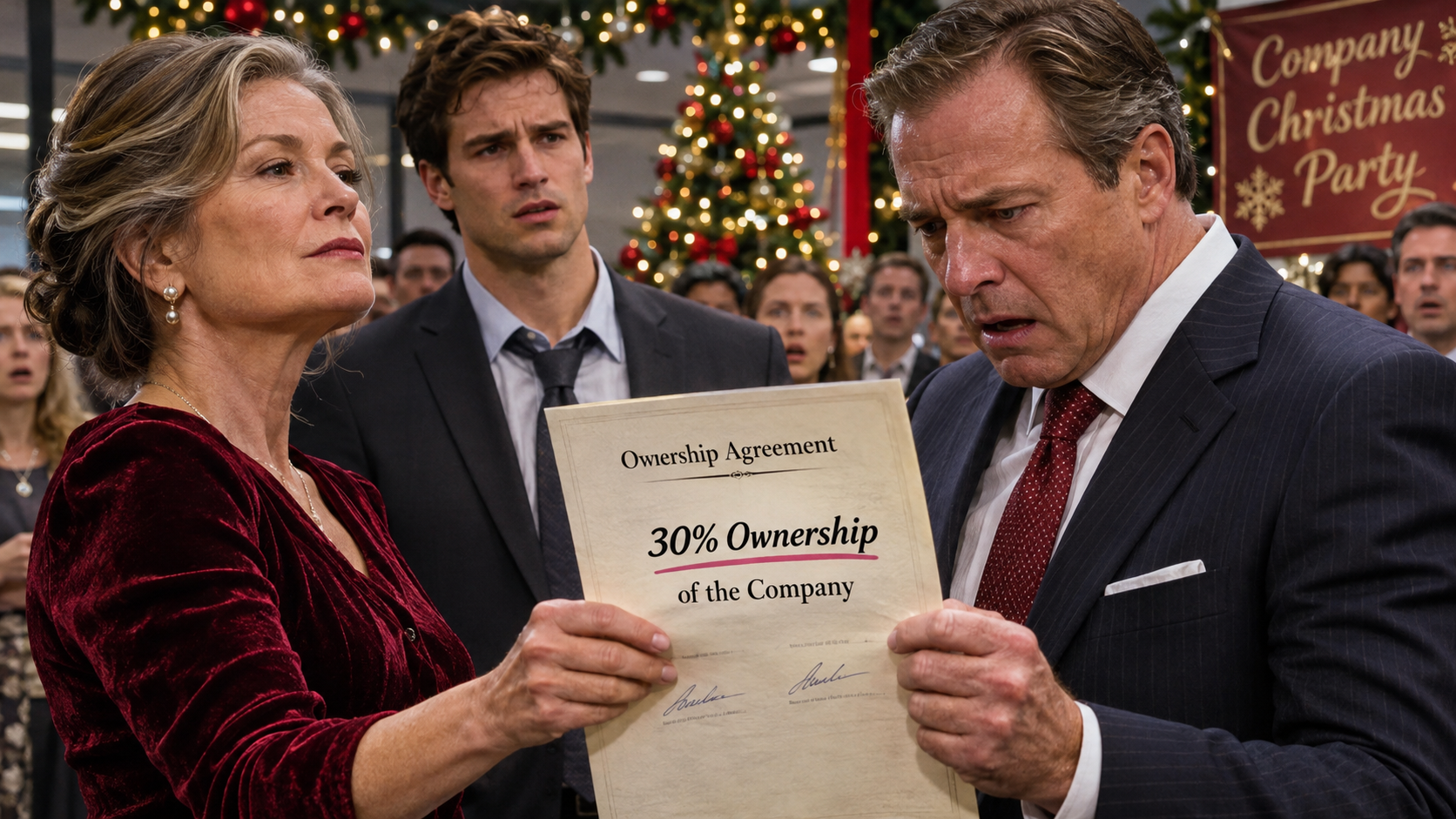
"We're comparing those entries with the agreement you supplied."
I nodded.
"That seems appropriate."
He placed several pages on the table.
I didn't reach for them.
I waited for him to explain.
He pointed to an entry in the old records.
It referred to the initial financing arrangement.
The date was consistent with the agreement I had brought.
I felt my stomach tighten.
I remembered that period clearly.
I remembered how much I had worried about the risk.
I remembered checking my own accounts before agreeing to anything.
And I remembered the conversation with Doug's father.
He had promised that my contribution would be recognized.
Now, years later, his son's company was examining those same records.
The financial representative looked at me.
"Does this match your recollection?"
I nodded.
"Yes."
Doug leaned forward.
"Those records don't establish current ownership by themselves."
The lawyer answered before I could.
"That's why we're examining them together with the signed agreement."
Doug leaned back.
His face was tense.
Jeremy looked at me.
I could tell he was trying to understand how much of this had been kept from him.
The adviser asked whether I had been involved in the company's operations after the initial financing.
I explained that I hadn't managed the business.
I hadn't attended regular meetings.
And I hadn't tried to control daily decisions.
I had trusted the people running it.
The adviser wrote something down.
"Did you receive any formal ownership reports over the years?"
I shook my head.
"No."
Doug looked up.
"That is important."
I turned toward him.
"Important for whom?"
He didn't answer.
I continued.
"I wasn't receiving reports because nobody was sending them. That doesn't mean I agreed to surrender my ownership."
The lawyer nodded slightly.
The meeting continued.
They discussed the original agreement.
They discussed the company records.
They discussed the possibility that the ownership arrangement had never been properly reflected in later documentation.
I listened.
I didn't interrupt unless something needed clarification.
I had learned that anger could make people careless.
And I didn't intend to be careless with something I had protected for so long.
At one point, Doug asked for a break.
The lawyer agreed.
We stepped into the hallway.
Jeremy stood beside the window.
"Mom, this is getting bigger than I thought."
"I know."
"Do you think they could say the agreement doesn't count?"
I looked at him.
"That's a question for the legal review."
He nodded.
Then he said something that surprised me.
"I don't care about the money as much as I thought I would."
I studied his face.
"What do you care about?"
He looked back toward the conference room.
"I want them to admit what happened."
I understood.
He wanted his work to mean something.
He wanted his dismissal to be treated fairly.
And he wanted the company to acknowledge that its success hadn't come from one family alone.
When we returned, the lawyer said the review was continuing.
She asked whether I would consider a formal discussion about recognizing the ownership arrangement.
I agreed.
Doug looked unhappy.
But he didn't object.
Before we left, I gathered my papers.
The lawyer thanked me for bringing the original agreement.
I placed it back inside the leather folder.
The adviser watched me.
"Those documents have been kept in very good condition."
I gave a small smile.
"I never thought I would need them again."
He nodded.
"Sometimes old records become important."
I looked at him.
"Sometimes they were important all along."
That evening, Jeremy came to my house.
He had received another message from a former colleague.
The colleague had asked what happened at the Christmas party.
Jeremy didn't know what to say.
He showed me the message.
I told him he didn't need to explain anything he wasn't comfortable discussing.
He put his phone away.
Then he looked at me.
"Do you regret helping them?"
I thought about it for a long time.
"No."
He seemed surprised.
"Even now?"
I nodded.
"I don't regret helping your father's company get started. I regret that the people who came after him forgot what that help meant."
Jeremy lowered his head.
I reached across the table and touched his hand.
"Don't let their choices change the kind of person you are."
He nodded.
For the first time since the party, he looked a little more at peace.
Click here to continue reading: PART 8: When the Company Finally Prepared Its Formal Review, Doug Realized the Christmas Party Had Changed More Than One Person’s Future
My Son Thought Losing His Job Was the Worst Thing That Could Happen That Night, Until I Asked One Question
Part 7 of 10