
The doctor's office smelled exactly as I remembered.
Disinfectant.
Paper.
And coffee that had been sitting too long.
I was sixty-five years old, but sitting in that waiting room made me feel twenty-three again.
I hated that.
Samuel came with me.
He offered to wait outside.
I told him to stay.
There was no reason I should sit alone while somebody explained those old records.
Not anymore.
The doctor was a woman named Dr. Reynolds.
She was younger than I expected.
She wore glasses and had a calm way of speaking.
She looked through the papers carefully.
Then she asked whether I understood what the original tests had been intended to determine.
I nodded.
"Whether I could have children."
She looked at me.
"That was part of it."
I folded my hands.
I had spent decades thinking I understood.
Now I wanted the truth.
She explained that the records were old.
The medical methods used in the early 1980s were not the same as those available today.
And the paperwork contained an important problem.
One finding had been assigned to the wrong patient.
She showed me the notation.
Garland's name.
A corrected entry.
A date.
The doctor explained that the records did not establish that I had been unable to become pregnant.
I stared at her.
For a moment, I couldn't answer.
She continued.
That didn't mean she could prove I would have conceived.
Too much time had passed.
The information was incomplete.
And no doctor could tell me what might have happened in a life I hadn't lived.
I understood.
I hadn't come for a promise.
I had come because I wanted somebody to tell me whether the certainty Garland used against me had been justified.
It hadn't.
I looked at Samuel.
His eyes were wet.
I turned back to the doctor.
"So he shouldn't have told me it was definitely my fault?"
She shook her head.
"These records don't support that conclusion."
I let out a breath.
It felt as though I had been holding it since 1984.
I looked down at my hands.
I remembered the kitchen.
The duffel bag.
Garland's pickup.
The morning he told me our marriage could never become the family he wanted.
For forty-two years, I had believed the problem was something inside me.
Now a doctor was telling me that belief had never been established.
I wanted to be angry.
Part of me was.
But mostly, I felt tired.
Tired for the young woman who had accepted blame without understanding the evidence.
Tired for the years she spent ashamed.
Tired for every time somebody suggested she was less of a woman because she hadn't given birth.
I looked toward the window.
The parking lot was full of ordinary cars.
People were coming and going.
The world hadn't changed.
Only my understanding of what happened.
The doctor asked whether I had more questions.
I shook my head.
Then I changed my mind.
I asked whether it was foolish to still care about something that happened so long ago.
She looked at me.
"Not at all."
That was all she said.
And it was enough.
Samuel helped me gather the papers.
We thanked the doctor.
Then we walked outside.
I stood beside the car for a moment.
The sunlight felt warm against my face.
Samuel waited.
He knew I needed a little time.
Finally, he asked how I felt.
I thought about it.
"Older than I did when we went inside."
He smiled.
Then I shook my head.
"No. That's not right."
I looked at him.
"I think I feel lighter."
He hugged me.
I held on.
For forty-one years, Samuel had been my son.
He didn't need a medical report to make that true.
And I didn't need a pregnancy to prove I had become a mother.
But knowing Garland had blamed me without justification mattered.
It gave a name to something I had carried for decades.
An unfairness.
A lie.
A burden that should never have been mine.
We drove home.
Samuel wanted to stop for lunch.
I told him I had leftovers.
He laughed.
"Of course you do."
We stopped anyway.
I ordered chicken salad.
He ordered a hamburger.
We talked about ordinary things.
His work.
His family.
The school year.
The tomatoes in my garden.
I liked that.
I was tired of every conversation becoming an examination of the past.
I wanted to return to the life I had worked so hard to build.
When we got home, I placed the medical papers in a folder.
I labeled it with the year.
Then I put it in the cabinet with my other important documents.
Not hidden.
Not forgotten.
Just filed away where it belonged.
That evening, Ernestine came over.
She brought cornbread.
I told her I already had food.
She ignored me.
We sat at the kitchen table.
I explained what the doctor had said.
Ernestine listened without interrupting.
When I finished, she reached across and squeezed my hand.
"You should've been told the truth back then."
I nodded.
"I know."
She looked toward the hallway.
"Would it have changed anything?"
I thought about that.
Perhaps it would have changed how I felt about myself.
Perhaps I would have argued harder when Garland left.
Perhaps I would have found the courage to begin again sooner.
But I couldn't know.
And I wasn't willing to pretend the life I built afterward was some lesser version of the one I had imagined.
I looked at Ernestine.
"It would have changed what I believed about myself."
She nodded.
"That's enough."
We sat quietly.
Then she asked whether Garland had called again.
I shook my head.
I hadn't heard from him since our conversation about Evelyn.
And that was fine.
I didn't need to speak with him every day.
I didn't need updates about Bonnie.
I didn't need to become involved in every difficult conversation between him and his sons.
They had their own family matters to settle.
I had mine.
A few days later, Curtis called.
I recognized his voice immediately.
He asked whether I had a moment.
I told him I did.
He said he had spoken with Garland.
Not once.
Several times.
The conversations had been difficult.
His father had apologized.
He had admitted that hiding the truth about Curtis's birth had been wrong.
He had also admitted that he used his sons as proof that leaving me had been the right decision.
I closed my eyes.
That was painful to hear.
Not because I needed Garland's approval.
Because Curtis had been treated as evidence in an argument he never knew existed.
I asked how he was doing.
Curtis said he was trying.
He had begun speaking with a counselor.
He wanted to understand his feelings before deciding whether to search for information about his biological father.
I told him that sounded sensible.
He said Michael was still considering testing.
Thomas wasn't ready.
Bonnie had finally agreed to answer their questions privately.
I was glad.
Whatever happened next, those men deserved honest answers.
Curtis told me he had also spoken with Samuel.
They planned to meet for coffee.
I smiled.
"That sounds nice."
He hesitated.
Then he thanked me for letting him visit.
I told him he was welcome.
He was quiet for a moment.
Then he said something I hadn't expected.
He told me he had spent most of his life believing the story about Garland's first marriage.
He had imagined me as a bitter woman living alone somewhere.
A woman who had never moved beyond being abandoned.
I listened.
He sounded embarrassed.
I told him I understood.
People often accepted the stories they were given as children.
Especially when those stories came from their parents.
Curtis continued.
He said walking into my kitchen changed that.
He had seen photographs on the walls.
Children.
Graduations.
Weddings.
Grandchildren.
He had seen the measurements beside the doorway.
He had watched Samuel move around the house as though he belonged in every room.
And he had realized he had been wrong about me.
I smiled sadly.
"Well, now you know."
He laughed.
"Yes, ma'am."
Before ending the call, he asked whether he could visit again.
I said yes.
But I warned him that next time he had to bring his wife.
And perhaps that grandson he kept talking about.
He promised he would.
After hanging up, I sat quietly.
I thought about Bonnie.
For a long time, I had imagined what I might say if she ever apologized.
I had imagined telling her exactly how cruel her invitation had been.
How much it hurt to be reminded of a marriage that ended decades earlier.
How angry I was that she knew something about Garland's medical records and still used my supposed childlessness against me.
But when she finally called, I found myself less interested in rehearsed speeches.
The call came on a Thursday afternoon.
I was peeling potatoes.
The landline rang.
I answered with the peeler still in my hand.
Bonnie introduced herself.
I told her I knew who she was.
She was quiet.
Then she apologized.
Not gracefully.
Not with the kind of words people practice for important occasions.
She stumbled.
She corrected herself.
She admitted she had written the message on the invitation.
She said she wanted me to feel uncomfortable.
She believed I would arrive alone.
She expected my presence to remind Garland how fortunate he was to have married her.
I listened.
There it was.
The truth behind those curling letters.
She hadn't wanted to celebrate.
She wanted to win.
I looked down at the potato in my hand.
It seemed ridiculous now.
Two women in their sixties.
One standing in a kitchen.
The other calling from somewhere in Tupelo.
Discussing a contest that should never have existed.
I asked Bonnie why she thought I still wanted Garland.
She was quiet.
Then she admitted she wasn't certain I did.
She had been afraid.
Afraid of how Garland talked about me.
Afraid of what he remembered.
Afraid that the life he left behind might mean more to him than he admitted.
I thought about that.
For forty-two years, I had assumed Garland forgot me.
Perhaps Bonnie had spent those same years worrying he hadn't.
Neither of us had been given peace by his silence.
I told her something simple.
"I don't want your husband."
She exhaled.
I continued.
"I haven't wanted him for a very long time."
She began crying.
I didn't know whether she believed me.
That was her business.
I told her the message had been cruel.
And the medical secret was worse.
She admitted both.
Then she apologized again.
I thanked her for saying it.
But I didn't invite her over.
I didn't promise friendship.
I didn't pretend the past had become pleasant.
Some relationships didn't need to begin.
Some things only needed to end.
When the call was finished, I returned to my potatoes.
The water was already boiling.
I added salt.
Then I stood for a moment, looking out the kitchen window.
I realized something.
Bonnie had spent years measuring herself against me.
Garland had spent years defending the choice he made.
And I had spent years believing something was wrong with me.
All three of us had allowed an old decision to take up too much space.
But only one of us had built a life that no longer depended on that decision.
I thought about the invitation.
The gold paper.
The large seventy-five.
The sentence written at the bottom.
I had kept it.
Not because I wanted to remember Bonnie's cruelty.
Because I wanted to remember what happened when I answered.
I had written twelve in the little space.
And twelve people had walked into that hall.
I smiled.
Two weeks later, my family gathered at my house.
Nothing special.
Just a Sunday dinner.
Samuel brought his wife.
Lorraine came with Emma.
Marcus and Denise arrived carrying food.
Patricia brought dessert.
Raymond came early to help with the tables.
Other relatives arrived throughout the afternoon.
And Ernestine showed up with enough sweet tea to fill a bathtub.
I watched them coming through the front door.
One after another.
The house filled with noise.
Shoes near the entrance.
Coats on chairs.
Children arguing about who got to sit beside Grandma.
Somebody wanted extra ice.
Somebody couldn't find a spoon.
And somebody was asking whether the biscuits were ready.
I stood in the kitchen and listened.
Forty-two years earlier, I had believed silence would be my future.
An empty house.
An unused nursery.
A table set for one.
But there I was.
Surrounded.
Not by the family Garland thought I should have.
By the family life had given me the chance to love.
Curtis arrived that afternoon too.
He brought Linda and their little grandson.
He looked nervous when I opened the door.
I smiled.
"Come on inside."
His grandson held a toy car.
Red.
I noticed it immediately.
For a moment, I remembered Samuel's old photograph.
The little boy with the truck.
The promise Garland hadn't kept.
Then Curtis's grandson held up his toy.
He wanted to show me the wheels.
I crouched carefully.
"That's a fine car."
He smiled.
Then he ran toward the other children.
Curtis watched him go.
He looked at me.
"Thank you for inviting us."
I nodded.
"There's plenty to eat."
He laughed.
Samuel appeared beside him.
The two men greeted each other warmly.
I watched them walk toward the dining room.
There was something comforting about that.
Nobody had come to replace anybody.
Nobody needed to prove they belonged.
They were simply people learning how to know one another.
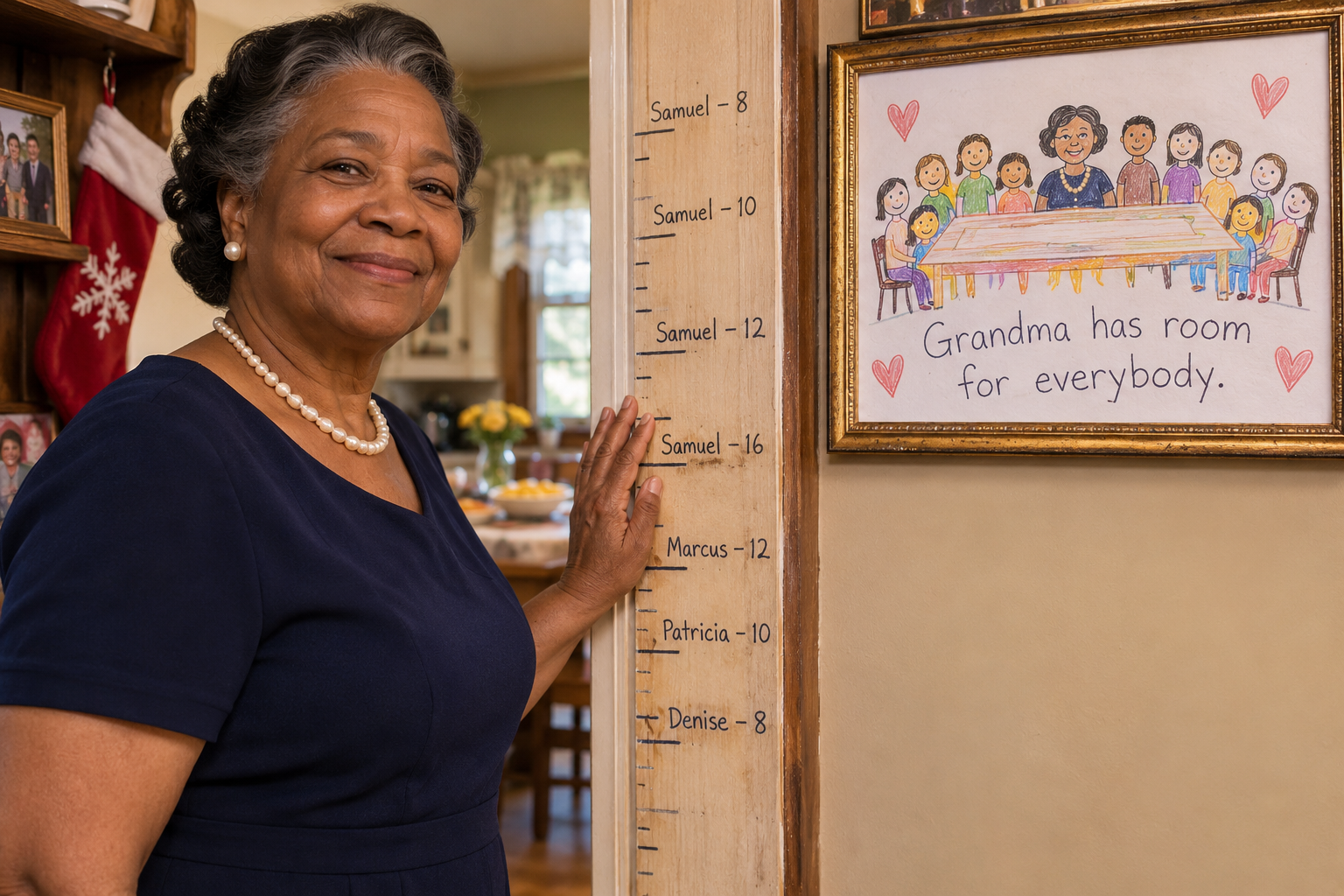
Later, after supper, Emma brought me her drawing.
The one Lorraine had told me about.
A large table.
People seated all around it.
And a woman in a navy dress wearing white pearls.
I looked at the picture.
Emma stood beside me.
"Do you like it, Grandma?"
I smiled.
"I love it."
She pointed toward the middle.
"That's you."
"I figured."
She showed me each person.
She had drawn Samuel.
Lorraine.
Marcus.
Patricia.
Raymond.
And several others.
There were people she hadn't finished drawing.
She said the paper was too small.
I laughed.
"That's a good problem."
Emma nodded seriously.
Then she asked whether we could hang it up.
I took it into the hallway.
Beside the old height measurements was a small empty space.
I found a frame.
Samuel helped me hang it.
We stood back.
I looked at the drawing.
Then at the names and dates running up the doorway.
Two kinds of records.
One showing how children grew.
The other showing how a family could grow beyond what anybody expected.
That evening, after everybody left, I cleaned the kitchen.
There were crumbs on the table.
Napkins on the floor.
A forgotten sweater hanging over a chair.
I washed the dishes.
Then I sat beside the landline.
The house was quiet again.
But it wasn't the silence I had feared when I was young.
It was the quiet that came after a good day.
A full day.
I opened the drawer and removed Garland's invitation.
The gold paper had bent slightly.
I read the message at the bottom one last time.
For a moment, I imagined the woman I had been at twenty-three.
Standing in that small kitchen.
Watching her husband's pickup disappear.
Believing she had failed at becoming the one thing she wanted most.
I wished I could sit beside her.
I wished I could take her hand.
I wished I could tell her that Garland's words weren't the final judgment on her life.
That one day, a little boy would climb onto her school bus carrying everything he owned.
That he would call her Mama.
That other children would follow.
That her house would fill with schoolbooks, birthdays, arguments, weddings, and grandchildren.
And that one afternoon, when a cruel invitation arrived, she would have eleven people ready to stand behind her.
I folded the card.
I didn't throw it away.
I placed it in the box with the Christmas stockings.
Not because Garland belonged there.
He didn't.
But because that invitation had become part of our family's history.
The day somebody tried to remind me of what I supposedly lacked.
And my children reminded me of everything I had.
The telephone rang.
I smiled before answering.
Sunday evening.
Samuel.
"Hi, Mama."
"Hello, baby."
He asked whether I had rested after everyone left.
I told him I was sitting down.
He didn't believe me.
I laughed.
Then he said Emma wanted to visit again next weekend.
She wanted to help me pick tomatoes.
I looked toward the garden.
A few ripe ones were waiting.
"Tell her I'll save some."
Samuel promised he would.
Then he grew quiet.
"Mom?"
"Yes?"
"I'm glad that county lady called you."
I closed my eyes.
I remembered the spring afternoon.
The oversized coat.
The grocery sack.
The frightened little boy who hadn't known whether he was welcome.
I thought about everything that followed.
Forty-one years.
A lifetime.
I held the receiver more tightly.
"So am I, sweetheart."
We talked for a few more minutes.
Then he told me he loved me.
I told him I loved him too.
After we hung up, I left the telephone where it had always been.
I walked to the hallway.
I looked at the Christmas stockings.
Then at Emma's drawing.
And finally at the doorway where my children's names climbed toward the ceiling.
Garland had left because he believed I couldn't give him a family.
He had been wrong about the medical evidence.
Wrong about what made a mother.
And wrong about what kind of life I would have without him.
I no longer needed him to admit any of that.
He had his sons.
They had difficult truths to work through.
Bonnie had her own mistakes to face.
And I had my family.
Not perfect.
Not always easy.
But real in every way that mattered.
I turned off the hallway light.
Then I went to bed.
The next morning, there would be tomatoes to pick.
A sweater to return.
And a little girl waiting to come help her grandmother in the garden.
That was enough.
More than enough.
The End
Read more original stories on Feel Every Story.
My Ex-Husband Invited Me to His Birthday to Show Off the Family He Said I Could Never Have
Part 10 of 10


One Comment on “PART 10 – Forty-Two Years After Garland Left Me for a Real Family, I Finally Understood What His Birthday Invitation Had Given Me”