
Curtis arrived at my house carrying a small bakery box.
I had expected questions.
I had expected anger.
I had even prepared myself for him to blame me for what happened at his father's birthday party.
I hadn't expected him to bring cake.
He stood on my porch wearing a blue shirt and holding the box with both hands.
Samuel was beside him.
Neither man looked particularly comfortable.
I opened the screen door.
"Well, come inside before the mosquitoes carry you away."
Samuel smiled.
Curtis looked relieved.
I stepped aside.
The kitchen smelled of chicken simmering on the stove.
I had made enough food for six people.
There were only three of us.
Old habits.
Whenever somebody was coming, I cooked as though the entire church might arrive.
Curtis looked around.
His eyes stopped on the beige telephone beside the refrigerator.
"Samuel told me about that phone."
I smiled.
"He thinks I ought to get rid of it."
Samuel raised his hands.
"I've stopped arguing."
"Good. You're finally learning."
Curtis laughed.
It was a small sound.
But it helped.
He placed the bakery box on the table.
"I wasn't sure what to bring."
"You didn't need anything."
"I know."
He looked down.
"I just didn't want to show up empty-handed."
I understood that feeling.
Sometimes people carried a gift because they didn't know what to do with their hands.
I had bought chewing gum for exactly the same reason on the drive to Tupelo.
I opened the box.
Lemon pound cake.
I looked at Curtis.
"Well, you chose correctly."
He smiled again.
Samuel pulled out a chair.
Curtis sat carefully, as though he wasn't certain how long he would be welcome.
I recognized that too.
Children who arrived at my house often sat the same way.
Perched near the edge.
Ready to move.
Ready to apologize for taking up space.
It bothered me to see it in a grown man.
I poured three glasses of sweet tea.
Then I sat across from him.
For a few minutes, we discussed ordinary things.
His drive.
The weather.
The road construction outside Grenada.
Curtis told me he worked in equipment sales.
He had a wife named Linda.
Two grown daughters.
One grandson.
He spoke about them with a softness that reminded me of Samuel.
I asked how old his grandson was.
"Four."
"That's a good age."
"He thinks he runs the family."
"He probably does."
Curtis laughed.
Then the laughter faded.
He looked toward Samuel.
My son nodded.
Curtis folded his hands.
"Mrs. Bennett, I wanted to apologize for what happened at Dad's party."
I set down my glass.
"You didn't write that invitation."
"No, ma'am."
"You didn't tell me I couldn't have a family."
"No."
"Then you don't owe me an apology for those things."
He looked at me.
"I still feel terrible about it."
I nodded.
"That part I understand."
He rubbed his palms together.
Then he said he hadn't slept properly since the party.
His mother had called repeatedly.
His father had tried to explain.
Michael wanted medical testing.
Thomas refused to discuss any of it.
Curtis felt caught between everybody.
I listened.
He said he loved Garland.
That hadn't changed.
But he couldn't understand why Garland and Bonnie had hidden the truth about his birth.
For fifty years, he believed one thing.
Then, in a crowded VFW hall, he learned something else.
He looked at me.
"How do you get past that?"
I considered my answer.
I had spent forty-two years trying to get past what his father did.
Some days, I had succeeded.
Other days, an old memory still found me.
I didn't want to give Curtis some pretty sentence that would make his pain sound simple.
"You don't have to settle everything this week."
He stared at me.
I continued.
"You can love your daddy and still be angry with him."
He looked down.
"You really think so?"
"Of course."
I thought about Samuel when he was sixteen.
He had been furious with me over a punishment.
He told me he wished he'd never come to live in my house.
Those words hurt.
But I knew anger didn't always tell the whole truth.
Sometimes it came from fear.
Sometimes from disappointment.
And sometimes from loving somebody who had let you down.
Curtis looked toward Samuel.
"Your mama ever keep anything from you?"
Samuel smiled faintly.
"She didn't tell me everything about Garland."
I lowered my eyes.
There it was.
The truth.
I had kept an old letter hidden.
I had done it because I didn't want my children carrying my shame.
But silence could have consequences even when a person meant well.
I looked at Curtis.
"Yes. I've kept things to myself."
He seemed surprised.
I explained that I hadn't told Samuel everything about the letter Garland wrote in 1985.
I had put the pages away.
I thought the matter belonged in my past.
But the past had found us anyway.
Curtis nodded slowly.
"Did he forgive you?"
I looked toward Samuel.
He answered before I could.
"I understood why she did it."
Curtis studied him.
"That's different from forgiving."
Samuel thought about that.
Then he nodded.
"You're right."
He looked at me.
"I wish she'd told me sooner. But I know she wasn't trying to hurt me."
I felt something loosen in my chest.
I hadn't realized I needed him to say that.
Curtis leaned back.
He stared at the ceiling.
"That's what I can't figure out about my parents."
I waited.
He said he believed Garland had loved him.
He remembered learning to ride a bicycle.
Fishing trips.
Baseball games.
His father waiting at the hospital when his first daughter was born.
Those memories were real.
Curtis knew that.
But he also remembered the way Garland spoke about carrying on the family name.
About having sons.
About being a real father.
He shook his head.
"How could he say those things when he knew?"
I looked toward the window.
My tomato plants were visible beyond the glass.
A few needed tying before the next storm.
I thought about how much trouble people caused when they believed love needed proof.
Garland had spent years measuring family by blood.
Yet one of his own sons had been loved and raised without that connection.
I looked back at Curtis.
"Maybe he was trying to convince himself."
Curtis frowned.
"Of what?"
"That the life he chose made him the man he wanted to be."
I couldn't know whether that was true.
But I knew Garland had been ashamed of something.
He had admitted as much.
And shame could make people behave foolishly.
Sometimes cruelly.
Curtis stared at his hands.
Then he asked the question I had been waiting for.
"Do you think he's really my father?"
I took a breath.
I knew he wasn't asking about biology.
Not entirely.
He was asking whether the years counted.
Whether the birthdays counted.
Whether his father's pride had been genuine.
Whether the man who taught him to drive had meant it when he called him son.
I reached across the table.
"Curtis, who came when you were sick?"
"Dad."
"Who taught you to drive?"
"Dad."
"Who walked beside you at your wedding?"
"Dad."
He nodded.
I held his gaze.
"Those things happened. Nobody can take them away."
His eyes filled.
"But he lied."
"Yes."
I didn't soften it.
"He did."
Curtis wiped his face.
I continued.
"And he owes you the truth."
For a moment, I thought he might begin crying.
Instead, he asked whether I believed he should take a DNA test.
I told him that was his decision.
Not Garland's.
Not Bonnie's.
Not mine.
If he wanted to know more about his biological father, he had every right to ask questions.
If he wasn't ready, he could take his time.
Nothing needed to be settled that afternoon.
Samuel nodded.
Curtis looked relieved.
He told us Michael had been pushing everyone to get tested immediately.
Thomas wanted no part of it.
And Bonnie was terrified.
I asked whether Curtis had spoken with her privately.
He shook his head.
Every conversation ended in an argument.
I thought about Bonnie standing near the birthday cake in her sequined dress.
I remembered the handwritten insult.
I still disliked what she had done.
But I also remembered the frightened woman who admitted knowing more than she had told her sons.
She had spent decades guarding a secret.
Now it was out.
And there was no simple way to put it back.
Curtis looked at me.
"Do you hate my mother?"
I was surprised.
I considered lying.
Then I shook my head.
"No."
He seemed relieved.
I continued.
"I don't like what she did."
I glanced at Samuel.
"And I won't pretend it was harmless."
Curtis nodded.
"But hate takes more of my time than I'm willing to give her."
He looked toward the telephone.
Then he smiled sadly.
"Samuel said you were practical."
"Your brother there exaggerates."
Samuel raised an eyebrow.
"Brother?"
Curtis looked embarrassed.
He hadn't intended to use that word.
I noticed the color rising in his cheeks.
He looked from Samuel to me.
"I didn't mean to presume anything."
Samuel considered him.
Then he smiled.
"After the last few days, I think we're allowed to be confused about who's related to whom."
Curtis laughed.
This time, it sounded genuine.
I laughed too.
For the first time since Garland's party, I felt the tension around that family begin to loosen.
Not disappear.
Just loosen.
We ate chicken.
Curtis had two helpings.
He tried to help with the dishes.
I told him guests didn't wash dishes in my house.
Samuel laughed.
He reminded me that I had made him wash dishes before he could properly reach the sink.
I pointed toward him.
"You weren't a guest."
Curtis watched us.
Something changed in his expression.
He looked toward the empty chairs around my table.
Then he asked how many children had lived with me over the years.
I told him eight.
Some stayed briefly.
Others stayed until they were grown.
A few came and went as their circumstances changed.
Every one had left something of themselves in that house.
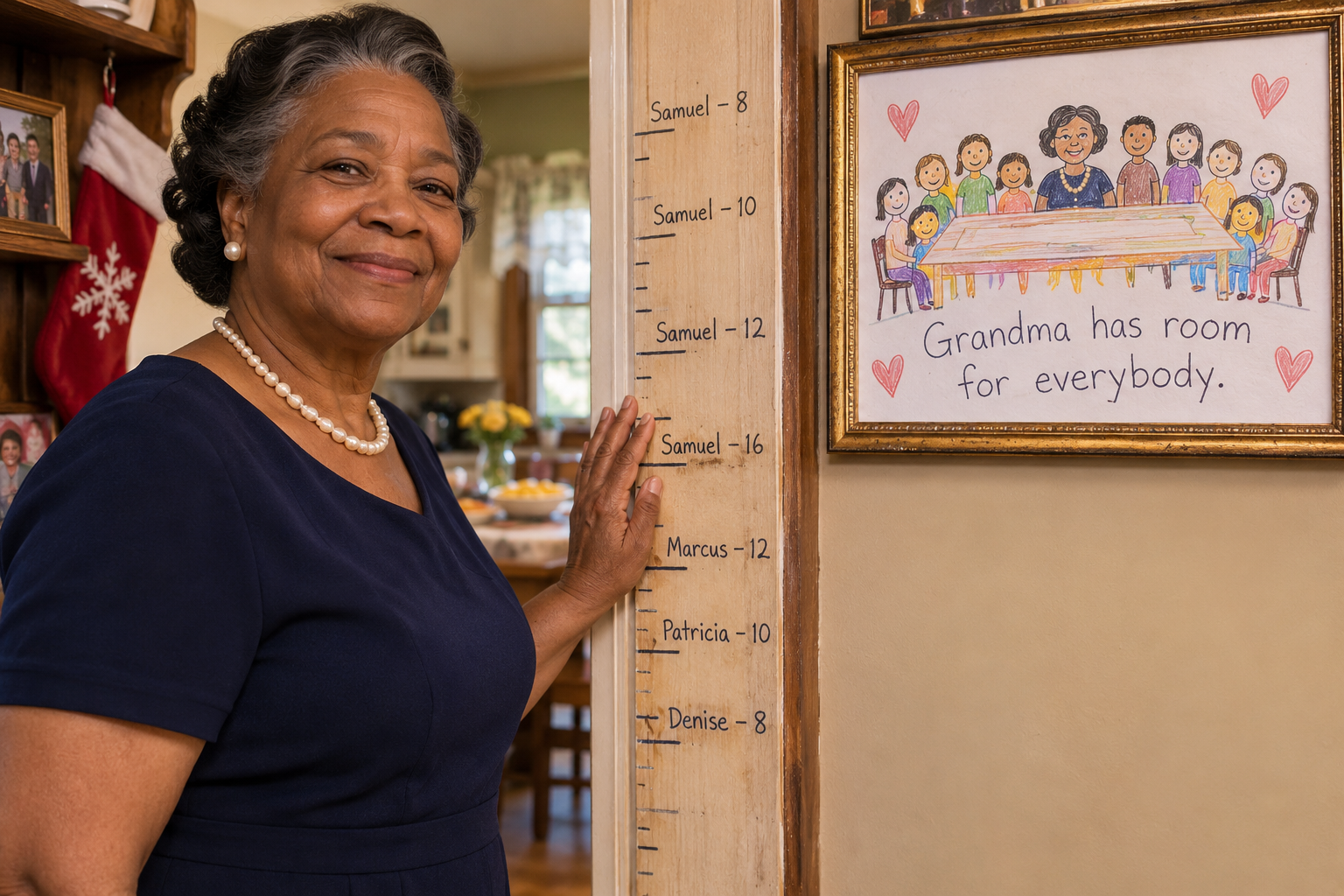
Samuel showed him the marks on the kitchen doorway.
Height measurements.
Names.
Dates.
I had started keeping them when Samuel was small.
Over the years, the marks climbed higher.
Sometimes a name appeared only once.
Sometimes it appeared every year until it reached the top of the frame.
Curtis ran his finger beside one of Samuel's measurements.
"You kept all of these?"
"Of course."
"Even the ones who weren't here long?"
I nodded.
"They were here."
He looked at me.
I could see the question forming before he asked it.
"Did you ever wish you'd had children of your own?"
The room became quiet.
Samuel stopped smiling.
He had heard similar questions before.
But this one felt different.
I thought about the medical report.
About the years I believed I couldn't become pregnant.
About the life I might have had.
And the life I did have.
I answered carefully.
"When I was young, I wanted to give birth to a baby."
Curtis nodded.
"I never stopped wondering what that would have felt like."
I looked toward Samuel.
"But I never considered these children anything less than mine."
My son lowered his eyes.
Curtis stared at the measurements.
He touched the lowest mark.
Samuel's name.
Age eight.
Then he said something so quietly I almost missed it.
"I think I understand why Dad was afraid of you."
I frowned.
"Afraid of me?"
Curtis nodded.
He said Garland spent years telling himself that leaving me had been necessary.
That he had gone on to build the family he wanted.
That I had remained behind.
Curtis looked around my kitchen.
"Then you walked into his birthday party with twelve people."
I smiled sadly.
He continued.
"And suddenly he had to look at the life he told himself you couldn't have."
I didn't answer.
I had never considered it quite that way.
Curtis looked toward Samuel.
"He spent his whole life acting like family was something he could prove."
He touched the old measurements again.
"But you just made one."
I felt my eyes fill.
I turned away.
I didn't want to cry in front of these two grown men.
But Samuel noticed.
He always did.
He stepped toward me.
I waved him away.
"I'm fine."
He smiled.
"You say that every time you're about to cry."
I laughed.
Then I cried.
Curtis looked embarrassed.
I reached for his hand.
"Don't worry. People cry in this kitchen all the time."
He smiled.
Then he asked whether he could tell me something else.
I nodded.
He said he had spoken with Garland the previous evening.
His father was ashamed of what happened at the party.
He wanted to make things right.
But he didn't know how.
I listened.
Curtis said Garland had finally admitted that he had spent years comparing his life with mine.
Not openly.
Not in front of Bonnie.
But whenever he heard something about me.
A child graduating.
A wedding.
A grandchild.
Another gathering at my house.
He learned things through people in Mississippi who knew us both.
I stared at Curtis.
I hadn't known Garland followed my life.
I hadn't cared enough to follow his.
Curtis said his father had been particularly affected when he learned Samuel became a principal.
He remembered the little boy in the striped shirt.
The child with the red truck.
The one he had failed to help himself.
I looked toward Samuel.
My son stood very still.
Curtis continued.
Garland knew Samuel had grown into a good man.
He knew I had raised him.
And he knew he had remained silent for decades.
I thought about Garland holding that photograph at the VFW hall.
The worn edges.
The date.
The guilt on his face.
For years, he had kept proof of a child he had not raised.
I had kept Christmas stockings.
We had carried very different reminders of our past.
Curtis looked toward the door.
Then he asked whether I thought his father deserved another chance.
I knew he wasn't asking me to decide whether Garland should be welcomed back into my life.
He wanted permission to continue loving his father.
Even after everything.
I squeezed his hand.
"Curtis, you don't need my permission."
He nodded slowly.
"You can be angry and still love him."
He wiped his eyes.
I continued.
"And you can forgive somebody without pretending they never hurt you."
He looked at me for a long moment.
Then he stood.
I thought he was preparing to leave.
Instead, he walked around the table.
He stopped beside my chair.
"Mrs. Bennett, may I hug you?"
I stood.
"Of course, baby."
The word escaped before I thought about it.
Baby.
I had called frightened children that for most of my adult life.
Curtis bent and wrapped his arms around me.
He held on longer than I expected.
I felt his shoulders shake.
And for one brief moment, I understood why he had come.
He hadn't been looking for another mother.
He had been looking for somebody who could tell him that being loved didn't depend on a secret medical fact.
I held him until he was ready to let go.
When he stepped back, his eyes were red.
He apologized.
I told him not to.
Then I packed leftover chicken into two containers.
One for him.
One for Samuel.
Curtis laughed.
"You don't let anybody leave empty-handed, do you?"
"No."
I handed him the food.
"Especially not men who look like they haven't been eating properly."
He thanked me.
At the door, he turned around.
He said he wanted to speak with Garland again.
Not to excuse what happened.
But to ask him to tell the whole truth.
I nodded.
"That's a good place to begin."
Curtis promised to call.
Then he left.
Samuel remained behind.
We stood on the porch and watched Curtis drive away.
The afternoon sun was warm.
A breeze moved through the tomato plants.
Samuel leaned against the railing.
"Mom, you helped him."
I shook my head.
"I listened."
He smiled.
"Sometimes that's the same thing."
I looked toward the road.
A pickup passed.
For one moment, I remembered Garland's truck disappearing in 1984.
Then I looked at Samuel.
At the house behind us.
At the kitchen where Curtis had just eaten supper.
I realized I had spent the entire afternoon talking about family without once wondering whether I was enough.
That was new.
Samuel kissed my cheek.
Then he gathered his leftovers and left.
I went back inside.
The kitchen was quiet.
Three glasses stood beside the sink.
The lemon pound cake was half gone.
And the doorway still held all those measurements.
I ran my fingers along the old marks.
Eight years old.
Ten.
Twelve.
Sixteen.
I remembered the children standing straight while I measured them.
Some complained.
Some laughed.
Some insisted I had made them shorter than they really were.
I never erased a single mark.
Not even when the paint began peeling.
I returned to the table.
The beige telephone rang.
I looked at the clock.
Sunday afternoon.
Right on time.
I picked up.
It was Lorraine.
She wanted to know whether Curtis had been polite.
I smiled.
"Very."
She asked whether he had eaten.
I laughed.
"Twice."
She said that sounded about right.
Then she told me Emma had made something at school.
A drawing.
It showed a large table.
There were people sitting all around it.
In the middle was a woman wearing a navy dress and a necklace of white pearls.
I closed my eyes.
Lorraine said Emma had written a sentence beneath the picture.
She wanted me to hear it.
I asked what it said.
Lorraine read the words.
Grandma has room for everybody.
I sat down.
I couldn't speak for a moment.
Then I asked Lorraine to bring the drawing the next time she visited.
I wanted to put it beside the Christmas stockings.
Not because I needed another reminder of what I had built.
Because one day, when Emma was older, I wanted her to know what she had understood at such a young age.
A family wasn't measured by how many people shared a name.
It was measured by who made room when somebody needed a chair.
Click here to continue reading: PART 10: Forty-Two Years After Garland Left Me for a Real Family, I Finally Understood What His Birthday Invitation Had Given Me
My Ex-Husband Invited Me to His Birthday to Show Off the Family He Said I Could Never Have
Part 9 of 10

