Samuel reached me first.
He wore a gray suit and carried a bouquet of yellow roses.
At fifty, he had become a school principal in Jackson.
He looked serious most of the time.
But whenever he was nervous, I could still see the little boy who used to straighten his back and pretend he wasn't frightened.
He stopped in front of Garland.
"Happy birthday, sir."
Garland looked at the flowers.
"That's very kind. Have we met?"
"No, sir."
Samuel introduced himself.
Then he turned toward me.
"Mom, where should I leave these?"
I pointed toward the gift table.
He nodded and went to put them down.
That one word had already changed the room.
Mom.
Bonnie repeated it as though she thought she had heard incorrectly.
Samuel looked back.
"Yes, ma'am?"
"You're calling Della your mother?"
"That's right."
A fork fell somewhere near the buffet.
I heard it strike the floor.
The music was still playing, but conversations around us had gone quiet.
Garland stared at Samuel.
Then he looked toward the entrance.
People were still coming in.
Lorraine walked through holding little Emma's hand.
Lorraine had silver streaks in her hair now.
She worked as a nurse and had spent more than twenty-six years caring for people who sometimes had nobody else.
I remembered the thirteen-year-old girl who arrived at my house convinced I would eventually abandon her.
She had been angry.
She argued about everything.
She once told me I should stop pretending to care because she wasn't staying.
I told her she could be angry and still have supper.
It took nearly two years before she trusted that I meant it.
Now she had a family of her own.
And there she was, standing beside me.
Emma held onto her hand.
The little girl had insisted on wearing a pink cardigan.
She said she wanted to look nice for my important afternoon.
I thought about that while watching Bonnie study us.
Marcus came next.
He had grown into a broad-shouldered man who ran a construction company.
When he was eleven, he came to my home with a damaged wrist and a single suitcase.
He had been careful about asking for anything.
Even a glass of water.
I remembered that more clearly than I remembered his first report card.
Now Marcus owned his own business.
When my roof needed replacing, he arrived with workers and materials.
He refused my money.
I told him I wasn't a charity.
He told me I should take my complaint to somebody who cared.
His wife, Denise, stood beside him now.
Then came Patricia.
Raymond was with the others.
And more familiar faces followed.
My children.
Some of their spouses.
And grandchildren who had known me as Grandma for as long as they could speak.
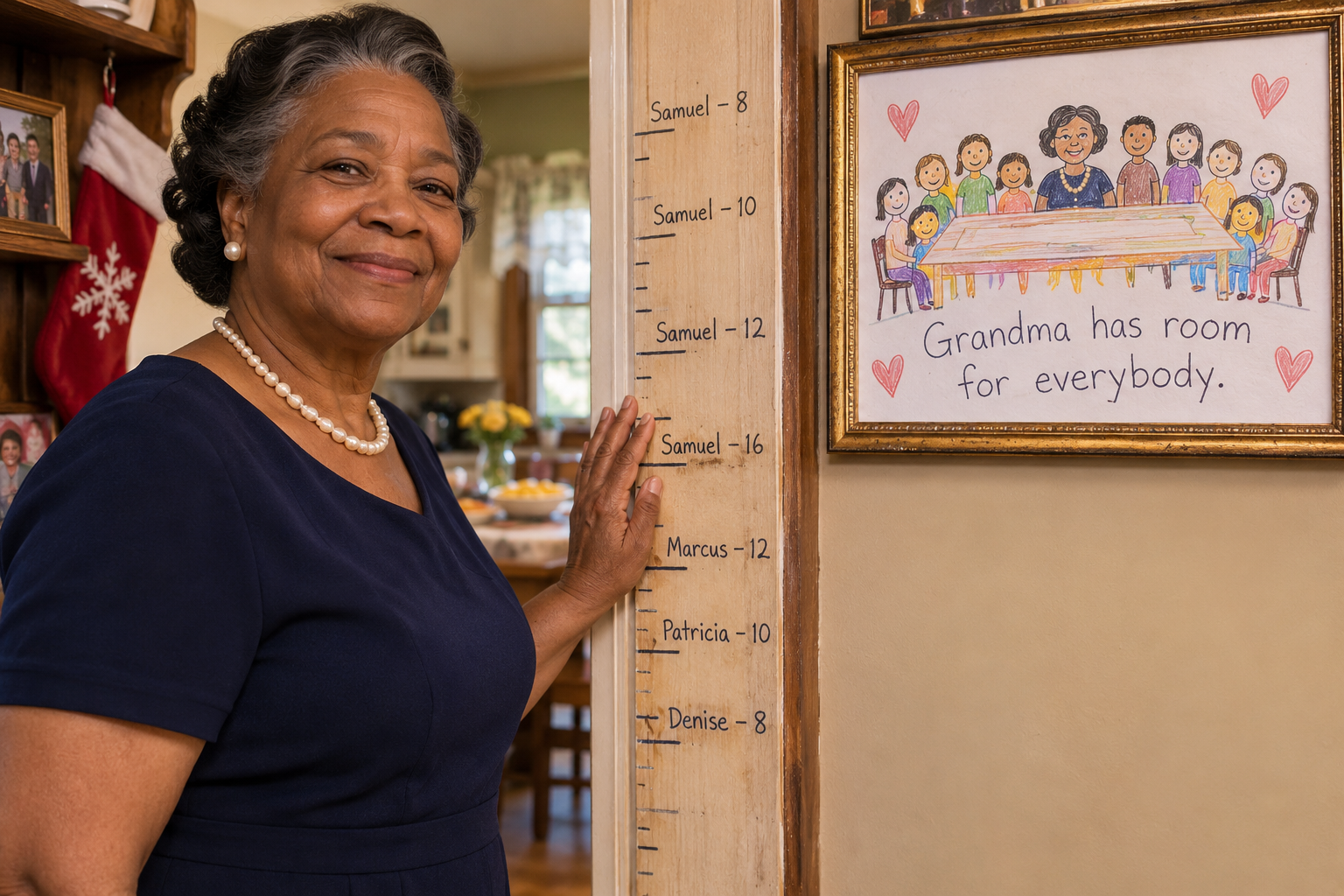
There were eleven people behind me.
Twelve counting me.
Garland watched them gather.
I saw his eyes moving from one face to another.
He was counting.
I knew the expression.
I had worn it myself every Christmas morning, making certain every stocking had been filled.
Bonnie recovered first.
She made a remark about my bringing enough people to fill a church service.
I knew what she was doing.
She wanted laughter.
She wanted the people in the room to treat us as an inconvenience.
But nobody seemed particularly amused.
Samuel returned from the gift table.
He stood close enough that I could touch his sleeve.
I gave him a look.
He understood.
He had been my son long enough to know when I wanted him to stay quiet.
Garland stepped away from the cake.
"Della, are these your children?"
I looked toward Lorraine.
Then Marcus.
Then Samuel.
"Some of them are. The others are family too."
He seemed puzzled.
"But I thought you couldn't have children."
He stopped before finishing whatever else he intended to say.
I waited.
He looked embarrassed.
I decided not to rescue him.
"What exactly did you think I couldn't do, Garland?"
His cheeks reddened.
Bonnie moved closer.
She told me that we ought to keep the afternoon pleasant.
I turned toward her.
"Then perhaps the note on my invitation wasn't necessary."
Garland frowned.
"What note?"
I opened my handbag.
The gold invitation was still inside its envelope.
I had brought it deliberately.
Not because I wanted an argument.
Because I had learned that people sometimes denied saying things the moment those words became inconvenient.
I handed him the card.
He unfolded it.
His gaze moved down the printed details.
Then he reached the handwriting.
I watched his face.
The change was immediate.
He looked toward Bonnie.
"Did you add this?"
She shrugged.
She said it had been meant as a harmless bit of teasing.
I looked around the hall.
Nobody was laughing.
Garland looked at the card again.
For a moment, I wondered whether he remembered his own words from 1984.
I certainly did.
They had shaped too many years of my life for me to forget.
Samuel touched my shoulder.
"Mom, may I say something?"
I hesitated.
I knew that voice.
He used it when he was determined to do something and wanted to sound reasonable about it.
"Keep it respectful, baby."
He almost smiled.
"I will."
Then he faced Garland.
He told him he had grown up hearing a little about the man who had once been married to me.
Garland shifted his weight.
Samuel spoke quietly.
He said that when he was eight, there hadn't been anybody prepared to take care of him.
His father was absent.
His mother could no longer look after him.
For several nights, he had been stuck in a county office while adults tried to find somewhere he could go.
I remembered how small he looked.
His coat sleeves hung past his hands.
His eyes stayed fixed on the floor.
The county worker had called me because she needed another possibility.
I had driven to collect him.
I arrived in my school bus.
It had been raining.
Samuel sat near the curb with his belongings in a grocery sack.
I asked whether he liked chicken for supper.
He didn't answer.
He only climbed aboard.
At home, he ate very little.
He kept his bag beside the chair.
I didn't move it.
I understood that taking it away might make him feel trapped.
That first night, I heard him crying.
I stood outside his bedroom for a long time.
Then I knocked.
He said he was fine.
I told him I was nearby if he needed anything.
Two days later, he called me Mama.
I had to leave the room so he wouldn't see me cry.
Now that same boy stood in front of Garland Hatchett.
He was a grown man.
And he was telling strangers what my life had become.
Samuel explained that I hadn't earned much money.
That was true.
Driving a school bus had never made anybody wealthy.
There were years when I took extra work just to cover what the children needed.
Sometimes I ate crackers for supper because there wasn't enough money for both my meal and a child's new shoes.
I hadn't thought of that as a sacrifice.
I had thought of it as Tuesday.
But Samuel remembered.
He told Garland that even when money was scarce, I never made him feel he was less important than a child born into a family.
I stared at the floor.
I didn't like being praised in public.
Especially not for doing what I believed a mother was supposed to do.
Lorraine stepped closer.
She said I had given her the same kind of home.
Marcus agreed.
Patricia wiped her eyes.
Raymond stood quietly among the others.
I looked at them.
I wanted to tell everyone to stop.
Not because I was ashamed.
Because the room was filling with memories I usually kept to myself.
Hospital visits.
School conferences.
Birthdays with homemade cakes.
The nights when a child woke screaming.
The mornings when somebody finally slept through the night without being afraid.
Garland looked from person to person.
"How many children did you raise?"
"Eight came through my house."
He stared.
"Eight?"
"Some lived with me briefly. Some never really left. Every one of them still calls me Mama."
I saw him swallow.
I explained that six of those children were represented at the party, with some of the relatives and grandchildren who had joined our family over the years.
Others couldn't travel.
That didn't make them any less mine.
Garland looked at the people around me.
I remembered how he once spoke about family as though it were a prize he could win.
A wife.
Children.
A respectable house.
A name passed down.
He had been so certain of what counted.
And so certain that I couldn't give it to him.
Emma tugged at my dress.
I bent toward her.
"What is it, sweetheart?"
She looked at Garland.
"Is he the man who didn't think you had a family?"
Lorraine closed her eyes.
I heard Marcus exhale.
Children did not always understand when adults wanted to avoid an unpleasant question.
Garland looked uncomfortable.
He said things had been different many years earlier.
Emma studied him.
Then she took my hand.
"Well, he was mistaken."
A woman toward the back murmured her agreement.
I squeezed Emma's fingers.
"Come stand beside me, honey."
Bonnie turned toward the food tables.
She suggested we return to celebrating.
I would have preferred that.
The afternoon had already become far more public than I intended.
But Garland was still looking at Samuel.
He asked whether Samuel's last name was Bennett.
Samuel said yes.
Then Garland asked about mine.
I told him I had stopped using Hatchett after our divorce.
I had no reason to keep it.
Bennett was my name.
And it was the name Samuel carried.
Garland looked troubled by that.
I found myself wondering why.
He had walked away from the name we shared.
He had no right to be surprised that I built a life without it.
Samuel touched my shoulder again.
His expression had changed.
"Mom, there's something I found that we need to discuss."
I frowned.
"Not here."
He glanced toward Garland.
"I think it matters."
Lorraine stepped closer.
"Samuel, maybe we ought to talk outside."
But he had already reached inside his jacket.
He removed a yellow envelope.
It was worn along the edges.
The paper had darkened with age.
I recognized it immediately.
My mouth went dry.
I hadn't seen that envelope in more than thirty years.
"Samuel, where did you find that?"
He looked surprised by my reaction.
He explained that while helping sort through my old paperwork three weeks earlier, he had discovered something he believed the family needed to know.
I stared at the envelope.
I knew what was inside.
I knew who had written it.
And I knew why I had kept it hidden.
For years, I had told myself there was no reason to bring up that part of the past.
Garland had made his choice.
I had survived it.
My children didn't need to carry my old wounds.
But Samuel stood there holding the proof.
I reached toward him.
"Please put that away."
He hesitated.
Garland moved closer.
"What is it?"
Samuel carefully unfolded the paper.
I saw the familiar handwriting.
Garland saw it too.
His face lost its color.
The letter had been written in 1985.
One year after he left me.
One year after I believed our marriage had failed because of my body.
I had opened that envelope in the same kitchen where Garland once told me he was leaving.
I still remembered how badly my hands shook.
Now Samuel was preparing to read it aloud.
I looked at Garland.
He looked back at me.
And I knew that he remembered exactly what he had written.
Click here to continue reading: PART 3: The Old Letter Revealed Why My Husband Had Blamed Me for Our Childless Marriage and What He Knew About His Sons
My Ex-Husband Invited Me to His Birthday to Show Off the Family He Said I Could Never Have
Part 2 of 10