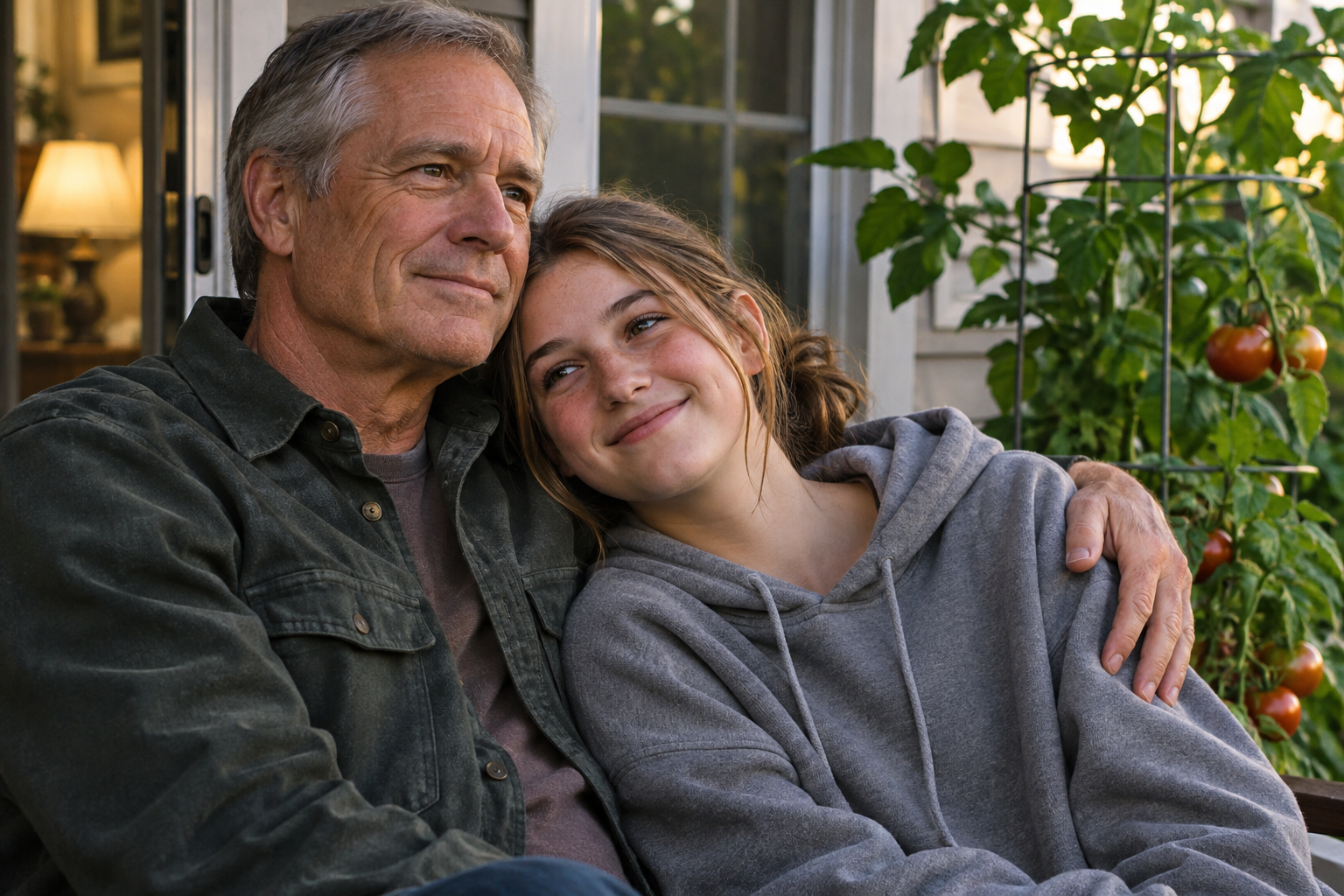
Daniel entered the precinct shortly before five in the morning.
I had spent the drive hoping he would do the right thing.
That hope lasted only a few seconds.
He looked exhausted.
His eyes were red.
His jaw was tight.
I knew he had come from the hospital, where Victoria was being treated.
He walked into the room and stopped in front of Emma.
She looked up at him.
I could see she was waiting for him to ask about her face.
He didn't.
Instead, he demanded to know why she had behaved the way Victoria described.
Emma's expression changed.
It was as though the last bit of strength she had been holding onto disappeared.
“Dad, that's not what happened.”
Daniel looked at her without speaking.
“She hurt me.”
He shook his head.
I watched Emma pull her sleeves farther over her wrists.
Daniel didn't seem to notice.
That is the detail I remember most.
Not his raised voice.
Not his anger.
His failure to look at her hands.
I had photographed those injuries.
I had examined them carefully.
But her own father stood a few feet away without asking how they had happened.
“Daniel,” I said.
He turned toward me.
“Dad, you don't understand what she's done.”
“I understand that she's injured.”
“Victoria is in the hospital.”
“I know.”
He rubbed his forehead.
“Emma's been having problems for a long time.”
I looked at my granddaughter.
She was staring at the floor.
“What problems?”
Daniel hesitated.
Then he repeated what Victoria had told him.
Emma had never properly accepted her mother's death.
She had difficulty adjusting.
Her behavior had become increasingly troubling.
Doctors, according to Daniel, were concerned she might have injured herself.
I listened.
I had heard similar explanations in my career.
Sometimes they were true.
Sometimes families were dealing with complicated situations and needed help.
But an explanation wasn't proof.
And a frightened child's history of grief didn't make her injuries irrelevant.
“Has anyone confirmed that Emma caused these marks herself?”
Daniel frowned.
“Dad, you're not listening.”
“I am listening.”
“No, you've already decided Victoria is lying.”
I kept my voice level.
“I've decided we need to examine what happened.”
Emma finally raised her eyes.
“Dad, I tried to tell you.”
Daniel looked away.
She tried again.
“I didn't send anyone after Victoria. I didn't want any of this.”
He said nothing.
The room grew quiet.
I could hear the low noise of the precinct beyond the door.
I remember that ordinary sound.
People were working.
Phones were ringing.
The building continued functioning.
Meanwhile, my granddaughter was learning that telling the truth might not be enough to make her father hear her.
I wanted to get angry.
I wanted to tell Daniel that he was failing his daughter.
But anger would have given him one more reason to stop listening.
So I asked a question.
“Did Victoria tell you Emma was locked in her bedroom?”
His eyes moved toward me.
“What?”
“Three days. Emma says she wasn't allowed out.”
“Victoria said there had to be consequences.”
“For what?”
Daniel didn't answer immediately.
“Her behavior.”
“What behavior?”
He exhaled sharply.
“Dad, this isn't helping.”
I glanced at Emma.
Her face was pale.
She looked tired enough to fall asleep sitting upright.
She had already spent hours defending herself.
I wasn't going to make her do it again for my benefit.
“I'm not asking Emma to repeat herself,” I said. “I'm asking you what you know.”
Daniel crossed his arms.
He told me Victoria had been trying to manage a difficult situation.
She was worried about Emma.
She believed professional help might be necessary.
I listened to him describe his wife's concerns.
I waited for him to mention the swollen lip.
The bruised eye.
The injured wrists.
He never did.
That omission said more than his words.
I had spent thirty-one years learning how to identify what a statement left out.
Standing there, I wished I didn't have that skill.
Because I could hear how carefully my son was repeating someone else's version of his daughter's life.
When Detective Prior returned with paperwork, I made my position clear.
Emma would come home with me.
Daniel objected immediately.
“She belongs at home.”
“She needs a safe place while this is reviewed.”
“Dad, she's my daughter.”
“I know.”
He looked offended.
I let the silence sit between us.
Then I asked him whether a few days away from the conflict would interfere with a fair investigation.
He said it wasn't that simple.
I agreed that it wasn't.
Nothing about the situation was simple.
But Emma needed rest.
She needed someone to listen.
And she needed to be away from the person she had accused of hurting her.
I reminded Daniel that if Victoria's account was accurate, a short separation wouldn't change the evidence.
If Emma's account was accurate, the separation mattered enormously.
He looked toward Detective Prior.
Then toward Emma.
Finally, he agreed.
There was no apology.
No attempt to reassure his daughter.
He simply stopped objecting.
I hated how relieved I felt.
Relieved that I could take her.
Relieved that she would not be returning to Victoria that morning.
Relieved by something that should never have been in doubt.
Emma stood slowly.
I made sure she had what she needed.
Then I led her out of the interview room.
She stayed close to me.
I didn't ask her to explain anything on the way to the car.
There would be time for questions.
There would be time for documents and phone calls.
Right then, she needed to leave that building.
Outside, the morning was beginning.
The sky was lighter than it had been when I arrived.
Cars were moving through the streets.
People were starting their ordinary days.
I couldn't stop thinking about how ordinary the world looked.
Emma climbed into the passenger seat.
She fastened her seat belt.
Then she turned toward me.
“Grandpa?”
“Yes?”
“Am I really going with you?”
I looked at her.
“Yes.”
She nodded.
A few minutes later, she was asleep.
She slept through the drive back to Marietta.
I kept my eyes on the road.
Every so often, I glanced toward her.
Her face looked younger with her eyes closed.
Fourteen years old.
I kept returning to that number.
She was fourteen.
She should have been thinking about school, friends, and the ordinary problems of growing up.
Instead, she had spent three days confined to a bedroom and part of the night inside a police station.
And her father had questioned her before asking whether she was all right.
When we reached my house, I brought her inside.
I wanted her to have a quiet place to rest.
I didn't press her for more details.
She had told me enough for one morning.
The next day, I began making calls.
I wasn't going to treat Emma's account as a finished investigation.
I needed independent records.
Dates.
Names.
Earlier observations.
Information from people who had known her before the police became involved.
I contacted Marcus Webb.
Marcus was a retired investigator.
I trusted his ability to examine a person's background without becoming distracted by reputation.
I asked him to look into Victoria Hartwell's history.
I explained that the situation involved my granddaughter.
I also told him not to assume anything.
I wanted records, not opinions.
Then I went to Emma's school.
Her guidance counselor was Deborah Finch.
She knew Emma.
That mattered.
Someone at the school had seen the changes in my granddaughter while they were happening.
I explained why I had come.
Deborah listened carefully.
She didn't immediately offer a conclusion.
That was reassuring.
Then she began telling me what she had observed.
Emma's grades had declined.
She had withdrawn from friends.
Her participation at school had changed.
Those details sounded familiar.
I had noticed similar things myself.
But I had been able to tell myself that Emma was going through a difficult adjustment.
Now I was hearing that the changes had been significant enough for school staff to notice.
Deborah also confirmed two earlier reports involving unexplained bruising.
I felt my stomach tighten.
“Two?”
She confirmed it.
I thought about Emma's wrists in the interview room.
The older-looking marks.
The way she had hidden her hands when Daniel arrived.
I asked what had been done about those concerns.
Deborah explained what the school had recorded.
I listened closely.
I didn't want to blame the counselor for what I had failed to recognize myself.
The school had seen pieces of the situation.
I had seen other pieces.
And Daniel had lived in the same house as the child experiencing it.
Yet Emma had remained frightened and isolated.
Then Deborah showed me something that changed the direction of my questions.
Three weeks before Emma's call to the police station, she had emailed the counseling office.
She wanted to know whether a report about trouble at home would remain confidential.
I stared at the date.
Three weeks.
Emma had been searching for help before the night Victoria accused her of an attack.
I read the message carefully.
It was a request for information.
But underneath that request was something I knew too well.
Fear.
A child wanted to speak.
She needed to know whether speaking would make things worse.
“Did she meet with anyone?”
Deborah explained that the school had intended to speak with her.
But before the meeting could take place, Victoria had appeared.
She asked the staff to respect the family's privacy.
The words sounded ordinary.
Reasonable, even.
Families did have privacy.
Parents did have concerns about how schools handled sensitive information.
But I couldn't separate that request from what Emma had told me.
She had tried to reach a counselor.
Victoria learned about it.
Then Emma was confined to her room.
I asked Deborah about the dates.
We compared the sequence.
A week after Victoria's intervention, Emma stopped attending school normally.
I sat very still.
There it was.
Not proof of every accusation.
But a pattern that needed immediate attention.
An attempt to ask for help.
An adult stepping in.
A change in attendance.
And eventually, a police accusation against the child.
I looked again at the email.
It bothered me more than almost anything I had seen.
Emma hadn't demanded that someone punish Victoria.
She hadn't made a dramatic public accusation.
She had simply asked whether it was safe to tell someone what was happening at home.
That was how frightened she had been.
She was trying to understand the consequences before she spoke.
I thanked Deborah for explaining what she knew.
I made sure the relevant records were preserved through appropriate channels.
Then I left the school.
Outside, I sat in my car.
For a while, I didn't start the engine.
I thought about the many times Daniel had told me Emma was adjusting.
I remembered agreeing.
I remembered telling myself that grief was complicated.
Both statements could be true.
But neither justified ignoring signs of mistreatment.
I had allowed a familiar explanation to replace difficult questions.
And Emma had paid for that hesitation.
That afternoon, Marcus called.
He sounded different from usual.
More restrained.
“Robert, I found something about Victoria.”
I asked him to explain.
“She was married before Daniel.”
I knew almost nothing about that marriage.
Marcus gave me the name of her former husband.
Gregory Doss.
Then he told me Gregory had a son.
Tyler.
I listened without interrupting.
The marriage had ended years earlier.
But records from that period referred to serious changes in Tyler's behavior.
There had also been statements to a school counselor.
I looked toward the hallway.
Emma was safe inside my house.
At least for the moment.
“Are those records available?”
Marcus said there were documents worth examining.
He didn't tell me what conclusion to draw.
He didn't need to.
I already knew what I had to do next.
I was going to speak to Gregory Doss.
And I was going to find out whether another child had tried to tell adults something they had not wanted to hear.
Click here to continue reading: PART 3: Victoria’s Former Husband Showed Me the Records He Had Kept for Years, and I Realized Emma Was Not the First Child to Change
My Granddaughter Called Me From a Police Station Before Sunrise, and the Injuries on Her Wrists Told Me Her Story Was Far From Over
Part 2 of 10