I thought being told Emma was cleared would feel like the end.
It wasn't.
It was the first morning I could look at my granddaughter without wondering whether someone might take her back to that police station.
That mattered.
But the house didn't suddenly return to normal.
Emma still woke early.
She still watched people's faces before answering certain questions.
And she still asked permission for things she was allowed to do.
The difference was that she had begun to smile again.
Not every day.
Not all the time.
But enough that I noticed.
One morning, she came into the kitchen and opened the cupboard.
She took down a bowl without asking.
I watched from the sink.
She poured cereal.
Added milk.
Then sat down.
Nothing unusual happened.
No argument.
No apology.
No one telling her she had done something wrong.
I realized I was smiling.
Emma looked up.
“What?”
“Nothing.”
She narrowed her eyes.
“Grandpa.”
I laughed.
“I'm glad you're comfortable here.”
She looked at the bowl.
Then she smiled too.
It was such a small moment.
But after everything that had happened, I treasured it.
The prosecutor's decision had removed the accusation against Emma.
The separate investigations were still moving forward.
Victoria's conduct was being examined.
So was Detective Prior's handling of the complaints.
I knew better than to assume those matters would resolve quickly.
An investigation into possible misconduct required records.
Witnesses.
Independent review.
And decisions based on evidence.
I had spent most of my working life inside that process.
I understood why it took time.
But I also knew the waiting could be difficult for the people whose lives had already been affected.
Emma didn't ask about Victoria as often anymore.
I was glad.
She needed room to think about things other than the woman who had frightened her.
Still, I wanted to know what the records would establish.
There had been too many unanswered questions.
The two earlier complaints involving injured minors.
The consulting payments to Prior's wife.
The connection to Hartwell Community Solutions.
And the concerns about Victoria that predated Gregory Doss.
Each one deserved examination.
Not because I wanted a particular punishment.
Because ignoring those questions might leave someone else unprotected.
A few days after Emma was cleared, Margaret called.
I was at the kitchen table.
The notebook was beside my coffee.
I answered.
“Margaret.”
“Robert, I wanted to update you about the independent review.”
I sat straighter.
She explained that the review had confirmed the financial relationship previously identified.
Prior's wife had received thirty-eight thousand dollars in consulting payments from a nonprofit associated with Victoria's organization.
The payments had occurred over eleven months.
The review had also established that Prior had handled complaints involving the organization during the same general period.
I listened carefully.
Margaret explained that investigators were examining whether the relationship had been properly disclosed and whether it influenced his professional decisions.
I thought about the first night at the precinct.
The way Prior had spoken to me.
The way he resisted questions about Emma's injuries.
I had wanted those actions explained.
Now they were receiving independent scrutiny.
“What about the earlier complaints?”
Margaret said the closures were being reviewed as part of the broader examination.
The circumstances surrounding the injuries and the decisions not to investigate further were important.
I asked whether the review had established criminal conduct by Prior.
She said that conclusion had not yet been reached.
I appreciated her honesty.
I wanted accountability.
But I didn't want accusations replacing facts.
We had spent too much time fighting that exact problem in Emma's case.
I asked about Victoria.
Margaret explained that the evidence concerning the disputed messages remained significant.
The authentication records connected the remote access to credentials associated with Victoria.
Those records supported further inquiry into whether evidence had been deliberately manufactured.
The allegations involving Emma's injuries and confinement were also being examined.
I looked toward the hallway.
My granddaughter was in her room.
She was working on getting ready to return to school.
The idea that an official investigation was examining what happened to her was important.
But I knew the result couldn't restore the days she had lost.
I asked Margaret about the older complaint.
The one that came before Gregory Doss.
She told me it had been included in the broader review of Victoria's history.
She couldn't discuss private details involving other individuals.
I understood.
Those people had their own lives.
Their own families.
Their own reasons for wanting privacy.
I didn't need their names to recognize the seriousness of the concern.
What mattered was that earlier reports were no longer being dismissed simply because they had been closed.
I thanked Margaret.
Before we ended the call, she asked how Emma was doing.
I looked at the bedroom door.
“She's getting ready to return to school.”
Margaret was quiet for a moment.
“I'm glad.”
“So am I.”
After the call, I closed the notebook.
I had expected to feel satisfaction when the investigation began examining Prior's conduct.
Instead, I felt a familiar sadness.
I kept thinking about the children involved in the earlier complaints.
I didn't know what had happened to them.
I didn't know whether their concerns had been taken seriously.
But I knew what it felt like to sit across from a frightened child who believed nobody would listen.
I had seen that expression on Emma's face.
And I never wanted to see it again.
That afternoon, Deborah Finch called.
She wanted to discuss Emma's return to school.
We spoke about her attendance.
Her assignments.
The support she might need.
Deborah was careful.
She didn't treat Emma like a problem that needed fixing.
She wanted to help her return at a pace she could manage.
I appreciated that.
When I told Emma about the conversation, she looked nervous.
“Will everyone know what happened?”
I sat beside her.
“We'll make sure your privacy is respected as much as possible.”
She nodded.
“What if someone asks?”
“You don't have to explain things you don't want to discuss.”
She considered that.
Then she asked whether she could speak to Deborah if she became uncomfortable.
“Of course.”
She looked relieved.
I thought about the email she had sent three weeks before the police incident.
She had asked whether speaking to the counselor would remain confidential.
That request had been one of the earliest warnings.
Now she was preparing to return to the same school.
But this time, the adults around her knew she needed support.
I hoped that made a difference.
A few days later, Daniel came to see us.
Emma had agreed to speak with him.
She asked me to stay.
I told her I would.
When Daniel arrived, he looked thinner than I remembered.
His clothes were neat.
But his face showed the strain of the past several weeks.
I opened the door.
He looked at me.
“Dad.”
“Come in.”
Emma was sitting in the living room.
She had chosen the chair beside mine.
Daniel stopped when he saw her.
For a moment, he seemed unable to speak.
Then he sat across from her.
I remained quiet.
This wasn't my conversation.
It belonged to them.
Daniel looked at Emma.
“I wanted to say I'm sorry.”
She didn't answer.
He lowered his eyes.
“I should have listened to you.”
Emma's hands were folded in her lap.
I noticed she wasn't hiding her wrists.
Daniel continued.
“When I walked into the police station, I believed what I'd been told.”
He paused.
“I didn't ask you what happened.”
Emma looked at him.
“No.”
He nodded.
“I was wrong.”
The room became quiet.
I could hear the clock ticking.
Daniel swallowed.
“I saw your face. I saw that you were hurt. And I still blamed you.”
Emma's expression changed.
Her eyes filled with tears.
Daniel looked down.
“I can't explain that in a way that makes it acceptable.”
I felt a tightness in my chest.
For the first time, my son was describing his own actions without defending them.
He wasn't blaming Victoria for every decision.
He wasn't asking Emma to understand how difficult things had been for him.
He was admitting what he had done.
That mattered.
But it didn't erase the damage.
Emma wiped her eyes.
“Why didn't you believe me?”
Daniel closed his eyes.
I watched him struggle.
Finally, he answered.
“I believed what Victoria said. I told myself she understood what was happening better than I did.”
Emma looked at him.
“But I was your daughter.”
His face crumpled.
“I know.”
She began crying.
I wanted to reach for her.
But she was still looking at Daniel.
I stayed quiet.
She needed to say what she had been carrying.
“I told you I was scared.”
Daniel nodded.
“I know.”
“You said I was the problem.”
He lowered his head.
“I did.”
She wiped her face again.
“I thought you didn't want me anymore.”
Daniel began crying.
He put his hands over his face.
I looked away.
It was painful to watch.
Not because Daniel didn't deserve to hear those words.
Because Emma had believed them.
For days, she had lived with the fear that her father no longer wanted her.
I had known she was hurt.
But hearing her say it made the pain feel different.
Daniel finally looked up.
“I never stopped loving you.”
Emma didn't answer.
He continued.
“But I didn't protect you. And I understand why you don't trust me.”
She looked down.
“I don't know how to.”
He nodded.
“Then I'll have to earn it.”
I felt a small measure of relief.
Not because everything was repaired.
It wasn't.
But Daniel had stopped asking his daughter to make him feel better.
He understood that trust couldn't be demanded.
It had to be rebuilt.
Emma looked toward me.
I gave her a small nod.
She turned back to Daniel.
“I don't want to go home yet.”
Daniel took a breath.
“Okay.”
“I want to stay with Grandpa.”
“Okay.”
She studied him.
“Are you mad?”
“No.”
He wiped his face.
“I want you to feel safe.”
Emma nodded.
For a moment, nobody spoke.
Then Daniel asked whether he could visit again.
Emma thought about it.
“Maybe.”
He accepted that.
I was proud of her.
Not because she had forgiven him.
She hadn't.
But because she was beginning to understand that she could make decisions about her own comfort without being punished for them.
When Daniel left, I walked him to the door.
He stopped on the porch.
I waited.
Finally, he said, “Dad, I don't know if she'll ever trust me again.”
I looked at him.
“She might.”
He looked hopeful.
I continued.
“But you can't make that the reason you do the right thing.”
His expression changed.
“You have to do it because she's your daughter. Whether she forgives you quickly, slowly, or not at all.”
He nodded.
I put my hand on his shoulder.
“I love you, Daniel.”
His eyes filled again.
“I know.”
“But I won't protect you from the truth.”
He looked down.
“I don't want you to.”
We stood there for a moment.
Then he left.
I watched his car disappear down the street.
I felt sad.
But I also felt that something important had changed.
My son had finally stopped defending his mistake.
He had begun accepting responsibility for it.
That was a beginning.
Nothing more.
In the weeks that followed, Emma continued staying with me.
Her return to school was gradual.
Deborah Finch helped her through the transition.
Some days were easier than others.
There were mornings when Emma seemed eager to leave.
Other mornings, she sat at the kitchen table looking worried.
I didn't rush her.
I made breakfast.
I listened.
And I reminded her that needing help didn't mean she had failed.
Daniel visited when Emma agreed.
Sometimes they talked.
Sometimes they sat together without saying much.
He didn't pressure her.
He didn't ask her to forget the police station.
And he didn't tell her she was hurting him by needing more time.
I watched their relationship change slowly.
It wasn't the same as before.
I didn't know whether it ever would be.
But I could see Daniel trying to become someone she could trust.
That was his responsibility.
And for once, he seemed willing to carry it.
The investigations involving Victoria and Detective Prior continued separately.
I received updates when information could appropriately be shared.
The evidence involving the remotely accessed messages remained part of the inquiry into Victoria's conduct.
The allegations about Emma's injuries and confinement were also being examined.
Prior's financial connections and the handling of earlier complaints remained subjects of official review.
I didn't receive a final criminal judgment in the information available to me.
And I refused to pretend that I had.
Emma's accusation had been dropped.
That was the outcome we could state with certainty.
The broader questions about Victoria and Prior required their own legal conclusions.
I had spent too much of my life believing in the importance of evidence to abandon that principle at the end.
But the personal consequences were already real.
Emma no longer lived in Victoria's household.
Daniel had lost his daughter's trust.
Victoria's allegations were under serious scrutiny.
And the detective who had dismissed my concerns was facing independent examination of his conduct.
Our family had changed.
There was no way around that.
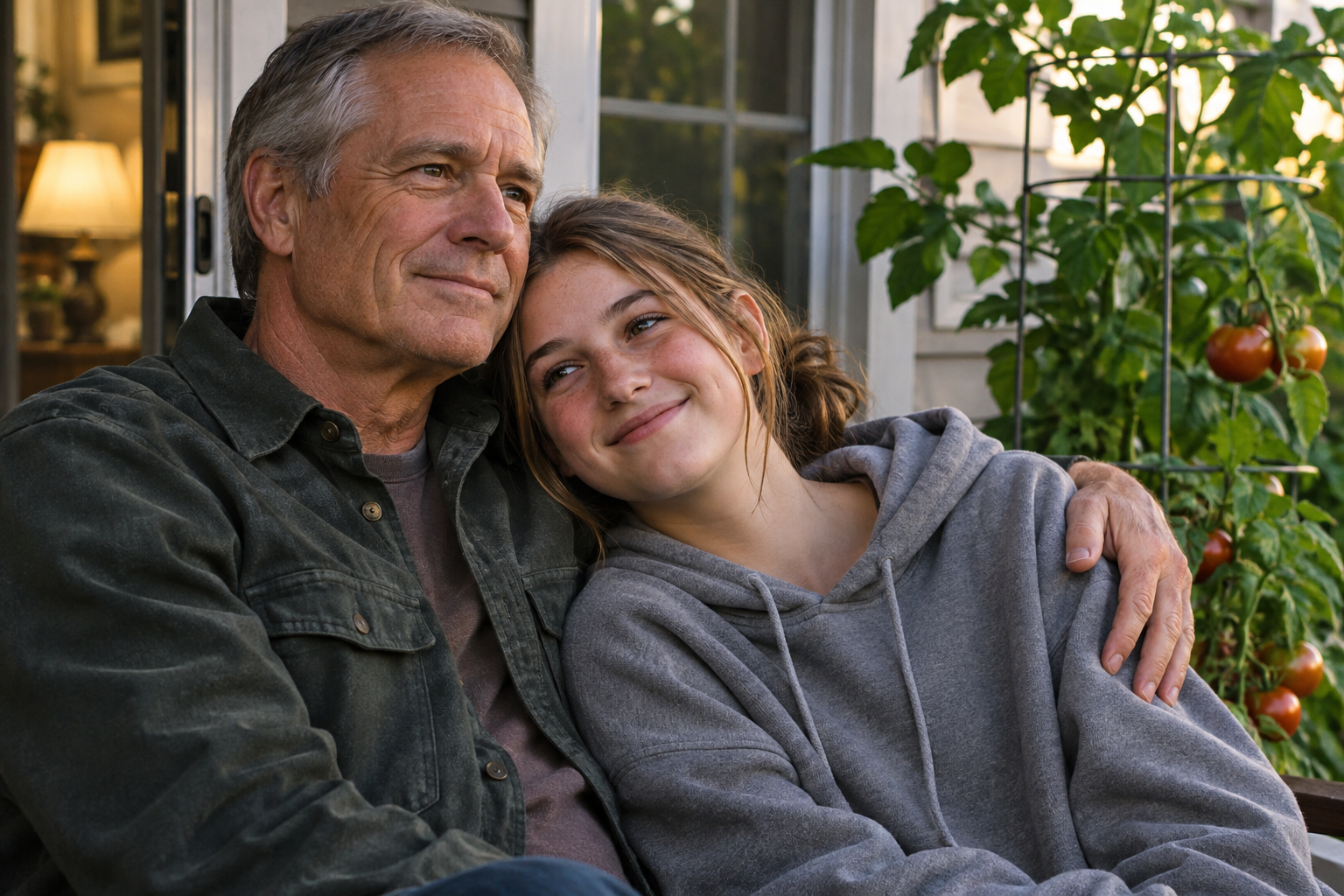
One evening, several weeks later, I was working in the garden.
Emma came outside.
She was carrying two glasses of water.
She handed me one.
“Thanks, sweetheart.”
She sat on the porch step.
I finished what I was doing and joined her.
The tomato plants had grown.
Some were beginning to produce fruit.
Emma looked at them.
“Do you remember when I first came here?”
I sat beside her.
“Yes.”
“I thought I was going to have to go back.”
I looked at her.
“I know.”
She was quiet.
Then she said, “I still get scared sometimes.”
I nodded.
“That's understandable.”
She looked toward the yard.
“But not as much.”
I felt something loosen inside my chest.
She took a sip of water.
Then she asked whether she could help with the garden the next morning.
“Of course.”
She smiled.
I looked at her hands.
The injuries around her wrists had healed.
There were no fresh marks.
She was holding her glass comfortably.
I remembered the night I first saw those wrists beneath the fluorescent lights.
I remembered how she flinched when I touched her.
I remembered photographing the injuries because I was afraid no one else would take them seriously.
Now she was sitting beside me in the evening light.
She was talking about tomatoes.
About school.
About tomorrow.
Ordinary things.
I had never been so grateful for ordinary things.
Emma leaned against my shoulder.
“Grandpa?”
“Yes?”
“Thank you for coming that night.”
I looked down at her.
“You never have to thank me for that.”
She shook her head.
“I know. But I wanted to.”
I put my arm around her.
For a while, we watched the yard.
I thought about the telephone call at 2:47 in the morning.
The whisper.
The fear.
The sound of my granddaughter asking whether anyone would believe her.
I had believed that my job was to rescue her.
To gather evidence.
To challenge the accusation.
To make sure the truth was examined.
Those things had mattered.
But sitting on the porch, I understood that the work hadn't ended when the prosecutor cleared her.
Emma needed more than a successful investigation.
She needed a home where she could ask questions.
A father willing to earn back her trust.
Adults who listened when she said something was wrong.
And the freedom to be fourteen years old without carrying responsibility for everyone else's mistakes.
I couldn't give her back the time she had lost.
I couldn't erase the memory of the police station.
I couldn't guarantee that she would never be hurt again.
But I could keep the promise I had made when she called.
I would come when she needed me.
I would listen.
And I would never ask her to stay silent just because the truth made someone uncomfortable.
Emma finished her water.
Then she stood.
“Are you coming inside?”
“In a minute.”
She smiled.
“Don't stay out too long.”
I watched her walk through the sliding door.
She didn't look back to see whether I approved.
She didn't hesitate before entering the house.
She simply went inside.
Like a child who knew she belonged there.
I stayed on the porch a little longer.
The grass was dry.
The garden was quiet.
And for the first time since that terrible night, I wasn't thinking about Detective Prior or Victoria Hartwell.
I was thinking about tomorrow morning.
Emma would probably make toast.
She might leave the peanut butter jar on the table.
She would ask about school.
She might complain about homework.
And if something bothered her, I hoped she would tell me.
Not because I was a retired federal investigator.
Not because I knew how to examine records.
But because I was her grandfather.
And she knew I would listen.
The End
Read more original stories on Feel Every Story.
My Granddaughter Called Me From a Police Station Before Sunrise, and the Injuries on Her Wrists Told Me Her Story Was Far From Over
Part 10 of 10