
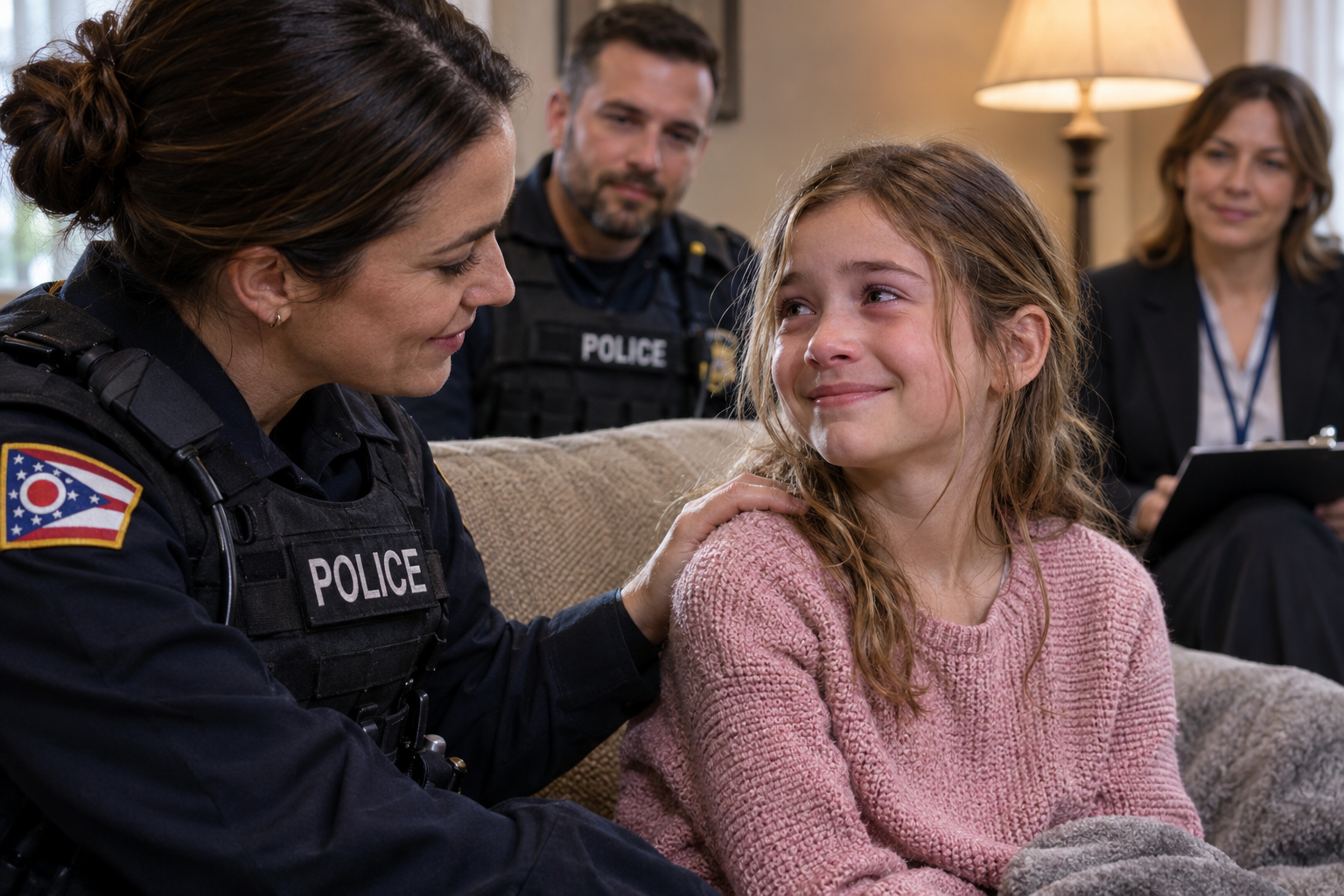
I thought Emily would begin talking as soon as Thomas was out of sight.
She didn't.
She sat with her hands in her lap.
Her eyes moved around the room.
The child protection worker waited patiently.
I remained nearby because Emily had asked whether I would stay.
I told her I could remain while the worker explained what would happen.
I knew there were limits to my role.
This wasn't the moment for me to conduct an investigation through a series of questions.
The worker needed space to speak with Emily properly.
And Emily needed to know that she didn't have to answer simply because an adult expected her to.
Still, she seemed comforted by knowing I was close.
I stayed quiet.
The worker began with ordinary words.
She explained who she was.
Why she'd come.
And that her job was to help understand whether Emily was safe.
Emily listened carefully.
Then she asked something that made my throat tighten.
"Will I get in trouble?"
The worker shook her head.
"You're not in trouble for talking to me."
Emily looked uncertain.
"But Dad says talking about family things is bad."
I felt my face grow warm.
I didn't want Emily to see my reaction.
So I kept my expression steady.
The worker didn't rush to respond.
"What do you mean by family things?"
Emily looked down.
"Things that happen at home."
There was a long pause.
I could hear voices from another part of the house.
Thomas was still speaking with Daniel and our supervisor.
The sound made Emily look toward the doorway.
She stopped talking.
The worker noticed immediately.
"Would another room feel more comfortable?"
Emily nodded.
We arranged a quieter place for the conversation.
Daniel and the other officers continued managing the situation with Thomas.
I didn't hear everything that happened between them.
And I wasn't going to pretend I did.
My attention was on Emily.
I walked with her until the worker was ready to continue.
Before sitting down, Emily looked at the door.
"Can it stay open?"
The worker agreed.
Then Emily changed her mind.
"Not all the way."
We adjusted it so she felt comfortable.
I remember thinking how important that small choice seemed.
For once, Emily was being asked what she wanted.
Nobody was snapping at her for taking too long.
Nobody was insisting she decide immediately.
She had room to think.
She sat down.
The worker took a seat nearby.
And the conversation began again.
Emily didn't speak in a straight line.
She paused often.
Sometimes she answered a question.
Sometimes she asked one of her own.
Sometimes she seemed to forget what she had been saying because a sound elsewhere in the house caught her attention.
The worker gave her time.
I admired that patience.
It was difficult to watch a frightened child struggle for words.
My instinct was to help her finish a sentence.
But that would have been wrong.
Her words needed to belong to her.
Not to me.
Not to the worker.
Not to anyone who already had an idea about what might be happening.
At one point, Emily looked at the worker and said something I hadn't expected.
"Sometimes I know when Dad is going to get angry."
The worker waited.
Emily continued.
"His voice changes."
My chest tightened.
I remembered the moment Thomas had spoken her name.
The sudden turn of his head.
The way she'd recoiled.
For the first time, I could hear Emily describing the same thing I'd observed.
The worker asked her to explain in her own words.
Emily struggled.
She moved her hands slightly, as though trying to show something she couldn't describe.
Then she stopped.
"I don't know."
"That's all right."
Emily looked surprised.
"You don't have to guess," the worker said.
I watched Emily absorb that.
For a child who seemed accustomed to worrying about giving the wrong answer, permission not to know appeared important.
She became quiet again.
Then she asked whether her father was still in the house.
The worker answered truthfully.
She explained that officers were speaking with him and that Emily wasn't responsible for those conversations.
Emily looked at me.
"He's going to think I did something."
I wanted to respond immediately.
But the worker was handling the conversation.
So I remained quiet.
She reassured Emily that adults were responsible for their own decisions.
Emily stared at her hands.
I recognized the movement of her thumb.
Back and forth.
The same movement I'd seen when the backup officers arrived.
I found myself counting the seconds between her answers.
Not because I wanted her to hurry.
Because I was learning how much effort it seemed to take for her to speak.
She appeared to consider every word.
As though she was deciding whether it could be repeated somewhere she didn't want it heard.
That thought hurt.
I had assumed the biggest obstacle would be getting Thomas away from her.
I was beginning to see that distance alone couldn't undo the fear.
Even when he wasn't in the room, his presence seemed to remain with her.
The worker continued carefully.
She didn't demand a complete explanation.
She didn't ask Emily to choose between adults.
She simply allowed the conversation to develop.
Emily said she didn't like it when people argued.
She said loud voices frightened her.
She said she tried to stay quiet when her father was upset.
None of those statements established everything we needed to know.
But together with what we'd observed, they increased my concern.
I remembered how she'd covered her ears before Thomas had shouted.
How she'd seemed to know an argument was coming.
I had wondered what that meant.
Now I understood at least part of it.
She was paying attention to signs of anger.
She knew the changes.
She recognized the tone.
That knowledge hadn't appeared out of nowhere.
Still, I knew better than to assume precisely how she'd acquired it.
That was what further assessment was for.
I remained careful.
I wanted answers badly enough that I had to remind myself not to force them.
At one point, the worker asked Emily whether she needed a break.
Emily nodded.
We stopped.
No one complained.
No one told her to finish.
No one acted disappointed.
I watched her shoulders settle.
It was the first time I'd seen her respond to an adult's question without immediately checking the doorway.
The worker offered her water.
This time, Emily accepted.
She held the cup with both hands.
I noticed how carefully she placed it down afterward.
Then she looked at me.
"Did I do it right?"
I felt a sharp ache in my chest.
"Do what, sweetheart?"
"Talking."
I glanced toward the worker.
She answered gently.
"You don't have to perform for us. We just want to understand what you want us to know."
Emily considered that.
Then she gave a small nod.
I turned my eyes away for a moment.
I had seen children ask whether they'd done well on a school assignment.
Whether they'd followed instructions.
Whether they'd remembered something correctly.
But hearing Emily ask whether she'd spoken properly made me feel terribly sad.
She seemed to believe that even telling the truth could be something she might get wrong.
I couldn't change that belief in one afternoon.
But perhaps we could begin showing her something different.
A little later, the worker stepped aside to speak with our supervisor.
Emily remained with an officer.
I joined the conversation briefly.
We discussed only what had actually been said and observed.
The child's expressed fear.
Thomas's resistance.
The difficulty she'd had speaking while he was nearby.
And the need for a careful safety assessment.
Nobody claimed to know the full history.
Nobody declared the matter resolved.
The supervisor made it clear that we needed to continue following the appropriate process.
I was relieved.
Not because I wanted the situation to become more serious.
Because I didn't want Emily's words to be lost in an argument about whether her father had appeared polite enough.
When I returned, she was looking toward the doorway again.
I sat near her.
"How are you doing?"
She shrugged.
"Okay."
I didn't believe that word told me much.
But I accepted it.
Sometimes "okay" was all a frightened person could manage.
I told her the adults were still working out what should happen next.
She looked at me for a long time.
Then she asked whether she would have to explain everything again.
I answered carefully.
"There may be people who need to understand what happened, but we'll try to make sure you're treated gently and that the right person speaks with you."
She lowered her eyes.
I knew it wasn't the answer she wanted.
She wanted certainty.
She wanted control.
She wanted to know exactly what would happen after she spoke.
I couldn't give her all of that.
But I could give her honesty.
The worker returned.
Emily looked up.
There was another pause.
Then she moved her cup aside and sat a little straighter.
"I want to keep talking."
The worker nodded.
"All right."
And for the second time that day, Emily made a choice that seemed to belong entirely to her.
She was ready to say more.
Click here to continue reading: PART 7: While Daniel Questioned Her Father, I Began to See How Much of Emily’s Silence Came From Fear of Being Blamed
I Thought We Were Answering an Ordinary Call Until a Little Girl Made Me Question Everything About Her Home
Part 6 of 10

One Comment on “PART 6 – Emily Finally Spoke Without Her Father Beside Her, and I Learned How Carefully We Had to Listen to Every Word”