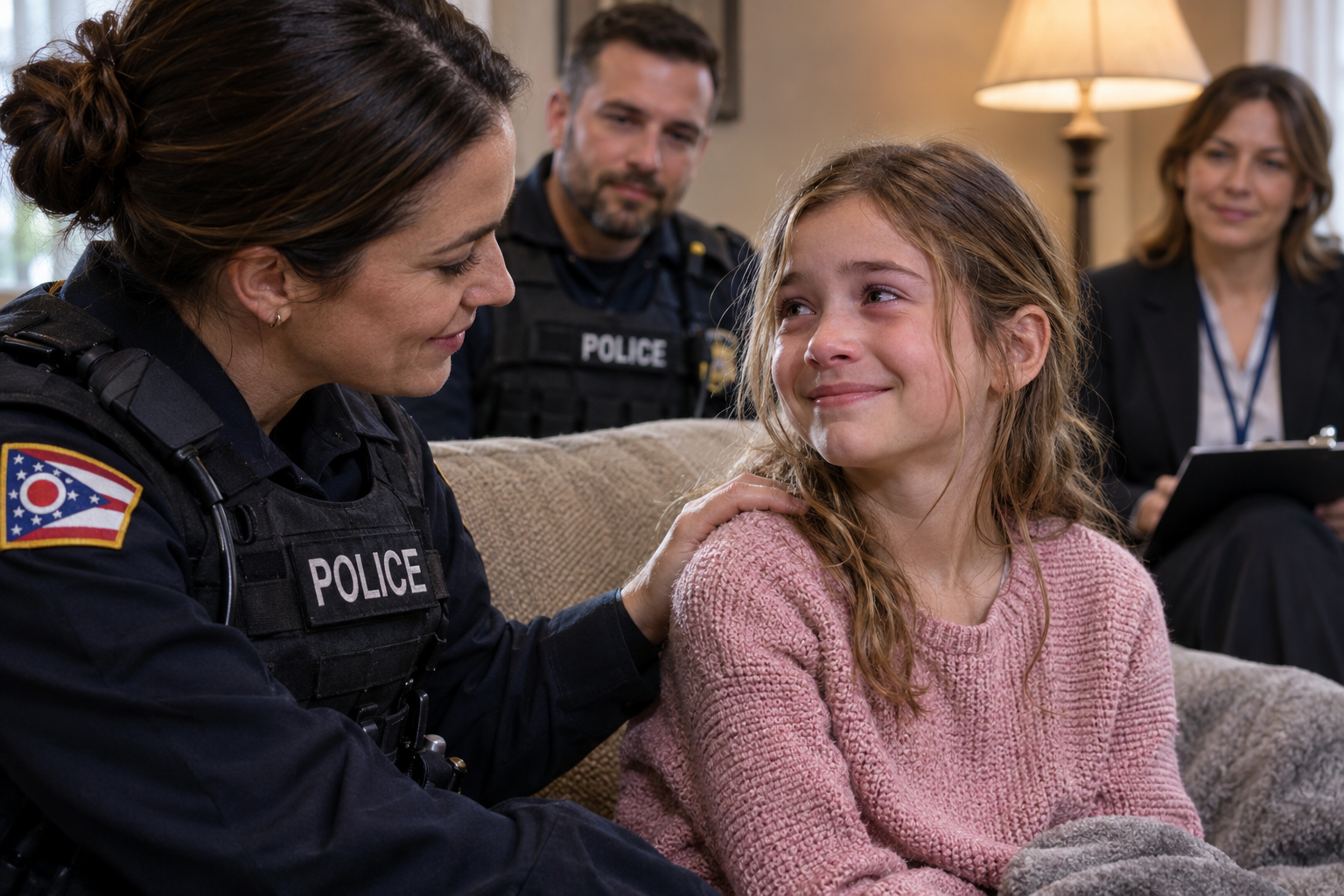
I had seen children cry in front of police officers.
I had seen them become angry.
I had seen them hide behind adults and refuse to answer simple questions.
Emily did none of those things.
She stayed quiet.
Too quiet.
And while Daniel spoke with her father, she kept studying him as though every small movement might tell her what was coming.
I remember her eyes following Thomas.
When he shifted his weight, she noticed.
When he moved his hands, she noticed.
When his expression changed, she noticed that too.
Nothing escaped her.
It was painful to watch.
Daniel stood beside Thomas.
He gave him another chance to move away from the conversation.
"Please wait in the living room while we talk with Emily."
Thomas didn't even consider it.
"I'm not doing that."
His answer was immediate.
There was no confusion about what Daniel had asked.
No suggestion that Thomas hadn't understood.
He simply refused.
I watched Emily.
She seemed to become even more attentive.
I had the strange feeling that she wasn't listening only to the words.
She was measuring what those words might cause.
Daniel remained calm.
"Then we need to keep things as they are until someone from child protection can get here."
Thomas stared at him.
"And if I don't agree?"
Daniel didn't raise his voice.
"We'll maintain the scene and wait for the appropriate people to arrive."
There was a pause.
I could hear how carefully Daniel had chosen his words.
He was giving Thomas a clear explanation.
He wasn't trying to frighten him.
He wasn't trying to provoke an argument.
He was telling him what would happen if he continued preventing us from speaking privately with Emily.
Thomas gave a strained smile.
The expression didn't seem to match the situation.
"This has gone far enough."
He said it as though he expected the statement to end everything.
It didn't.
I stayed focused on Emily.
Then she lifted both hands.
They went straight to her ears.
I remember that movement more clearly than Thomas's words.
It was sudden.
Not careless.
Not playful.
She covered her ears as though she knew something unpleasant was about to happen.
A tiny sound escaped her.
"Please, no."
I moved closer.
I lowered myself until I was near her eye level again.
"Emily, what's worrying you?"
She didn't look at me immediately.
Her eyes were still fixed in her father's direction.
I waited.
I wanted to reassure her.
But I didn't want to put words in her mouth.
I needed to hear what she was trying to say.
She answered in a small voice.
"When people don't do what Dad wants, he gets mad."
I felt cold.
Not because the statement was enough to tell me everything.
It wasn't.
Children sometimes described ordinary anger in frightening ways.
And we still needed to understand what she meant.
But her words matched what her body had been showing us.
She hadn't begun crying.
She hadn't thrown herself toward either officer.
She had simply prepared herself.
And now she had given us a reason.
I could feel Daniel's attention shift.
He had heard her.
Thomas had heard her too.
His head turned sharply toward his daughter.
"Emily."
One word.
Her name.
That was all he said.
But I saw her reaction.
Her body jerked.
It was immediate.
She recoiled before anyone had touched her.
I felt my stomach tighten.
There are things an officer can document very clearly.
The words that were spoken.
The movements people made.
The order in which events happened.
And then there are the conclusions that begin forming in your mind while you're watching.
I was careful not to confuse the two.
But what I had just seen frightened me.
Thomas hadn't needed to shout.
He hadn't needed to come closer.
He had spoken his daughter's name in a way that made her flinch.
And that reaction mattered.
I looked at Emily's hands.
They were still near her ears.
I wanted to tell her she could lower them.
I wanted to tell her she was safe.
Instead, I kept my voice steady.
"You're all right. I'm listening."
I didn't ask another question immediately.
She had already said something important.
And I didn't want to turn that moment into an interrogation.
Daniel understood.
He didn't argue with Thomas about what Emily had said.
He didn't attempt to explain the child's reaction aloud.
He reached for his radio.
Quietly.
Deliberately.
I knew what that meant.
He had decided we needed more help.
Not later.
Now.
He identified himself to dispatch as Unit Twenty-Four.
I kept my eyes on Emily while he spoke.
His voice was controlled.
He asked for a supervisor.
Then he requested someone from Child Protective Services.
He also wanted a detective sent to our location.
And he asked for another patrol unit.
I listened carefully.
Each request told me that Daniel was taking the situation seriously.
We didn't yet know the full story.
We hadn't established what Emily had experienced.
We didn't know whether she would be willing or able to explain more.
But we had enough concern to stop treating the situation as an ordinary conversation.
We needed people who could help assess what was happening.
We needed support.
And we needed to make sure our next decisions didn't increase the child's fear.
At dispatch, Claire was the one who heard Daniel's transmission.
I knew her.
And I knew she was familiar with the way Daniel worked.
He wasn't the sort of officer who made a situation sound worse than it was.
If anything, he became more controlled when he was deeply concerned.
That was the thing about his voice.
The calmer he sounded during a difficult call, the more closely experienced people listened.
Claire listened.
She could hear what he was requesting.
And she understood that the requests themselves carried a message.
A supervisor.
Child protection.
A detective.
Additional officers.
Those weren't casual requests.
They meant Daniel believed the situation required a more careful response than the two of us could provide alone.
Claire sent another unit.
I would later think about how important it was that she understood the tone of his call.
No dramatic warning had been necessary.
No raised voice.
No shouted declaration that things had gone wrong.
Just an officer who knew what help he needed.
And a dispatcher who recognized the seriousness of the request.
Back in the house, everything still seemed painfully quiet.
Thomas was there.
Emily was there.
Daniel and I were still trying to keep the situation controlled.
I looked at the little girl.
I could see how much attention she was giving to her father's reactions.
Even after she had spoken.
Even after Daniel had called for help.
She was still watching him.
That was what unsettled me most.
Children should be able to look away from their parents.
They should be able to become distracted.
They should be able to think about something other than whether an adult is becoming angry.
Emily didn't seem able to do that.
I couldn't stop thinking about the way she'd covered her ears.
It had happened before Thomas raised his voice.
Before any obvious confrontation.
She seemed to have anticipated trouble from the disagreement alone.
I didn't know what experiences had taught her to respond that way.
I wasn't going to invent an explanation.
But I was no longer willing to dismiss it as ordinary nervousness.
Her behavior deserved attention.
Her words deserved attention.
And Thomas's response deserved attention too.
I stayed near her.
I didn't want to crowd her.
I didn't want her to feel that she had said something wrong.
So I made myself remain patient.
I could hear Daniel continuing to manage the interaction with Thomas.
His tone stayed even.
That steadiness mattered.
I believed it was helping us avoid making a difficult situation worse.
But I couldn't ignore the fact that Emily still appeared frightened.
More adults were coming.
That was necessary.
It was also something we would need to handle carefully.
Because for a child who already seemed afraid of anger, an official response involving several strangers could be overwhelming.
I looked toward Daniel.
He gave me a brief glance.
There was no reassurance in it that everything would be fine.
And I appreciated that.
He wasn't pretending we knew more than we did.
We had to keep going.
We had to listen.
We had to let the people trained to assess a child's safety help determine the next steps.
Most importantly, we couldn't leave simply because Thomas wanted the conversation to end.
I turned back to Emily.
Her hands had shown me something her words alone hadn't.
Her flinch had shown me something too.
I couldn't say what those reactions meant beyond doubt.
But I could say they were real.
I had watched them happen.
And that was enough to make me understand that we needed to remain there until the proper help arrived.
Click here to continue reading: PART 4: The Radio Call Sounded Routine, but Everyone Who Understood Daniel’s Voice Knew We Could Not Treat This Child’s Fear Lightly
I Thought We Were Answering an Ordinary Call Until a Little Girl Made Me Question Everything About Her Home
Part 3 of 10