I had always wanted difficult calls to end with certainty.
Someone safe.
Someone responsible.
A clear explanation of what happened.
A decision everyone could understand.
Emily taught me that those endings were not always available when you needed them.
Sometimes the responsible thing was to admit what remained unknown.
And make sure the next people involved understood why those unanswered questions mattered.
By the time our immediate work was drawing toward its next stage, Emily looked exhausted.
She had stopped asking whether she'd spoken correctly.
But she still watched the adults carefully.
I didn't expect that habit to disappear in a few hours.
I knew better.
Fear doesn't always leave simply because the person causing it is in another room.
Sometimes the body keeps expecting the next frightening moment.
Even when everything becomes quiet.
I had watched Emily do that all afternoon.
Her eyes following movements.
Her hands pressing together.
Her attention shifting toward her father's voice.
And I couldn't forget how quickly she'd covered her ears when Thomas resisted Daniel's request.
That reaction had changed everything for me.
Not because it established a complete history.
It didn't.
But because it showed us that Emily was frightened in a way we couldn't ignore.
I looked toward the child protection worker.
She was explaining that the assessment would continue and that the adults responsible would determine the appropriate safety arrangements.
Emily listened.
She seemed to be concentrating on every word.
I wondered whether she was trying to memorize the explanation.
Or simply trying to understand what it meant for her.
I couldn't know.
But I could see that she was asking questions when she needed to.
That mattered.
"Will somebody tell me if the plan changes?"
The worker nodded.
"We'll explain what we're able to explain."
Emily considered that.
Then she asked whether she could speak again if she remembered something important.
The worker reassured her.
I watched her expression.
She didn't smile.
But she looked less uncertain.
For the first time that afternoon, she seemed willing to accept that she didn't have to provide every answer immediately.
I wished I'd understood how important that was much earlier.
Children aren't machines that produce complete explanations when adults ask the correct questions.
They remember things gradually.
They become frightened.
They lose their place.
Sometimes they need time before they're ready to speak.
And sometimes the first useful answer is simply an honest question.
Emily had given us several.
Was she responsible for her father's anger?
Could she refuse something that felt wrong?
Would she be blamed for speaking?
Could she ask for help?
Those questions had told me more about her worries than any dramatic accusation could have.
I thought about the first time I knelt beside her.
I'd wanted her to trust me.
I had assumed the task was to help her understand that I was there to listen.
Now I realized that trust also required allowing her to see what happened after she spoke.
Would we remain calm?
Would we take her seriously?
Would we let her ask for explanations?
Would we treat her words carefully?
Those things mattered.
Perhaps more than my first reassuring smile.
I stepped aside to complete my account of what I'd witnessed.
I wanted every detail recorded accurately.
Thomas's refusal.
Daniel's requests.
The involvement of additional personnel.
Emily's reaction to her father's voice.
And the words she'd spoken directly to me.
I was careful with the order.
Careful with the language.
I didn't want my account to become more dramatic with each retelling.
The truth didn't need that.
I remembered how Thomas had turned toward Emily when she spoke about his anger.
I remembered his tone.
And I remembered her flinch.
Those were the facts I could stand behind.
I couldn't honestly describe everything that happened in that home before our arrival.
I hadn't been there.
I couldn't claim to know exactly what Thomas had done in the past.
I couldn't know what he was thinking.
But I could explain why the situation had required an immediate, coordinated response.
That was my responsibility.
And I took it seriously.
Daniel completed his account too.
He had remained professional throughout the confrontation.
I appreciated that more than I could express.
He'd been firm without becoming aggressive.
He'd requested help rather than allowing the situation to grow into a pointless struggle over authority.
And he'd continued managing Thomas while the child protection worker spoke with Emily.
I thought about Claire.
She'd been sitting at dispatch when Daniel called.
She'd heard his voice.
She'd understood that his calm request meant something serious required attention.
And she'd sent backup.
I wanted to thank her later.
Not for doing something extraordinary.
For doing her job well at a moment when it mattered.
Our supervisor continued coordinating with the detective and the child protection worker.
I understood that the final findings and longer-term outcome couldn't be determined from our initial observations alone.
There were still questions that needed investigation.
There were decisions that belonged to other professionals.
And there were safety concerns that couldn't be settled by Thomas simply insisting his daughter was fine.
That was the difference between arriving at a house and completing an investigation.
We had reached the point where the right people were involved.
We had not reached the point where every question was answered.
I had to accept that.
For Emily's sake.
And for the sake of an accurate process.
I returned to her when I could.
She was sitting with the worker.
The cup of water remained nearby.
I noticed her hands.
They were resting on her lap again.
She looked toward me.
"Are you finished?"
"With some of my work."
She considered that answer.
"Does that mean you're going away?"
I felt the familiar ache in my chest.
I knew I couldn't remain with her indefinitely.
I had other responsibilities.
And the professionals overseeing her assessment would continue their work.
Still, I wanted to make the transition as gently as possible.
"The people helping you are going to keep working with you."
She looked at the worker.
Then back at me.
"Will they listen?"
I nodded.
"That's what they're here to do."
The worker confirmed that Emily could continue asking questions and explaining things that worried her.
Emily listened.
Then she gave a small nod.
I was relieved she didn't appear to believe that my leaving meant everyone else would stop listening.
That had been one of my worries.
I had become a familiar face during a frightening afternoon.
And I didn't want her to feel abandoned when another professional took responsibility.
The worker continued explaining the process.
Emily asked when she would know what happened next.
The answer remained careful.
I could see that she wanted more certainty.
But she didn't become silent the way she had earlier.
Instead, she asked another question.
And the worker answered it.
I watched that exchange with a strange mixture of sadness and relief.
Sadness because such ordinary communication had seemed difficult for her at the beginning.
Relief because she was beginning to take part in it.
Nobody scolded her.
Nobody told her she'd asked too much.
Nobody treated her questions as disrespect.
She was allowed to understand what was happening around her.
I wondered how different the afternoon might have been if Thomas had allowed that from the beginning.
But there was no point spending time imagining another version of the call.
We had to deal with the one that happened.
Thomas had refused our requests.
Emily had shown fear.
And that fear had led us to involve the appropriate people.
Now their work would continue.
I thought about the title I might give the incident if I were telling someone about it years later.
Not because of the paperwork.
Because of what had stayed with me.
A little girl who had learned to anticipate anger.
A father who didn't want her speaking privately.
And a group of adults trying to determine what she needed without making her more frightened.
It wasn't a neat story.
I couldn't pretend otherwise.
But there was something important about the way it unfolded.
Emily hadn't needed to scream to deserve attention.
She hadn't needed to arrive with a perfect explanation.
She hadn't needed to provide all the answers before we decided her fear should be taken seriously.
Her behavior was enough to justify asking more questions.
Her words were enough to justify listening.
And Thomas's resistance was enough to make us recognize that a private conversation was necessary.
Those decisions had consequences.
The police remained involved.
Child Protective Services began its assessment.
A detective was assigned to examine what warranted further investigation.
And the situation was no longer something Thomas could end simply by refusing to cooperate.
That was the change we had actually achieved.
I didn't know whether it would resolve every concern.
I didn't know what the final investigation would establish.
But I knew Emily had been given an opportunity she'd been afraid to request.
The chance to speak without her father listening.
And she had used it.
Carefully.
Quietly.
Sometimes with tears.
Sometimes with questions.
Sometimes with long silences.
But she had spoken.
I looked at her again.
She was listening to the child protection worker explain something.
Her head was slightly tilted.
She asked for clarification.
The worker repeated herself.
Emily nodded.
No flinch.
No sudden attempt to cover her ears.
Just a child asking someone to explain.
I felt my throat tighten.
It was such an ordinary moment.
And yet it was the moment I wished someone had been able to give her long before we arrived.
I moved closer when it was appropriate to say goodbye.
Emily looked up.
"Do you have to leave?"
"Yes, sweetheart. But these people are going to keep helping you."
She studied my face.
"Did I do something good?"
I hesitated.
I didn't want her to think she had been taking a test.
I didn't want to praise her in a way that made her believe she had to tell us more to earn approval.
So I answered simply.
"You spoke about something that worried you. That was okay to do."
She looked down.
Then back up.
"Even if somebody doesn't like it?"
"Even then."
She nodded.
I could see her thinking.
Then she asked one final question.
"Can I tell somebody if I'm scared tomorrow too?"
My heart hurt.
"Yes, Emily. You can tell someone whenever you're frightened or need help."
She looked toward the worker.
The worker nodded too.
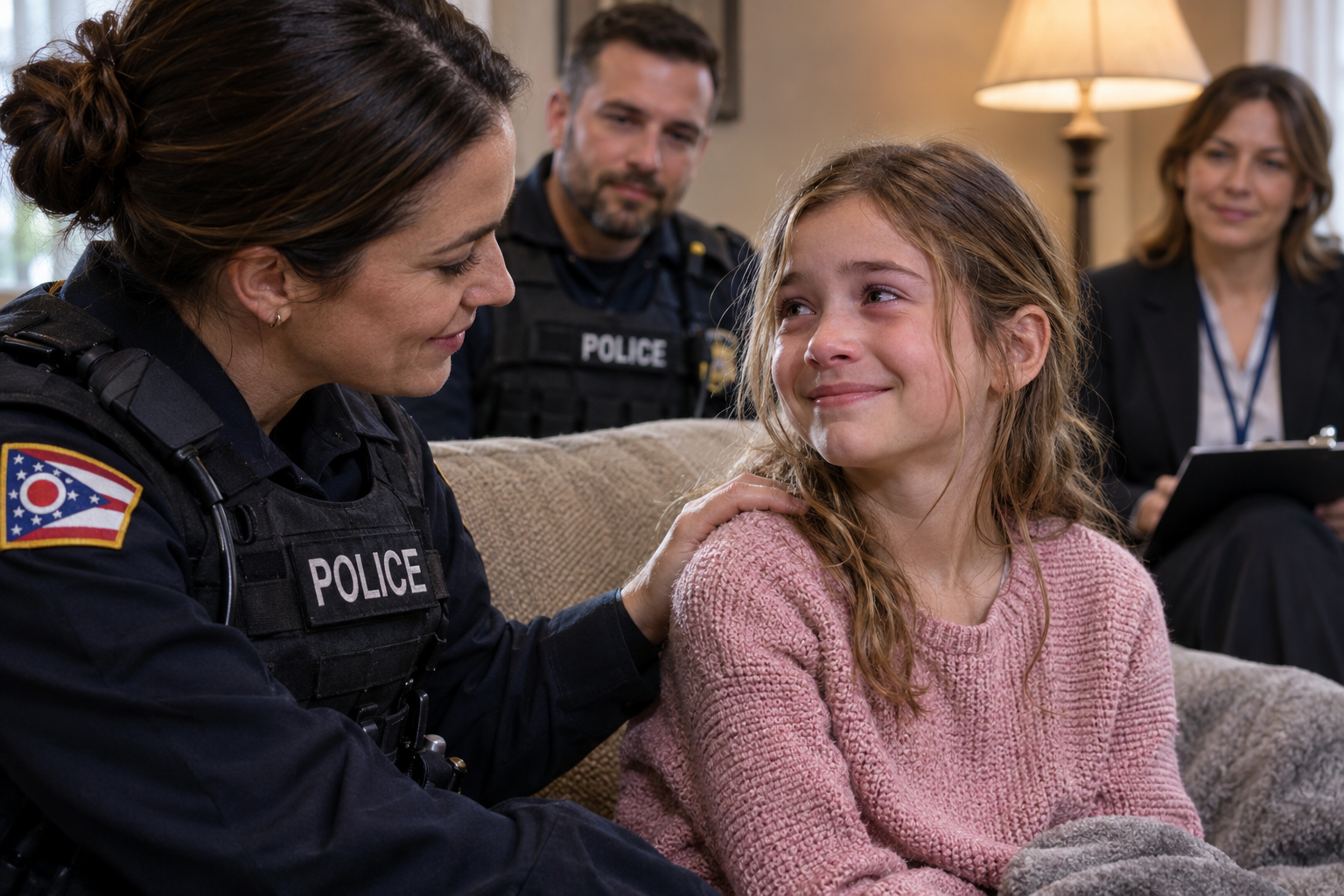
For the first time, I saw the smallest hint of a smile.
It didn't last long.
But it was there.
I wanted to hold on to that moment.
I knew better than to mistake it for a complete recovery.
A smile couldn't tell us whether she would be safe in the long term.
It couldn't explain the past.
It couldn't answer the detective's questions.
But it reminded me that Emily was still a child.
Not merely someone connected to an investigation.
Not simply a frightened witness.
A little girl who needed to know she could speak and be heard.
I said goodbye.
Then I stepped away.
Daniel was waiting nearby.
He looked at me.
"How is she?"
I thought for a moment.
"She's asking questions."
He nodded.
"Good."
I knew what he meant.
Not that everything was fine.
Not that the situation had been resolved.
Just that Emily was beginning to use her own voice.
We completed the responsibilities required of us.
The child protection worker and the other appropriate authorities continued determining the necessary next steps.
We did not have a final account of everything that had occurred in Thomas's home.
And I wouldn't pretend we did.
The true extent of what Emily feared remained something the investigation needed to establish.
That uncertainty troubled me.
It still does when I think about the call.
But I understood one important thing.
We had not ignored her.
We had not dismissed her because she was quiet.
We had not accepted her father's refusal as the final answer.
We had stayed.
We had listened.
And we had involved people who could continue the work.
I thought about the way Emily had watched Thomas when we first arrived.
Every movement.
Every change in his voice.
Every moment of disagreement.
I remembered how she'd seemed to expect anger before anyone raised a hand or shouted.
Then I remembered the final moments I'd spent with her.
She had still been frightened.
Still uncertain.
Still waiting for adults to explain what would happen.
But she had asked questions without first seeking her father's permission.
She had told us she wanted to speak.
And she had learned that she could ask for help again.
That wasn't the complete outcome of the investigation.
It wasn't a final answer about Thomas.
And it wasn't proof that every danger had passed.
It was something smaller.
But real.
A little girl had been heard.
And the adults responsible for her safety now had information they could not responsibly ignore.
I left the house knowing that the work would continue beyond my presence.
I hoped the remaining questions would be answered.
I hoped Emily would receive the support she needed.
And I hoped that someday, when someone asked her how she felt, she wouldn't first look toward another person to decide whether it was safe to answer.
I couldn't promise that day would come.
But I knew what we'd done that afternoon had given her a chance to begin.
And for the first time since I'd met Emily, I could remember her face without seeing only fear.
I remembered the little smile.
The cup of water.
The way she'd asked one more question.
And the quiet voice that had finally begun to belong to her.
The End
Read more original stories on Feel Every Story.
I Thought We Were Answering an Ordinary Call Until a Little Girl Made Me Question Everything About Her Home
Part 10 of 10