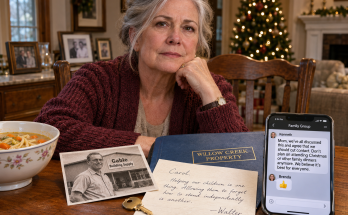
There were things I had learned to endure without making much noise.
I had learned them the hard way.
By sixty-eight, I had already lived through the death of my husband.
I knew what it meant to lose someone whose presence had shaped the ordinary parts of every day.
I had also learned what it meant to become seriously ill.
In 2014, I was diagnosed with breast cancer.
There had been a mastectomy.
There had been eight rounds of chemotherapy.
I remembered those facts clearly.
They were not things a person forgot.
And afterward, I had continued living.
I watched my sons grow older.
I watched them become husbands and fathers.
I saw them make homes and families of their own.
The years had moved forward whether I was ready or not.
I had believed that surviving those experiences would make me better prepared for whatever came next.
Looking back, that belief seems foolish.
Not because grief and illness hadn't been difficult.
They had been.
But nothing about those experiences had taught me how to read a message from my own child telling me to stay away from the family.
That pain was different.
It didn't arrive through a doctor's explanation.
It didn't come with a funeral or a date that the whole family understood.
It arrived in an ordinary conversation on my phone.
Just words on a screen.
And I was expected to understand that the decision had already been made.
Kenneth had been my oldest child.
That mattered to me.
I couldn't look at his name without remembering that he was the one who had first made me a mother.
Before Mason.
Before grandchildren.
Before the family had grown into separate households with separate lives.
There had been Kenneth.
I didn't need to pretend that raising children had been simple.
It hadn't been.
Children grew.
They changed.
Their lives became their own.
I understood that.
I had watched it happen with both my sons.
There was a time when I could tell whether either of them was getting sick just by looking at his face.
There was a time when a pot of soup seemed like a reasonable answer to almost any miserable afternoon.
They were men now.
They had wives.
They had children.
They owned houses.
Their lives didn't revolve around me, and I had never expected them to.
But I had expected to remain their mother.
That was the distinction I couldn't put into words as I stood in the kitchen.
I didn't need every holiday to be arranged around me.
I didn't need everyone to agree with me.
I didn't need to be the most important person at the dinner table.
I only wanted to know that there was still a place for me somewhere around it.
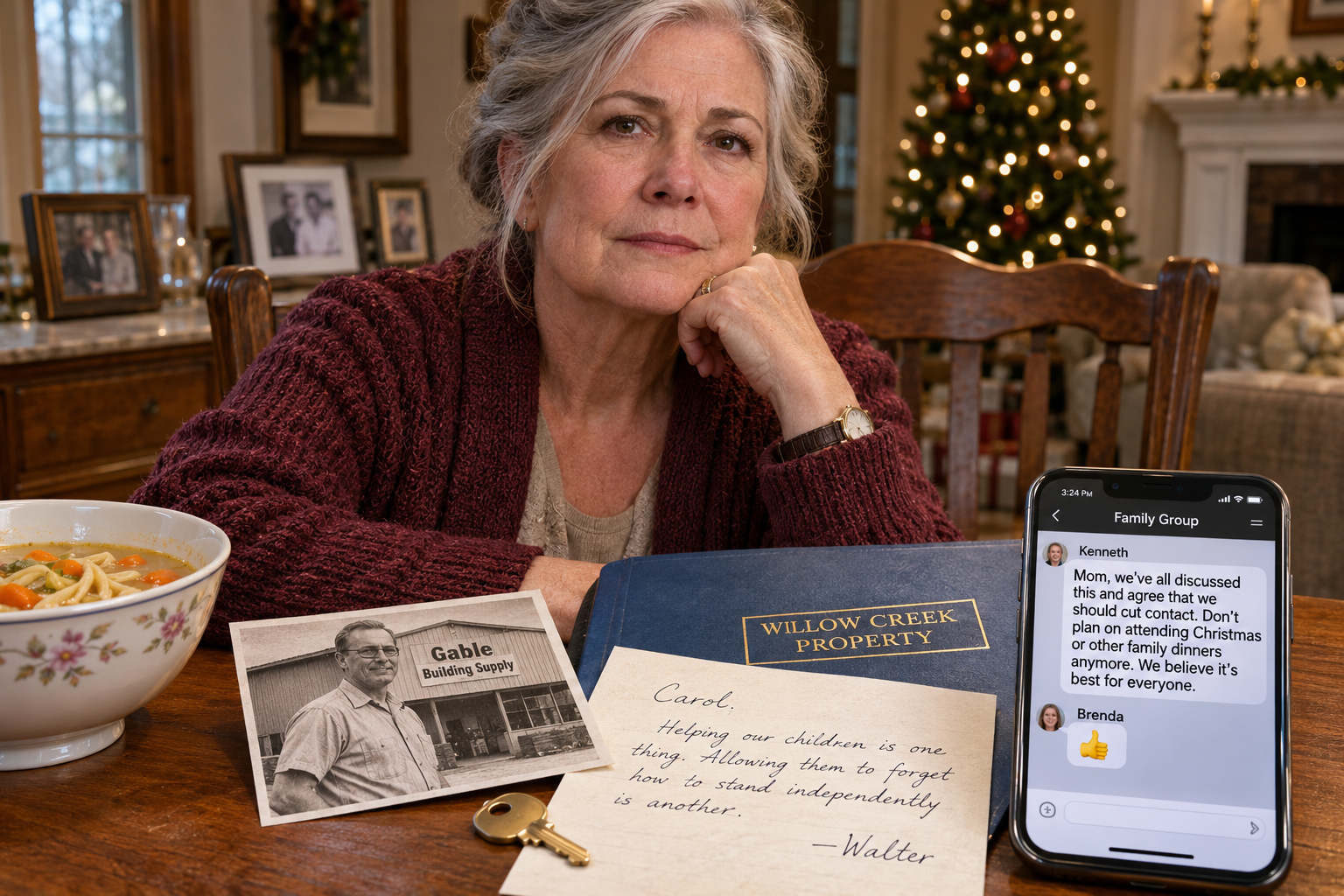
Kenneth's message told me there wasn't.
I returned to the first sentence.
He said they had discussed the situation as a family.
I kept noticing that.
A family discussion.
About removing a family member.
I tried to imagine when that conversation had happened.
Had everyone been present?
Had anyone questioned the decision?
Had someone said they should talk to me first?
I had no answers.
The message didn't provide any.
It simply presented the result as though I were being notified about a change of plans.
And the more I looked at it, the more I understood how deliberate the wording was.
He hadn't said he was upset with me.
He hadn't said he needed a little distance.
He hadn't said Christmas would be difficult this year.
He said they wanted to end the relationship.
That was much bigger than one dinner.
Christmas was only the occasion he had chosen to tell me.
I thought about how long I had been a mother.
The nights when my boys were sick.
The years when every small problem in their lives had seemed important because it was important to them.
The things a person did without thinking about whether they would ever be remembered.
I had never kept a record of those things.
Most mothers didn't.
You simply got through the days.
You made meals.
You worried.
You watched.
Then one morning you realized the children were adults, and the house was quieter than it used to be.
That was how life was supposed to work.
I knew that.
What I hadn't expected was to be informed that my presence had become something the family needed to remove.
It was a hard thing to understand.
Particularly because I could still picture Kenneth as one of the little boys who had eaten my soup.
I looked toward the stove.
The carrots were moving through the broth.
The noodles had softened.
I had started making the soup because Eleanor was ill.
I was still making it for her.
That hadn't changed.
But my attention kept returning to the phone.
I thought about my husband.
He had been gone long enough for me to know that wishing someone were beside you did not bring them back.
Still, there were moments when I felt his absence more sharply than others.
This was one of them.
There was no one standing beside me who could tell me whether I had misunderstood the message.
No one to say that Kenneth would surely call.
No one to help me sort through the strange feeling of being dismissed by people who had been the center of my life.
I was alone with the words.
I could have tried to explain them away.
Perhaps Kenneth was angry.
Perhaps he had written something too harshly.
Perhaps a private conversation would follow.
But none of those possibilities appeared on the screen.
The words were plain.
The family had decided.
I was not to attend the holiday gatherings.
It would be better for everyone.
I found that final claim especially difficult.
Better.
For whom?
The message didn't say.
I wondered whether Kenneth genuinely believed I would feel better staying away.
Or whether he had used that phrase because it made the decision sound less cruel.
I didn't know.
I couldn't know what was in his mind.
All I could judge was what he had written.
And what he had written left very little room for me.
I kept holding the phone.
I was old enough to understand that loving someone did not mean they would always treat you kindly.
I was also old enough to know that people could become strangers to each other while still sharing a family name.
But understanding something in general was very different from having it happen to you.
I had survived losing my husband.
I had survived the operation and the chemotherapy.
I had watched both sons become adults.
And still, I hadn't been prepared for a Thursday afternoon when the child who made me a mother would tell me that the family no longer wanted me at Christmas.
I wanted to ask why.
That was the simplest truth.
Not argue.
Not accuse.
Just ask what had happened between us that was so terrible that a family message had become the only explanation I would receive.
But before I could decide whether to respond, something else appeared beneath Kenneth's words.
A small symbol.
Yellow.
Familiar.
A thumbs-up.
Someone had approved his message.
Click here to continue reading: PART 3: Brenda Needed Only One Small Reaction to Tell Me Where She Stood, and the Others Said Nothing at All
I Was Making Soup for a Sick Neighbor When My Oldest Son Sent the Message That Changed Christmas for Me
Part 2 of 4