
Forty seconds.
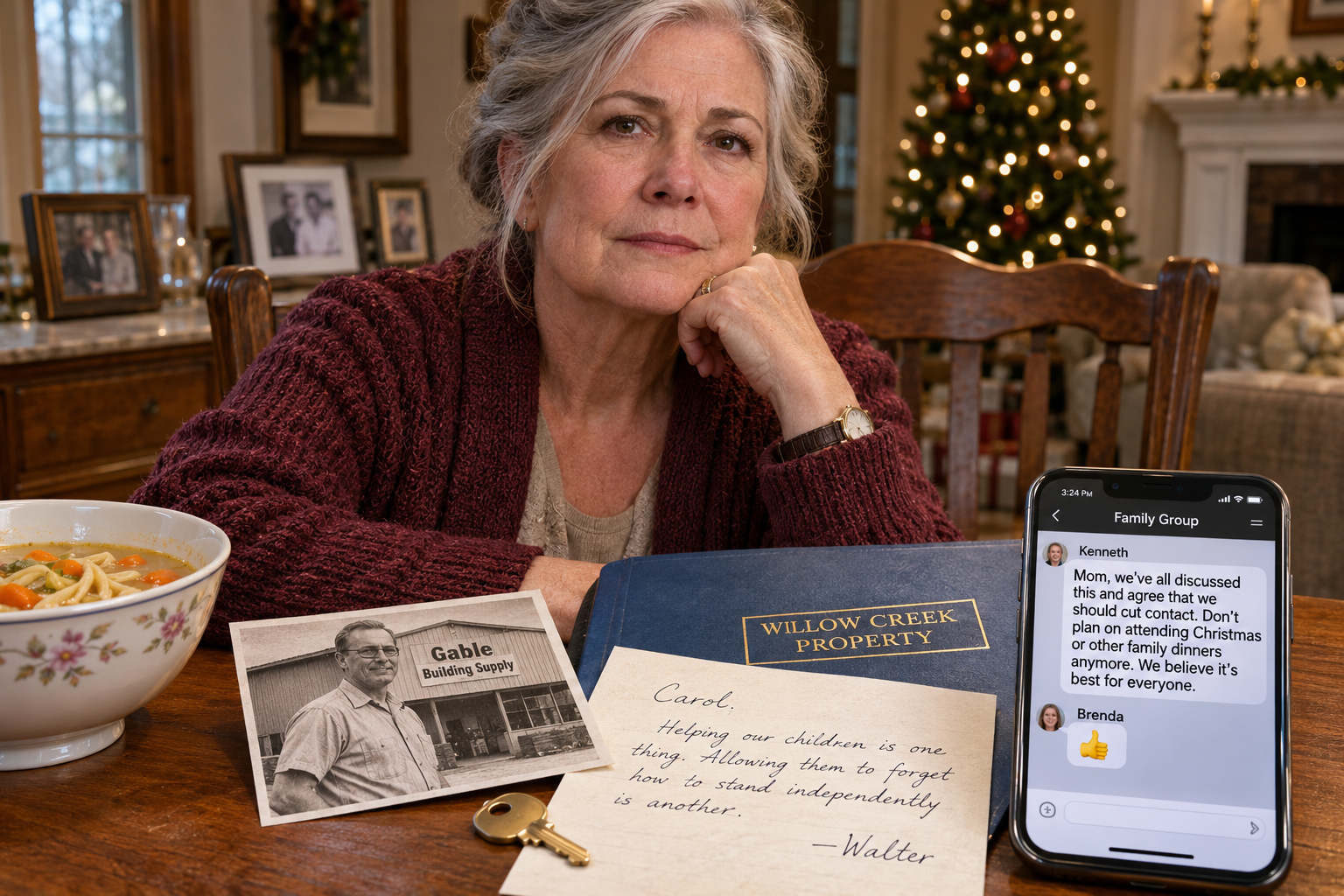
That was how long it took for someone to respond to Kenneth's message.
I remember the interval because it seemed so small compared with what he had just announced.
My son had told me I was being pushed out of the family.
And forty seconds later, someone had decided that the proper response was a little yellow hand with its thumb raised.
It was Brenda.
Kenneth's wife.
My daughter-in-law.
She didn't write a sentence.
She didn't ask whether I had seen what Kenneth said.
She didn't suggest that anybody should talk to me.
She pressed the button that meant she approved.
And that was all.
I stared at the symbol.
It seemed almost ridiculous that such a small picture could hurt so much.
I had seen people use that same reaction for ordinary things.
A photograph.
A reminder.
Some small arrangement that didn't require a written answer.
Now it was sitting beneath a message telling a mother she was no longer welcome among her own family.
I couldn't stop looking at it.
I tried to understand what Brenda meant.
Had she helped Kenneth decide what to write?
Had she simply agreed with him?
Had she pressed the reaction because she didn't want to say more?
There was no way to tell.
I didn't have access to the conversation that had supposedly taken place before Kenneth wrote to me.
I only had the result.
And Brenda's response made that result feel settled.
She had taken less than a minute to show which side she was on.
I wished she had written something.
Even a few words.
A sentence might have given me something to understand.
A sentence could have been questioned.
A sentence could have led to a conversation.
But a thumbs-up left nothing to answer.
It was approval without explanation.
I looked at the family group name again.
Gable Family.
The little red heart was still there.
Lily had chosen that name four years earlier.
I remembered how pleased I had been to have everyone connected.
It had seemed like a small gift.
I could follow the grandchildren's news.
I could see the photographs people shared.
I didn't have to rely on hearing everything secondhand.
For a woman whose children had grown and moved into lives of their own, that had meant more than I probably admitted.
I liked feeling that I could still take part.
Not every day.
Not in every conversation.
But enough to know I hadn't disappeared from the family's ordinary life.
At first, the messages had come regularly.
Someone would have good news.
Someone would post a picture.
There would be a comment or a little exchange that made me smile.
Nothing remarkable.
That was what made it valuable.
The family wasn't discussing emergencies or serious decisions all the time.
They were simply sharing their days.
Then the conversations had become less frequent.
At least, the ones that included me had.
I had noticed the difference.
I would be lying if I said I hadn't.
I had wondered whether everyone was busy.
Families had work and school and all the things that filled a week.
My sons had responsibilities.
Their children were growing.
People didn't always have time to keep up with every message.
That was reasonable.
I told myself it was reasonable.
And most days, I managed not to think much about it.
But that afternoon, looking at Kenneth's announcement and Brenda's little reaction, I began to wonder how much of that silence had been deliberate.
I didn't know.
I couldn't prove anything about the past.
Still, the question sat heavily with me.
Had the family been moving away from me for longer than I realized?
Had I mistaken distance for busyness?
Had I been the last person to understand that something had changed?
I looked at the names in the conversation.
They were all familiar.
People I knew.
People connected to me by years of shared family life.
This wasn't a stranger's message that I could ignore and forget.
These were the people who had watched my sons grow.
People who knew I had been ill.
People who knew my husband was gone.
They understood that I was a real person sitting somewhere on the other side of the screen.
At least, I believed they understood.
And that was what made their silence difficult to bear.
I waited.
I had no reason to think the messages would stop with Kenneth and Brenda.
Surely somebody would say something.
Perhaps someone would ask if we could talk.
Perhaps one of the others would tell Kenneth that a family decision deserved more than a text.
I didn't know what I expected.
I only knew I wasn't ready to believe that everyone would accept it without a word.
So I kept watching.
The phone remained in my hand.
The soup continued simmering.
I could hear the ordinary sounds of the kitchen around me.
And every time I looked down, Kenneth's message was still there.
There was no new explanation.
No attempt to soften the meaning.
Brenda's reaction remained beneath it.
I found myself reading the message in smaller pieces.
The family had spoken.
The decision had been made.
The holiday invitations were over.
Everyone would supposedly be happier this way.
It was such a tidy announcement.
As though a relationship between a mother and her children could be closed with a few lines.
As though the years behind it needed no acknowledgment.
I wasn't expecting gratitude for raising my sons.
That wasn't what bothered me.
A mother didn't spend years caring for children so she could send them a bill when they became adults.
I had never thought of my family that way.
But I did expect a little consideration.
Especially when the subject was something as painful as separation.
I thought Kenneth could have told me himself.
Not through the family group.
Not with everyone watching.
He could have called.
We could have spoken privately.
I might not have liked what he said.
I might have cried.
But at least I would have heard his voice.
Instead, the whole thing had been presented in front of the others.
And I had been left to decide whether to defend myself in that same conversation.
That was another part of it.
If I answered, everyone would see my answer.
If I asked what I had done, everyone would see that too.
If I became upset, there would be a written record of it.
I didn't know whether Kenneth had considered that.
I didn't know whether he cared.
I only knew how exposed it made me feel.
For years, that group had been a place where I could see ordinary pieces of the family's life.
Now it had become the place where my son announced that I was no longer part of it.
I looked at Brenda's reaction again.
One little sign.
No explanation.
No kindness.
And then I noticed the information beneath the message beginning to change.
The phone was showing who had read what Kenneth wrote.
The names were appearing.
And I realized I wasn't only waiting for someone to respond.
I was watching the people I loved learn that I had been excluded.
Click here to continue reading: PART 4: As the Family Read Kenneth’s Message in Silence, I Remembered the One Fact About His Christmas House He Had Overlooked
I Was Making Soup for a Sick Neighbor When My Oldest Son Sent the Message That Changed Christmas for Me
Part 3 of 4

One Comment on “PART 3 – Brenda Needed Only One Small Reaction to Tell Me Where She Stood, and the Others Said Nothing at All”