
Beatrice left the conference room before anyone else moved.
Her heels struck the floor.
The sound followed her into the hallway.
Then the door closed.
I sat quietly.
My mother stared at the empty chair.
Dad rubbed his forehead.
David began arranging the documents.
Nobody seemed certain what to say.
I understood that feeling.
We had entered the office expecting an estate meeting.
Instead, we had discovered how little we understood about Arthur's financial arrangements.
And how much my sister had expected to receive.
My father spoke first.
"She's upset."
I looked at him.
"I noticed."
He frowned.
"Audrey."
I knew that tone.
He wanted me to soften.
He wanted me to consider Beatrice's feelings.
He wanted the room to return to the familiar arrangement.
My sister was hurting.
Everyone else should accommodate her.
I looked at the empty chair.
"She's upset because she didn't inherit what she expected."
Dad sighed.
"That's not fair."
I turned toward him.
"What isn't fair?"
"She's just lost her husband."
I felt something move painfully in my chest.
"I lost him too."
My father looked away.
I continued.
"I lost him before he died."
Mother lifted her eyes.
For once, she did not immediately defend Beatrice.
I looked down at the envelope.
"Nobody seemed particularly worried about that."
The words came out quietly.
But they had been waiting inside me for months.
Dad opened his mouth.
Then closed it.
I remembered the night of the divorce.
How Arthur had told me he wanted to leave.
How Beatrice had appeared in her red dress.
How I had waited for someone to tell her that what she was doing was cruel.
Nobody had.
Not Arthur.
Not my parents.
Not anyone.
I had been expected to survive it quietly.
Now Beatrice was angry about estate documents.
And my father wanted sympathy for her.
I looked at him.
"I don't want to fight about this anymore."
He nodded.
"Neither do I."
"Then please stop asking me to make her comfortable."
He stared.
I had never said anything like that to him.
Not so plainly.
I almost apologized.
The habit was strong.
I could feel the words forming.
Sorry, Dad.
I didn't mean to upset you.
But I did not say them.
David finished organizing the papers.
He looked toward my parents.
"Mrs. Jensen is entitled to seek legal advice. If she chooses to challenge any arrangement, that will be addressed through the appropriate process."
Dad nodded.
"Of course."
David continued.
"But nothing discussed today changes the fact that Audrey was the intended recipient of Arthur's private letter."
I looked at him gratefully.
He had repeated that point so many times.
Not because it was complicated.
Because my family kept trying to ignore it.
Mother stood slowly.
She picked up her purse.
Then she looked at me.
"Audrey, are you coming?"
I shook my head.
"I need to speak with David."
She hesitated.
"About the money?"
I looked at the smaller folder in front of me.
"About the education fund."
Mother nodded.
For a moment, she seemed about to say something else.
Then she followed Dad out of the room.
I watched the door close.
Only David and I remained.
The silence felt different.
Nobody was trying to interrupt.
Nobody was demanding an answer.
I could finally think.
David sat across from me.
"Would you like more water?"
I looked at the glass.
It was empty.
"Yes, please."
He filled it.
I took a sip.
Then I placed Arthur's letter beside the education documents.
"Can I ask you something?"
"Of course."
"Did Arthur know Beatrice expected to inherit everything?"
David considered his response.
"I can tell you what the records establish. Arthur knew the distinction between the family trust and his personal estate."
I nodded.
"That's what he wrote."
David remained quiet.
I looked at the envelope.
"He knew she misunderstood."
David did not speculate about Arthur's conversations with Beatrice.
That was fair.
He had not been present for every conversation.
Neither had I.
But I knew what Arthur had admitted in his letter.
He had allowed my sister to believe the fortune was something he could simply hand over.
He had enjoyed her admiration.
He had accepted what she offered.
Then he had left her to discover the truth after his death.
I felt angry again.
Arthur had hurt both of us.
Not in the same way.
And not with equal innocence.
But his dishonesty had left consequences that other people now had to manage.
I looked at David.
"Why didn't he just tell the truth while he was alive?"
David paused.
"I can't answer that for him."
I nodded.
That was the most honest answer anyone had given me all day.
I had spent months wanting Arthur to explain every decision.
Now he had left a letter admitting his mistakes.
But he could not answer follow-up questions.
He could not tell me what he would do differently.
He could not make anything right in person.
I wondered whether I would ever stop wishing for that conversation.
David opened the education folder.
"Would you like to discuss what Arthur proposed?"
I looked at the papers.
"Yes."
He explained the fund's purpose in ordinary language.
It was designed to support educational opportunities for children who needed additional resources.
Reading programs.
Books.
Classroom materials.
Assistance for schools and students with limited access to those things.
The governing documents identified how decisions would be made.
There were financial controls.
Reporting requirements.
Rules about using the money for its intended purposes.
I listened carefully.
I had taught long enough to know that good intentions were not enough.
Children needed actual help.
Books that arrived.
Programs that continued.
Supplies that teachers could use.
A promise did not matter if nobody followed through.
David explained that accepting a governing role would involve real work.
Meetings.
Reviewing proposals.
Making decisions with others responsible for the fund.
It would not mean I could personally spend the money.
I appreciated that.
I wanted those boundaries.
After everything that had happened, I did not want Arthur's wealth becoming another way for people to judge me.
Then David asked whether I had any concerns.
I almost laughed.
"Several."
He smiled faintly.
"That's reasonable."
I looked at the pages.
"What if Beatrice challenges everything?"
"The legal arrangements can be reviewed and defended as appropriate. But I can't promise that every dispute will be simple or quick."
I appreciated that he did not promise me an easy outcome.
"What if she says I manipulated Arthur?"
David looked at me.
"Did you ask him to establish the fund?"
"No."
"Did you participate in preparing the documents?"
"No."
"Did you even know about the arrangement before today?"
"No."
He nodded.
"Then those are important facts."
I stared at the table.
I had spent years defending myself against accusations I did not deserve.
It was exhausting.
Sometimes I had started to believe that if someone accused me strongly enough, I must have done something wrong.
Beatrice knew that.
She had used it throughout our childhood.
Whenever I received something she wanted, she found a way to suggest that I had taken it unfairly.
I remembered the spelling-bee ribbon again.
How proud I had been.
How quickly I had hidden it when nobody seemed interested.
I wondered how many other small pieces of myself I had put away.
David turned another page.
"You don't have to accept immediately."
I nodded.
"Arthur said that in the letter."
"Then he meant for you to have a choice."
I looked at him.
"That's what I'm struggling with."
He waited.
"For ten years, Arthur was part of almost every decision I made."
My voice grew quieter.
"Then he made the biggest decision of our marriage without me."
I looked down at my wedding finger.
The ring was gone.
I had removed it after the divorce.
But sometimes I still caught myself touching the place where it had been.
"Now he's gone, and somehow he's asking me to make another decision because of him."
David said nothing.
I appreciated that too.
I did not need advice immediately.
I needed room to understand what I felt.
I picked up the education documents.
"The work matters to me."
David nodded.
"I understand."
"I know children who need this kind of help."
I thought about the students in my classroom.
The ones who borrowed books and returned them carefully because they had none at home.
The children who pretended not to care when reading was difficult.
The students who came to school carrying problems far beyond anything I could solve alone.
I knew what a well-run education fund could mean.
And I knew that money, used responsibly, could make a real difference.
But I was afraid.
Not of the work.
Of the connection to Arthur.
Of the way Beatrice would treat every decision as a contest.
Of the possibility that accepting the role would keep me tied to the marriage I had spent months trying to survive.
I looked at David.
"Would accepting this mean I'm accepting Arthur's apology?"
He shook his head.
"No. Those are separate matters."
I felt tears gather in my eyes.
I had needed someone to say that.
For months, I had believed I had to choose one feeling.
Love or anger.
Grief or relief.
Forgiveness or resentment.
But perhaps the truth was less simple.
I could believe Arthur had loved me.
I could also believe he had behaved cruelly.
I could appreciate what he had established.
And still refuse to excuse his betrayal.
I wiped my eyes.
"Can I take the documents home?"
"Absolutely."
"And the letter?"
"That's yours."
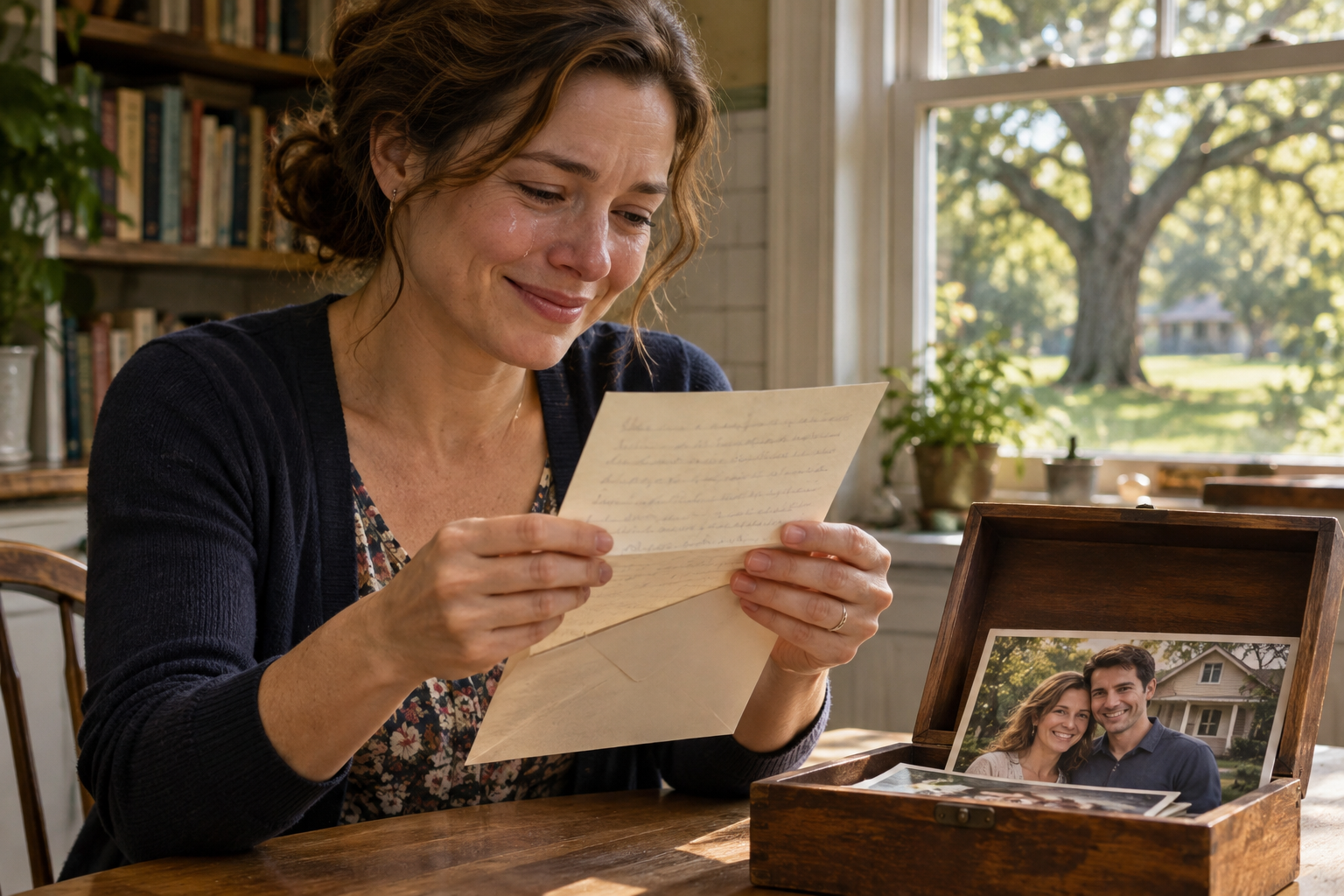
I looked down at the white envelope.
Mine.
Not part of a competition.
Not something my sister could claim because she had married Arthur.
Just a letter addressed to me.
I placed it inside my bag.
Then I gathered the education papers.
David walked me toward the door.
Before I left, I turned.
"One more question."
"Yes?"
"If I decide to help with the fund, will I have to deal with Beatrice?"
He considered the question.
"Not as part of the fund's ordinary operations. But I can't guarantee she won't raise legal objections to the estate arrangements."
I nodded.
That was enough.
I stepped into the hallway.
My parents were gone.
Beatrice was gone.
The office was quiet.
For the first time that day, I was grateful to be alone.
I drove home slowly.
At a red light, I looked at the bag on the passenger seat.
The white envelope was inside.
So were the education documents.
Two things Arthur had left behind.
One concerned the past.
The other concerned a future I had never imagined.
I thought about stopping for coffee.
Then I changed my mind.
I wanted to go home.
When I reached my house, I placed the bag on the kitchen table.
The room was small.
Nothing like the expensive properties Beatrice had been showing off.
But it was mine.
The furniture was ordinary.
The dishes were mismatched.
There were books stacked beside the chair where I liked to read.
I stood there for a moment.
Then I made coffee.
The smell reminded me of Arthur.
Of mornings in the bungalow.
Of notes beside the machine.
For a moment, I thought I might cry again.
Instead, I carried the cup to the table.
I opened the bag.
I took out the letter.
Then I took out the education documents.
I placed them side by side.
I did not know whether I would ever forgive Arthur.
I did not know what Beatrice would do next.
I did not know whether the estate arrangements would become a long legal fight.
But I knew something I had not known that morning.
I did not have to compete with my sister for the right to live my own life.
I had spent too many years doing that.
I opened the education folder.
On the first page, the fund's purpose was described in simple terms.
Helping children gain access to learning opportunities they might otherwise miss.
I read the sentence twice.
Then I thought about the classroom waiting for me.
The students.
The books.
The ordinary work I had always believed mattered.
Arthur had made his decision.
Beatrice had made hers.
Now I needed to make mine.
I picked up a pen.
On a separate sheet of paper, I began writing questions for David.
Not an acceptance.
Not a refusal.
Questions.
For once, I wanted to understand everything before I agreed.
I wanted to know who would oversee the money.
How the programs would be chosen.
How the fund would be protected.
And whether I could help children without letting Arthur's mistakes define the rest of my life.
I wrote until the coffee grew cold.
Then I put the pen down.
I looked around my kitchen.
No one was telling me what to do.
No one was asking me to move aside.
No one was telling me to think about Beatrice first.
I was alone.
And for the first time in a very long while, being alone did not feel like losing.
It felt like having a choice.
Click here to continue reading: PART 9: My Sister Hired a Lawyer to Fight Arthur’s Final Wishes, but the Evidence He Left Behind Forced Our Family to Face an Uncomfortable Truth
My Sister Thought Six Days of Marriage Made Her the Richest Woman in Our Family Until Arthur’s Attorney Looked at Me
Part 8 of 10


One Comment on “PART 8 – After My Sister Threatened to Challenge Arthur’s Estate, I Had to Decide Whether Accepting His Final Gift Would Keep Me Trapped in Our Old Life”