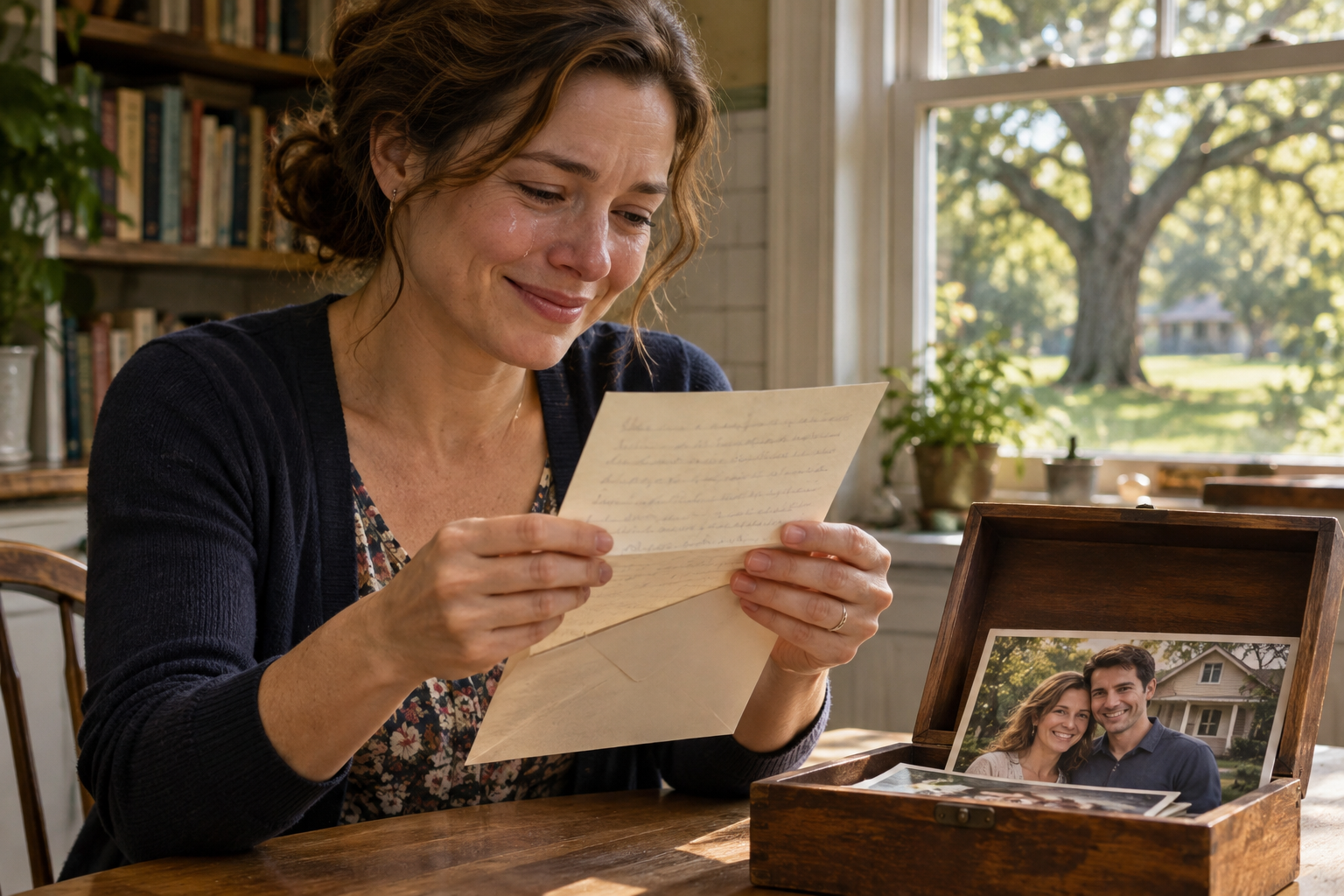
I had spent four months waiting for Arthur to explain himself.
Now that the explanation might be sitting in front of me, I was frightened of reading it.
That was the part I had not expected.
I had imagined demanding answers from him.
I had imagined standing in front of him and refusing to leave until he told me the truth.
But Arthur was dead.
And the only thing left between us was a white envelope.
David Allen waited patiently at the end of the conference table.
My sister did not.
"Audrey, are you going to open it or not?"
I looked at Beatrice.
She was still sitting with her expensive purse beside her.
Her black silk dress was perfectly arranged.
The narrow veil had been pushed back from her face.
I could see every bit of her impatience.
"I need a minute," I said.
She rolled her eyes.
"Of course you do."
My father cleared his throat.
"Audrey, we're all tired. Maybe you could just get this over with."
There it was again.
That familiar expectation.
Make things easier.
Do not upset Beatrice.
Do not make everyone wait.
For most of my life, I had obeyed those instructions without anyone having to say them directly.
This time, I looked at David.
"Arthur wanted me to read it alone?"
David nodded.
"That's correct."
"Then I would like to do that."
Beatrice opened her mouth.
David spoke before she could.
"There's a private room available. You can take as much time as you need."
I picked up the envelope.
It felt heavier than it should have.
Just paper.
Nothing more.
Yet my hands were shaking as I stood.
Beatrice watched me walk toward the door.
"Remember, Audrey, it doesn't matter what he wrote. I was the one he married."
I stopped.
For one second, I considered turning around.
I wanted to tell her that six days did not erase ten years.
I wanted to remind her that Arthur had once loved me when neither of us cared about expensive dinners or family money.
Instead, I kept walking.
David showed me into a smaller room down the hallway.
There was a wooden table.
Two chairs.
A box of tissues.
A window overlooking the parking lot.
He set a glass of water near the chair.
"Would you like me to stay?"
I shook my head.
"No, thank you."
He paused at the door.
"Audrey, whatever you read, you don't have to make any decisions immediately."
I looked at him.
Something about that sentence unsettled me.
"What decisions?"
His expression remained careful.
"We can discuss that afterward."
Then he stepped outside.
The door closed quietly.
I sat down.
For a long moment, I only looked at the envelope.
Arthur had written my name in blue ink.
The A leaned slightly to the right.
He had always written that way.
Even when he was in a hurry.
I remembered finding a note on our kitchen counter one rainy morning.
He had reminded me to take an umbrella.
I had laughed because he had already placed it beside the front door.
That was the kind of man I thought I had married.
Thought.
I hated that word now.
I slid my finger beneath the flap.
The paper tore unevenly.
Inside were several folded pages.
There was no photograph.
No jewelry.
No check.
Only a letter.
I unfolded the first sheet.
The first line made my throat tighten.
Audrey, I don't know whether you will ever forgive me, and I don't expect you to.
I stopped reading.
I had not expected an apology.
For months, Arthur had offered me nothing.
Not a reason.
Not a conversation.
Not even the dignity of hearing from him why our life was ending.
Now he was apologizing after he could no longer hear my answer.
I pressed my hand against my mouth.
Then I continued.
He wrote that he had spent too much time trying to find words that would make what he had done seem less cruel.
He had finally realized there were none.
He had betrayed our marriage.
He had allowed Beatrice into a place that belonged to us.
And when I needed honesty, he had given me silence.
I read those sentences twice.
They did not make me feel better.
But they sounded like the first truthful things Arthur had said to me in months.
He did not blame Beatrice for everything.
He did not claim he had been helpless.
He admitted that he had welcomed her attention.
He wrote about how she had made him feel important.
Admired.
Successful.
I stared at that word.
Successful.
Arthur had always worked hard.
His family had money, but he had spent years trying to build his own professional reputation.
He rarely talked about the family's wealth at home.
I had believed that meant it did not matter to him.
The letter told me something different.
Arthur admitted that he had enjoyed being admired for what he possessed.
Beatrice had understood that weakness.
And he had let her use it.
I put the pages down.
It was strange to discover that the man who had made me feel accepted had spent part of our marriage needing approval from someone else.
I had been satisfied with our little bungalow.
Our Saturday breakfasts.
Our ordinary evenings.
Arthur had been satisfied too.
At least for a while.
But somewhere along the way, he had begun confusing admiration with love.
I wanted to be angry.
I was angry.
Yet I also felt an unexpected sadness.
Not because he deserved sympathy.
Because I was finally seeing a weakness he had hidden from me.
A few minutes passed before I picked up the letter again.
Arthur wrote about the night he asked for our divorce.
He said he remembered the dinner table.
The untouched food.
The way I had looked at him.
He remembered Beatrice arriving in her red dress.
I closed my eyes.
I had spent months trying to forget that dress.
Its color.
The way she had stood beside him.
The casual confidence with which she announced their plans.
Arthur wrote that he should have stopped her.
He should have told her to leave.
Instead, he had stayed silent.
He knew exactly what that silence had cost me.
I began crying.
Not loudly.
There was no dramatic moment.
Just tears falling onto the paper while I sat in a room where nobody could see me.
I had wanted him to understand.
For months, I had wanted that more than anything.
Now I knew he had understood all along.
He had simply chosen not to act.
I wiped my face with a tissue.
Then I turned to the second page.
Arthur wrote that he had another confession to make.
He said Beatrice had been talking about his family's fortune long before they married.
At first, he had dismissed it as curiosity.
She asked about properties.
Business interests.
The way investments were structured.
Whether his parents had left everything directly to him.
Whether the money would someday belong to his wife.
He had laughed off the questions.
He had even been flattered by her interest.
But as their relationship continued, the questions became more specific.
She wanted to know who controlled the holdings.
She wanted to know whether his wife would inherit them.
And she repeatedly brought up the figure everyone seemed to know.
Four hundred million dollars.
I read that number slowly.
It looked enormous on the page.
It always had.
To Beatrice, it represented everything she believed she deserved.
To me, it had always been a number other people discussed.
Arthur wrote that he had allowed Beatrice to believe something that was not entirely true.
My breathing changed.
I sat straighter.
He had written that sentence plainly.
No explanation immediately followed.
Just the admission.
I looked at the next paragraph.
Arthur said the holdings associated with his family were not the same thing as his personal property.
Much of the wealth was controlled through a family trust.
There were rules.
Restrictions.
Documents signed long before either of us had married him.
He could benefit from certain assets.
He could help manage some of them.
But he did not own all four hundred million dollars outright.
And he could not leave the entire amount to a spouse simply because he wanted to.
I read the paragraph again.
Then again.
I had heard people talk about Arthur's family fortune for years.
I knew he had family holdings.
I knew he worked with investments and property.
But I had never asked to examine the legal arrangements.
I had never needed to.
We lived comfortably without discussing trust agreements at the breakfast table.
Beatrice had apparently asked different questions.
Much more detailed questions.
Arthur wrote that she had mistaken access for ownership.
And he had not corrected her clearly.
I felt a coldness spread through my chest.
My sister had married a man she believed controlled four hundred million dollars.
Arthur had known what she believed.
And he had permitted her to continue believing it.
I did not know whether that made him dishonest, foolish, or both.
Probably both.
Then I reached the next paragraph.
Arthur wrote that he had changed his estate arrangements after our divorce.
Not because he wanted to punish Beatrice.
Not because he believed money could erase what he had done to me.
He said the changes reflected decisions he had begun considering before our marriage ended.
He had wanted some of the wealth he could legally direct to support something connected to the life we had built.
I stopped.
Our life.
The ordinary life he had abandoned.
Arthur continued.
He remembered how I used to come home from school worried about children who did not have books at home.
He remembered the boxes of classroom supplies I bought with my own money.
The evenings I spent helping children who struggled to read.
The way I celebrated when a quiet student finally raised a hand.
I had never thought those things were especially remarkable.
They were part of being a teacher.
But Arthur had noticed.
He wrote that the most meaningful work he had ever watched was not performed in a boardroom.
It happened when I sat beside a child who believed they were incapable of learning and helped them try again.
I covered my face.
I was crying harder now.
For ten years, I had wondered whether Arthur truly appreciated the small things that mattered to me.
Apparently, he had.
That realization hurt almost as much as the betrayal.
Because he had understood my values.
He had known what made me happy.
And he had still chosen to leave.
On the third page, he mentioned David Allen.
He said David had been instructed to explain certain arrangements after I finished reading.
Arthur had also left documents concerning a charitable education fund.
He wanted me to hear what David had to say.
But he was careful about one thing.
He wrote that I was under no obligation to accept any role in those arrangements.
He had no right to ask me for another sacrifice.
Not after what he had done.
I sat motionless.
A charitable fund.
Legal arrangements.
Instructions that involved me.
I had entered the office expecting to hear how much money my sister would inherit.
Now I was reading about a part of Arthur's estate that had something to do with my teaching.
I did not understand it.
Not yet.
There was one final paragraph.
I read it slowly.
Arthur wrote that he had spent the last months of his life recognizing the difference between being admired for his wealth and being loved when he was simply himself.
He said I had given him the second kind of love.
He had failed to protect it.
And he would regret that for as long as he lived.
I lowered the page.
Arthur had written the letter while he was alive.
He had not known exactly when I would read it.
He had not known that I would be sitting in this room after his unexpected death.
Those words had existed somewhere in his attorney's files while I was trying to survive our divorce.
I wondered why he had not sent them sooner.
Then I remembered something he had written at the beginning.
He had no right to demand forgiveness.
Perhaps he had understood that a letter was easier than facing me.
Perhaps he had been a coward.
I could believe that now.
I looked at the signature.
Arthur.
Just his name.
The same name I had written beside mine for ten years.
I folded the pages carefully.
Then I unfolded them again.
There was one sentence near the bottom I wanted to read once more.
He had asked me not to confuse his final arrangements with an attempt to purchase forgiveness.
Whatever the documents provided, they were not payment for the pain he had caused.
I appreciated that he had written it.
But I still felt angry.
Money could not return the years I had lost.
It could not change the way Beatrice had stood in my dining room.
It could not erase my father's silence or my mother's willingness to look away.
And it could not make Arthur alive again.
I sat beside the window until my breathing settled.
Outside, someone crossed the parking lot carrying a cup of coffee.
A completely ordinary moment.
People were continuing with their lives.
Cars moved.
Doors opened.
The world did not seem to know that mine had changed.
I placed the pages back inside the envelope.
Then I stood.
My legs felt uncertain.
I picked up the glass of water David had left.
I drank half of it.
My reflection appeared faintly in the window.
I looked tired.
Older than I remembered.
But there was something different about my expression.
I had entered that room believing Arthur's letter might contain a final rejection.
Instead, it contained an apology I had needed and facts I did not know how to process.
I still had questions.
More than before.
But one thing had become clear.
Beatrice had not understood the fortune she believed she had married.
And Arthur had known that before he died.
I walked to the door.
When I opened it, David was standing nearby.
He looked at my face.
"Are you all right?"
I almost laughed.
"No."
He nodded.
"That's understandable."
I held the envelope against my chest.
"I finished reading."
He did not ask what Arthur had written.
He simply opened the conference room door.
Beatrice looked up immediately.
"Finally."
I sat down.
She leaned forward.
"Well?"
I looked at her.
For the first time in months, I did not feel the need to explain myself.
"It's a private letter."
Her smile disappeared.
"What does that mean?"
"It means Arthur addressed it to me."
David took his seat.
Then he placed another document on the table.
"Now that Audrey has received and read the letter, we can proceed with the estate instructions."
Beatrice turned toward him.
"Good. Then tell us what I inherited."
David opened the document.
I watched my sister lean forward.
She still believed the answer would be four hundred million dollars.
And I knew, before David spoke, that she was about to hear something very different.
Click here to continue reading: PART 6: The Attorney Explained Where Arthur’s Four Hundred Million Dollars Really Belonged, and My Sister Learned That Being His Widow Was Not the Same as Owning His Fortune
My Sister Thought Six Days of Marriage Made Her the Richest Woman in Our Family Until Arthur’s Attorney Looked at Me
Part 5 of 10