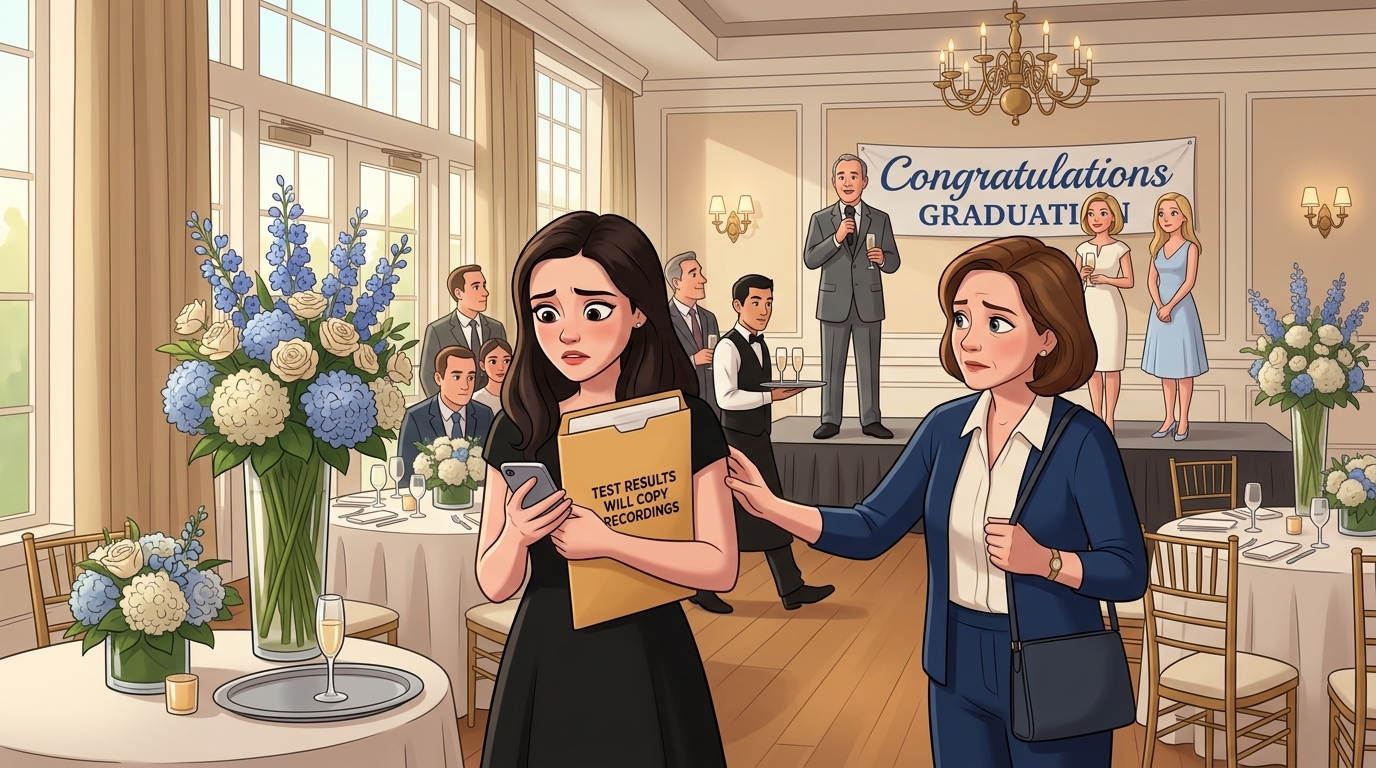
My mother called before I had even driven out of Lawrence Whitfield’s parking garage.
I watched her name pulse across the dashboard while rain gathered in thin silver lines on the windshield. Twenty minutes earlier, Lawrence had finished explaining Grandma Ruth’s will. The house was mine. Most of her investments were mine. Several smaller gifts would go to charities and friends. Mom had been left personal belongings and some cash. Olivia, my younger sister, had received money too, though nowhere near what Grandma had given me. Dad received nothing directly.
I let the call die. Then Olivia called. Then Mom again. By the time I reached the street, my phone had become a small machine for delivering demands. Mom texted that I needed to speak to her before doing anything with the estate. Olivia warned me not to sign anything, which would have been funny if my hands had not still been trembling. Grandma had signed the relevant papers months ago. The only person whose signature mattered was gone.
Before I left his office, I had asked Lawrence why Grandma had chosen me. He was a careful man, silver-haired and precise, the sort of attorney who seemed to measure sentences before releasing them. He told me Grandma had expected that question. She had also left additional material for me, but he could release it only if certain conditions occurred.
“What conditions?”
“If members of your family resist her estate plan.”
At the time, the phrase had sounded melodramatic. Seventeen missed calls later, it sounded like Grandma had known exactly what would happen.
I drove back to my Chicago apartment without answering anyone. Grief had been strangely practical until then. Grandma had been dead three weeks, and I had survived by doing things: funeral arrangements, thank-you notes, work, groceries, laundry. I had not allowed myself much time to think about the empty chair in her living room or the blue cardigan she always wore when the house was cold.
Grandma and I had been close, but never because of money. I called her on Sundays because she made me laugh. I visited because she served terrible coffee with excellent pie and because her kitchen was one of the few places where I never felt measured against Olivia.
Comparison had been the rhythm of my childhood. Olivia needed the bigger bedroom because she owned more toys. She needed dance lessons because she was talented. She needed the dependable car because her schedule was busier. I was praised for being sensible whenever something was taken from my side of the equation. Amelia understands. Amelia can handle it. Amelia doesn’t make trouble.
Grandma noticed what everyone else called normal. When my parents missed my high-school art competition for one of Olivia’s events, Grandma drove nearly two hours alone. She sat in the front row and applauded so enthusiastically when I won a ribbon that people turned to look at her. She kept the photograph from that afternoon on her mantel for years.
Mom’s eighteenth call finally broke me.
“What do you need?”
Her relief at hearing me lasted perhaps half a second. Then she told me Lawrence had contacted the family about the will. Grandma’s decisions, she said, did not make sense.
“She made them herself,” I said.
“She was eighty-two.”
“She was competent.”
“I didn’t say she wasn’t.”
“You came very close.”
Mom shifted tactics. Olivia had children. Mason and Sophie were expensive. Olivia and Mark had responsibilities. I was single, established in my career, financially stable.
I knew where the conversation was going before she said it.
“You should divide the inheritance with your sister.”
“Grandma could have divided it herself.”
“She was upset with Olivia.”
“About what?”
Mom avoided the question. Families, she said, should not allow money to tear them apart.
I looked around my quiet apartment and realized something uncomfortable: nobody had asked how I felt about Grandma dying. Their emergency was not grief. Their emergency was that Grandma had made a decision they could not control.
“Did Grandma ever tell you she wanted me to give Olivia half?”
Mom went silent.
“No.”
“Then I’m not doing it.”
She called me selfish.
The word had controlled me for most of my life. Selfish meant surrender the bedroom, the holiday plan, the money, the attention. Selfish meant someone else wanted something I possessed and I had failed to hand it over quickly enough.
This time the word did not work.
“I’ve been thinking about this for thirty-six years, Mom.”
That ended the conversation faster than anything else could have.
Olivia called next. She did not bother pretending the problem was family harmony.
“Did you know Grandma was changing her will?”
“No.”
“I don’t believe you.”
She accused me of spending years cultivating Grandma for money—the Sunday calls, grocery deliveries, visits, birthdays. In Olivia’s version, every ordinary act of affection had been a long investment strategy.
“You really believe I called Grandma every Sunday for eleven years because I was waiting for her to die?”
“I think you knew exactly what you were doing.”
I hung up.
When I turned my phone off, I sat in darkness for nearly an hour. What bothered me most was not Olivia’s accusation. It was Grandma’s anticipation of it. She had told Lawrence what to do if the family pressured me. Somehow, she had expected the argument before it began.
When I switched the phone on again, Mom had sent an ultimatum. If I chose money over the family, I should not bother coming home.
Dad had left a voicemail.
His voice was controlled, which was always worse than shouting. He ordered me to meet everyone at Grandma’s house the following morning and “straighten this out.” Then he warned me not to enter the property without them.
I listened twice.
There was no explicit threat. Dad preferred statements that could later be explained away.
I forwarded the recording to Lawrence.
He called almost immediately.
“Are you safe?”
The question made my stomach tighten.
“Yes.”
“Lock your door tonight.”
“What did Grandma think they were going to do?”
He hesitated.
Then he told me about a recording Grandma had prepared for me. She wanted me to see it if anyone tried pressuring me over the estate.
“What’s on it?”
“I can’t discuss that by phone.”
“Why?”
“Because she wanted you to see the evidence at the same time.”
Evidence.
That word kept me awake.
The following morning, Dad’s truck, Mom’s sedan, and Olivia’s minivan were already outside Grandma’s house when I arrived. Dad stood on the porch with his arms folded. Mom waited beside the steps. Olivia leaned against the railing in sunglasses despite the gray sky.
I remained in my car.
Lawrence had texted: Five minutes away. Do not engage.
Dad came to my window and ordered me out.
I cracked it open barely two inches.
“Lawrence is coming.”
“This is family business.”
“Apparently family business requires a lawyer.”
Dad’s jaw tightened.
Mom approached with the soft voice she used whenever she wanted pressure to sound like concern. She called the inheritance a misunderstanding. Olivia repeated that she had children. Dad finally told me to stop being ridiculous and get out.
“No.”
The word felt unfamiliar. It also felt solid.
Lawrence’s sedan entered the driveway before Dad could answer.
He walked directly toward me, carrying his leather case. When Dad insisted the matter was private, Lawrence reminded him that Grandma’s estate—and my legal ownership of the house—were precisely why he was there.
He also told me to preserve every text and voicemail.
Dad scoffed. “We’re collecting family messages as evidence now?”
“After the voicemail you left,” Lawrence said, “yes.”
The air changed.
Mom tried to restore the old script. Nobody had threatened anyone. Everyone was grieving. Olivia had been hurt. Couldn’t I simply be reasonable?
I looked at my sister.
“What exactly do you want?”
“Split the estate.”
“Why?”
“Because I’m your sister.”
“Grandma knew that.”
Olivia finally said Grandma had not been thinking clearly.
Lawrence opened his case.
Grandma, he explained, had undergone two independent capacity evaluations while preparing her estate documents. Both physicians concluded that she understood her assets, her relationships, and the consequences of her decisions.
Grandma had prepared for the incompetence argument too.
Mom’s face changed when Lawrence said there was additional material Grandma wanted shown privately to me.
Fear appeared before she could hide it.
Dad insisted he should be present.
Lawrence refused.
When I started toward the house, Dad caught my arm.
His fingers closed around my elbow firmly enough to stop me.
“Remove your hand,” Lawrence said.
Dad let go.
The moment lasted perhaps three seconds, but something inside me shifted. I saw the entire morning as if I had stepped outside it: Dad physically stopping me, Mom disguising coercion as peacekeeping, Olivia turning her children into leverage.
None of it was new.
Only my refusal was.
I walked inside.
Grandma’s house smelled of cedar, lavender lotion, and old paper. Her glasses remained beside an unfinished crossword. Butterscotch candies sat in a dish. Her blue cardigan hung near the door.
Then I saw my old art-competition photograph on the mantel.
My eyes burned.
“She was proud of you,” Lawrence said.
“Show me the recording.”
He placed a tablet on the coffee table.
Grandma appeared onscreen, thinner than I remembered but unmistakably herself. She complained briefly about her hair before looking straight into the camera.
She said that if I was watching, she was gone and the family had probably started arguing about money.
I laughed through tears.
Then she became serious.
She warned me that people might call her confused. They might invoke family harmony. They might claim she secretly wanted me to share what she had left.
She wanted me to know none of that was true.
The estate was arranged exactly as she intended.
She spoke about my calls, visits, groceries and birthdays—not as debts she was repaying, but as evidence of a relationship that had never depended on inheritance.
Then she said Olivia had asked about her assets.
For years.
Olivia had questioned the value of the house, whether there was a mortgage, what might happen if Grandma needed long-term care. Eventually she suggested putting her name on the deed.
Grandma refused.
Mom intervened on Olivia’s behalf, arguing that Olivia had children and needed stability while I was already doing well.
Different year. Same equation.
Grandma said she had finally confronted Mom about a pattern nobody else wanted to name: our family rewarded the person who demanded the most while congratulating the quieter person for surviving with less.
Then she described me in a way that broke something open.
I had been taught to need less.
I bent forward, covering my face.
Grandma had seen it.
Not just the inheritance fight. The machinery underneath it.
But she was not finished.
“When you were eight,” she said, “your grandfather opened an investment account for you.”
I looked at Lawrence.
I had never heard about any account.
Grandpa had deposited thirty thousand dollars for my education or first home. After his death, Dad became custodian.
By the time I reached adulthood, the account had grown substantially.
Then it disappeared.
“How much?” I asked.
Lawrence answered quietly.
About eighty-seven thousand dollars.
I thought about my student loans. Campus jobs. Cheap apartments. Weekends spent working. Opportunities I turned down because I could not afford them.
Dad had controlled money Grandpa had already given me.
Grandma said she confronted him.
Dad admitted using it.
The money had helped pay for Olivia’s education and expenses.
His explanation was simple.
Olivia needed it more.
Grandma said Dad had argued that I was smarter, more responsible, and more capable of recovering.
The old compliment.
Responsibility turned into permission to take.
Then Grandma said she had adjusted her estate partly to correct what had been done.
But there was something else.
Grandpa had created two accounts for me.
Lawrence reached into his case and placed a cream-colored folder on the table.
My full name was printed across the front.
AMELIA ROSE CARTER.
Outside the window, Dad stood watching the house.
Lawrence rested his hand on the folder.
“Before you open this,” he said, “you need to understand that your grandmother believed the first account was only the beginning.”