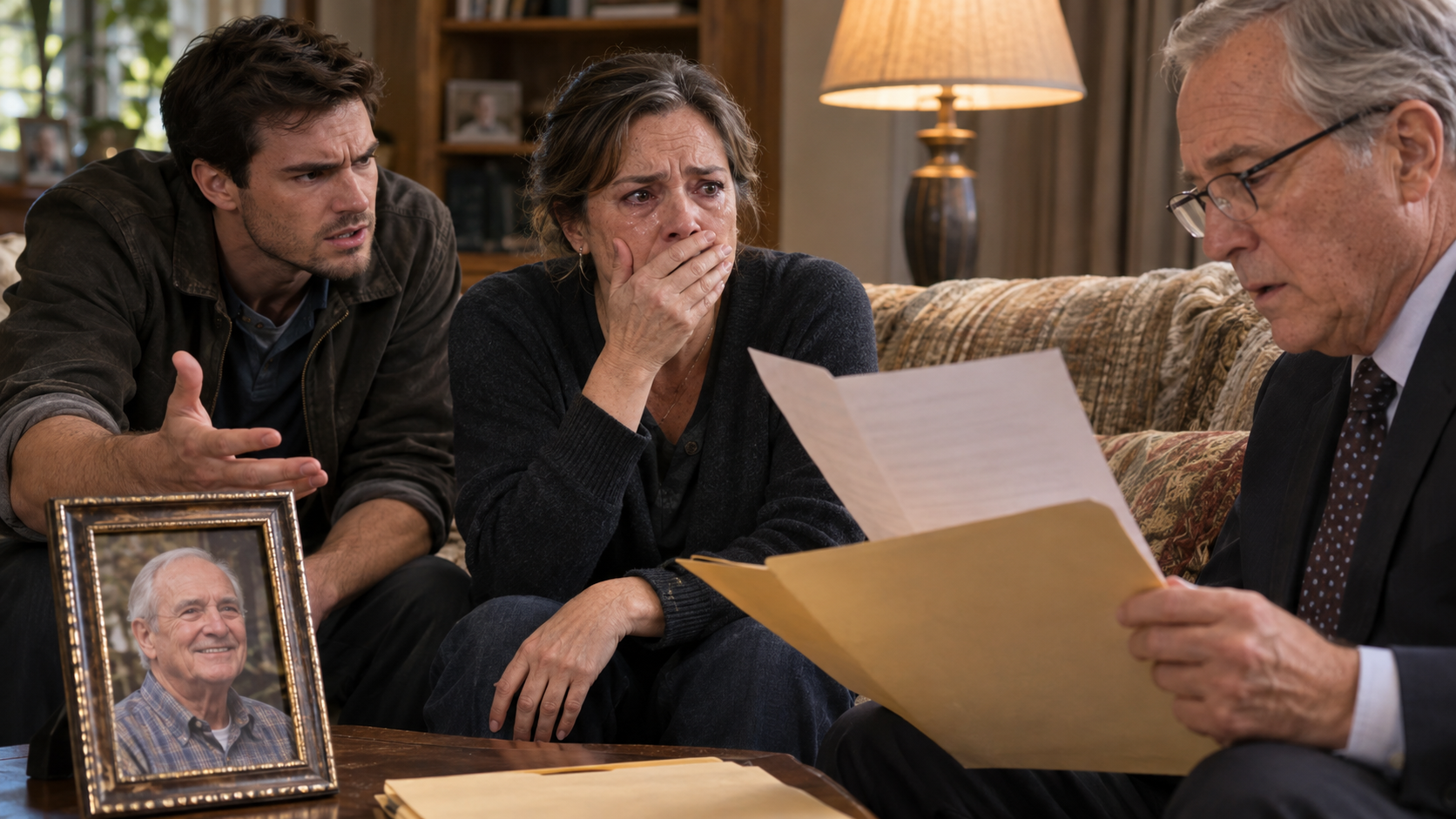
I had asked the attorney what my father-in-law meant.
Kevin had asked about money.
Those questions were still the clearest expression of what each of us wanted to know.
I couldn't stop thinking about the difference.
We had both heard the same statement.
We both knew my father-in-law had mentioned something hidden under my name.
And neither of us had heard enough to understand the arrangement.
But Kevin was already concerned with distribution.
I was concerned with intention.
Why had my father-in-law made this decision?
Why had he connected it to the meals?
Why had he told me he knew how I regarded him?
I didn't need an attorney to explain that last part.
It was plain.
My father-in-law had known I thought he contributed nothing.
The difficult question was what he wanted me to understand by saying so.
I tried not to assume the answer.
I had spent twenty years making assumptions.
I wasn't going to repair that mistake by immediately making another.
Still, I couldn't help considering the possibilities.
Perhaps the arrangement was a way of recognizing what I had provided.
Perhaps it was intended to correct my understanding of his contribution.
Perhaps it had a practical explanation that would make sense once the attorney continued.
I didn't know.
And the fact that I didn't know became important to me.
For years, I had treated uncertainty as though it didn't exist.
I had looked at my father-in-law and believed the situation was obvious.
He was dependent.
We supplied what he needed.
That was enough for me to reach a conclusion about his value.
Now the attorney had presented something I couldn't account for.
A decision made by the very man I thought had nothing to contribute.
And my name was involved.
That detail kept drawing my attention.
If the arrangement truly concerned me, I wanted to understand why my father-in-law had chosen me.
I didn't want to assume it was a reward.
I didn't want to assume it was an apology.
I didn't want to assume it was proof that he had been secretly wealthy.
None of those explanations had been given.
The words I had heard were specific but incomplete.
There was something hidden.
It was under my name.
And the meals were the reason he mentioned.
Those facts were enough to change how I listened.
They were not enough to tell me the ending.
I looked at Kevin again.
I wondered whether he understood that distinction.
His question had treated the possible arrangement as something available for division.
Maybe the attorney would eventually explain whether that was true.
But Kevin had asked before we knew what existed.
That impatience stood out to me.
Not because wanting financial clarity was wrong.
But because the statement had raised a human question before it raised a financial one.
My father-in-law had been speaking to me.
He had addressed what I thought of him.
He had remembered the meals.
I was the person who needed to hear that.
Not because the arrangement necessarily belonged to me.
Because the words concerned the way I had treated him.
I couldn't hand that responsibility to Kevin.
I couldn't hand it to the attorney either.
Whatever those men thought about the financial implications, I was the one who had carried the judgment for twenty years.
I was the one who had called my father-in-law a burden.
I was the one who believed he contributed nothing.
And I was the one who now had to listen to the possibility that I had misunderstood him.
I found myself thinking about how easy it would be to focus entirely on the money.
If I did that, I could avoid the uncomfortable part.
I could wait for a figure.
I could listen to an explanation of what was being divided.
I could treat the statement as an ordinary financial matter.
But that would mean ignoring the very words my father-in-law had chosen to address to me.
I didn't want to do that.
Not anymore.
I had dismissed enough of him while he was alive.
I couldn't dismiss what remained of his voice after his death.
The statement was the only explanation before us.
I wanted to hear it without trying to protect my pride.
That was harder than I expected.
Part of me still wanted to defend the past.
I wanted to remind myself that the meals were real.
That the household had responsibilities.
That supporting someone for years could feel difficult.
But none of those things had been disputed in the words the attorney read.
My father-in-law hadn't denied receiving food.
He had remembered it.
He had even described it as the reason behind his hidden decision.
I didn't know whether he had been grateful.
I didn't know whether he had been hurt.
I couldn't take either feeling for granted.
What I knew was that the meals mattered to him.
And I had been treating them only as a measure of his dependence.
That was a difference I could no longer ignore.
I thought about the word burden again.
It was such a final description.
It made a person sound like nothing more than what someone else had to carry.
I had never considered how much the word left out.
Now I was beginning to.
My father-in-law had made a decision.
He had kept it private.
He had arranged for words to be heard after his death.
And those words suggested that his understanding of our relationship was not the same as mine.
He was not simply a passive figure in the story I had told myself.
He had his own choices.
His own knowledge.
His own reasons.
I wished I had recognized that sooner.
I wished I could ask him what he meant.
But the question had to go to the attorney now.
And the attorney could only explain what had been left for him to explain.
I understood that limitation.
The statement might tell me what happened.
It might tell me why.
But it could not give back twenty years.
It could not make my old words disappear.
It could not give my father-in-law another opportunity to hear me acknowledge the possibility that I had been unfair.
I had to live with that.
I turned my attention back to what mattered.
I wanted the explanation.
I wanted the truth as far as the statement could provide it.
And I wanted to hear it before allowing Kevin's question about money to become the only question in the room.
My father-in-law had waited until after his death to leave those words for me.
I wasn't going to rush past them.
Click here to continue reading: PART 8: I Never Received the Explanation I Wanted in Those First Words, but I Could No Longer Call My Father-in-Law a Burden Without Questioning Myself
I Had Spent Twenty Years Believing My Father-in-Law Gave Us Nothing, Until His Attorney Read Words I Could Barely Understand
Part 7 of 8