I had always thought I understood what my father-in-law's place in our household meant.
He depended on us.
That was the beginning and end of my explanation.
I didn't consider that there might be another side.
I didn't look for one.
And after twenty years, I had become so comfortable with my conclusion that I no longer noticed how harsh it sounded.
A burden.
That was what I called him.
I hadn't needed anyone else to agree.
I had made the judgment myself.
Now I was confronting the fact that he knew it.
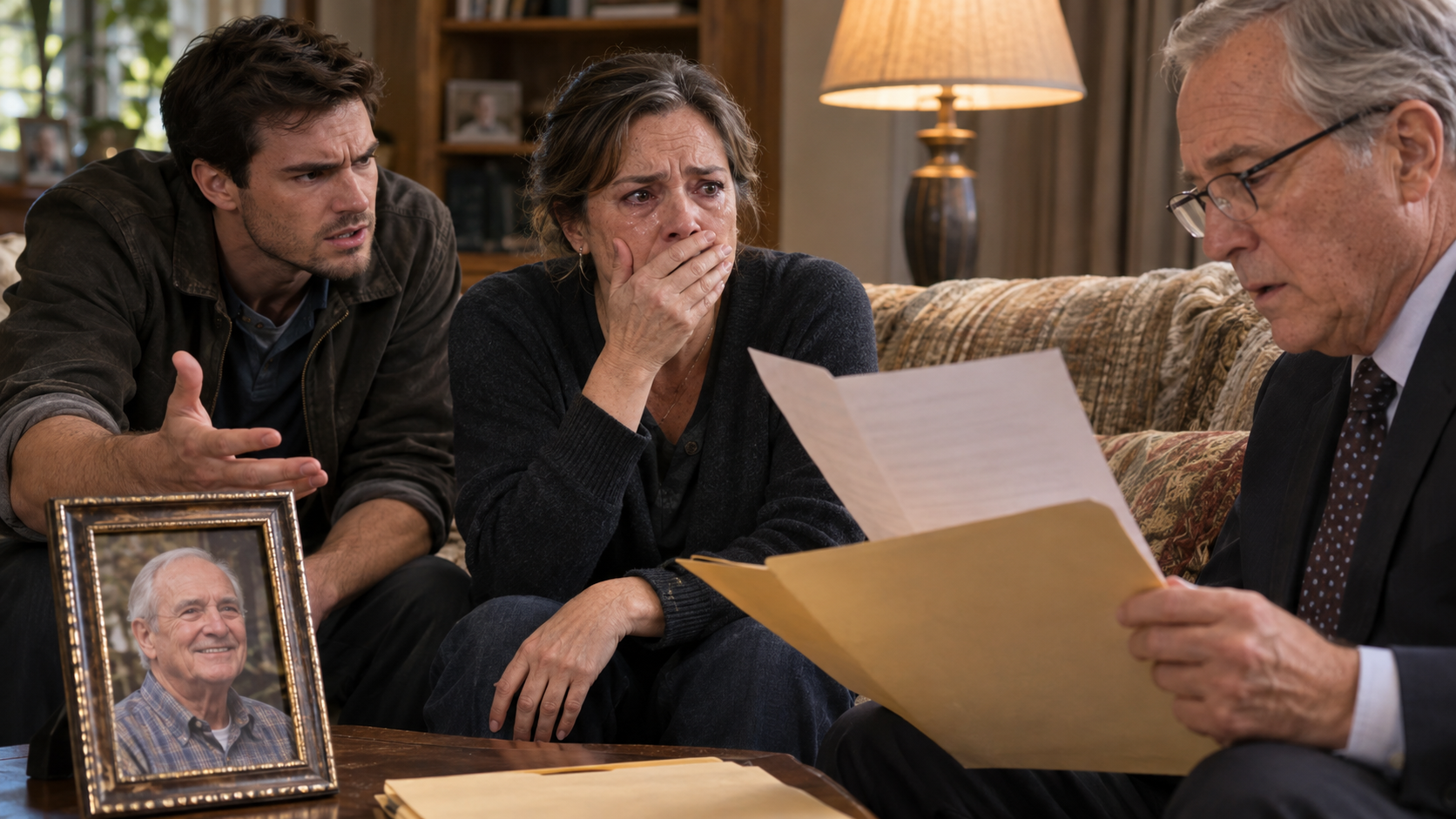
The attorney had read only a small portion of the statement, but those words were enough to unsettle me.
My father-in-law hadn't described himself as generous.
He hadn't asked me to admire him.
He hadn't listed what he had done or demanded gratitude.
Instead, he had started with my opinion of him.
That was what made the statement so difficult to hear.
He was speaking directly to the person who had underestimated him.
Me.
I wondered how long he had carried that knowledge.
The statement gave me no answer.
It told me only that he understood how I viewed his place in our household.
And that he connected something he had hidden with the meals I provided.
There was a terrible imbalance in that information.
I knew what I had given.
I knew what I had thought.
But I did not know what he had kept in my name.
I had spent years believing I could measure the relationship accurately.
Now I had to admit I might not even have known what was being measured.
That realization did not make me feel better about him.
Not yet.
It made me feel uncertain about myself.
I had always assumed that the person providing the meals was the person making the sacrifice.
Maybe that was true in one sense.
The statement hadn't erased the food or the years.
It hadn't made the daily responsibilities disappear.
But it suggested that my father-in-law had understood those responsibilities differently.
I kept thinking about that distinction.
I had seen each meal as another example of what he needed.
He had apparently seen those same meals as a reason for a private decision.
The attorney hadn't told me what the decision involved.
That uncertainty mattered.
I didn't want to replace one confident assumption with another.
I had already spent too long doing that.
I couldn't claim my father-in-law had been wealthy.
I couldn't claim he had arranged a fortune.
I couldn't even claim that I knew what was being held under my name.
The statement had raised those questions without answering them.
Kevin seemed ready to move straight past the questions.
His attention was on whether there was anything to divide.
Mine was on why my father-in-law had chosen not to tell me.
I wondered whether the secrecy itself carried meaning.
Why hide something from the person whose name was involved?
Why wait until after death for those words to be heard?
I couldn't answer either question.
And I had to resist the urge to invent an explanation that made me feel less responsible.
Perhaps he had reasons I would understand.
Perhaps he had reasons I wouldn't like.
Perhaps the rest of the statement would explain everything.
But none of that was certain.
The only certain thing was that I had been wrong to assume I knew every important fact about him.
I remembered how confident I had been in my judgment.
It had never required much thought.
Whenever I considered his place in the household, I came back to what he received.
I seldom considered what I didn't know.
That was a hard habit to recognize in myself.
It was even harder to admit that the habit had lasted two decades.
I looked at the attorney again.
He had been entrusted with words my father-in-law could no longer speak aloud.
I wanted him to continue.
At the same time, I dreaded hearing more.
If the next part explained the hidden arrangement, I might finally understand what had happened.
But I might also have to admit that my father-in-law had been a different man from the one I believed I knew.
And that possibility frightened me.
Not because I expected him to have done something terrible.
Because I feared I had already done something terrible in the way I judged him.
I had reduced a person to an expense.
I had allowed that description to stand for twenty years.
Now his own words were asking me to look beyond it.
I sat with that thought while Kevin waited for the financial explanation.
Neither of us had received an answer yet.
But I had reached one decision.
Whatever the attorney said next, I would listen to my father-in-law's words before deciding what they meant.
I owed him that much.
Click here to continue reading: PART 4: I Thought the Hidden Arrangement Would Be the Greatest Surprise, but Kevin’s Reaction Showed Me How Differently We Heard the Same Words
I Had Spent Twenty Years Believing My Father-in-Law Gave Us Nothing, Until His Attorney Read Words I Could Barely Understand
Part 3 of 8