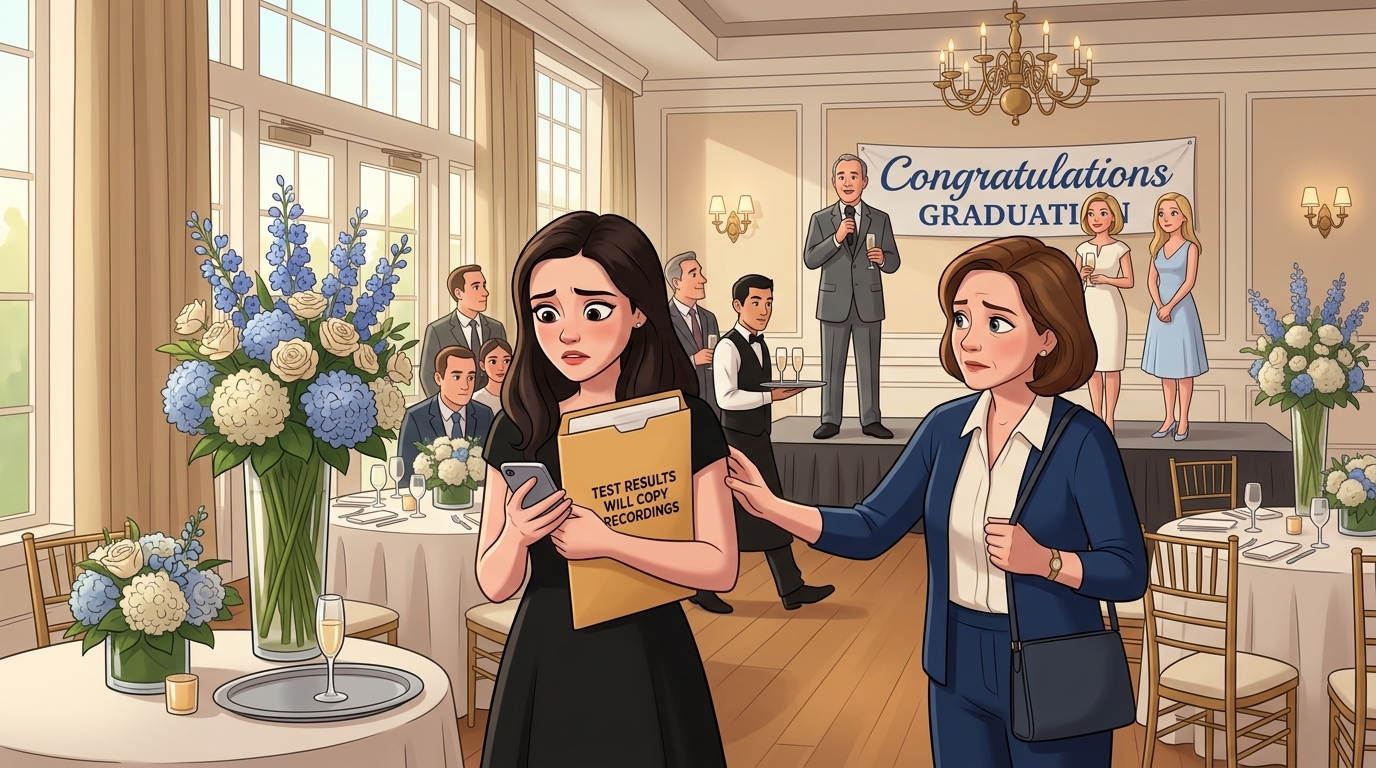
Mom did not deny knowing Caroline Mercer.
She cried.
I told her not to cry until she answered me.
“Was Caroline my mother?”
“I don’t know.”
The answer sounded impossible until Mom explained the beginning.
She and Dad had been married three years when I was born. They had been trying unsuccessfully to have a child. Mom suffered two miscarriages. Then Dad came home with a solution: an unmarried woman he knew was pregnant, frightened and unable to raise the baby.
Her name was Caroline.
Dad presented it as a private adoption.
Mom met Caroline once before the birth. She remembered a thin, angry young woman who barely spoke and looked at Dad with unmistakable hostility.
Dad arranged everything.
The lawyer.
The hospital.
The paperwork.
Mom signed what he put in front of her.
The attorney’s name was Martin Hale.
Lawrence recognized it immediately. Hale had later been disbarred for fraud, document falsification and misuse of client funds.
My adoption papers, Lawrence said, needed verification.
Mom also admitted that when I was six, she discovered Dad had been sending Caroline money. Dad claimed Caroline was threatening to challenge the adoption unless they helped her financially.
Mom did not fully believe him.
She did nothing.
When I was thirteen, Caroline called our house.
A buried memory surfaced: a woman asking whether I was Amelia, then asking for my parents.
Mom had told me afterward it was a wrong number.
It was Caroline.
She wanted to see me.
Mom refused.
Dad contacted Caroline afterward, and she disappeared again.
The unknown number texting me eventually identified himself as Jonah Mercer.
Caroline was his mother.
If Caroline had told him the truth, he said, I was his sister.
He gave me the address of a motel outside Milwaukee and told me to bring Lawrence.
Before we went, Naomi revealed another discovery.
Grandma had arranged DNA testing between herself and Caroline because Caroline claimed Ruth was her biological mother.
The result established a parent-child relationship.
Grandma Ruth had given birth at seventeen. Her parents sent her away and placed the baby for adoption.
That baby was Caroline.
Grandma had spent most of her life believing her first child was permanently lost.
Then, months before dying, she found her.
If Caroline was also my mother, Grandma was not merely my grandmother through the family that raised me.
She was my biological grandmother.
Jonah said Caroline was afraid Dad would find her. Someone had broken into her apartment three weeks earlier and stolen documents connected to Grandma’s investigation.
When I asked whether Caroline had actually given birth to me, Jonah answered quietly.
“Yes.”
Then he told me what Dad had allegedly done.
After the birth, Dad told Caroline her baby had died.
He told Elaine the baby had been voluntarily surrendered.
Lawrence and I drove to Milwaukee.
Caroline waited in a motel room with a canvas bag full of old papers. She had silver hair now, copper still showing near her ears, and pale green eyes that looked disturbingly like mine.
I asked the question before sitting down.
“Did you give birth to me?”
“Yes.”
“How can I prove it?”
She handed me an old hospital bracelet and a copy of a birth record.
Caroline Anne Mercer.
Female infant.
June 1990.
3:14 a.m.
My birthday.
My birth time.
Then Caroline told me the rest.
She had met Dad while working for a property management firm. Dad was married. They had an affair. She became pregnant.
Dad initially wanted the pregnancy ended.
Caroline refused.
He promised financial support if Mom never learned the truth.
Eventually Dad told Mom about Caroline’s pregnancy, but claimed another man was the father. He portrayed the situation as an opportunity for private adoption.
Caroline insisted she never agreed to give me away.
Near the end of her pregnancy, Dad persuaded her to deliver at a small private hospital where Dr. Warren Halpern practiced.
After a difficult labor, Caroline held me briefly.
She counted my fingers.
She named me Amelia.
Mom had always told me she chose my name.
Another piece of my history moved beneath my feet.
Caroline was medicated and fell asleep.
When she woke, I was gone.
Dad told her I had suffered respiratory failure and died.
For six weeks she believed him.
Then she saw Mom in a grocery store.
Mom was carrying an infant.
Me.
Caroline followed her. Dad intervened before she could confront Mom. Eventually he admitted I was alive.
He claimed Mom had bonded with me and would be destroyed if I were taken away. He also warned that Caroline lacked money and stability.
Then Martin Hale produced surrender papers carrying Caroline’s signature.
She said the signature was forged.
Dad told her to prove it.
Caroline hired an attorney, but the lawyer eventually withdrew after pressure from people connected to Dad. Police treated it as a civil adoption dispute. Hospital records disappeared.
Dad knew where Caroline lived and worked. He threatened to portray her as an unstable woman trying to extort a married man.
Finally, he offered monthly payments if she stopped trying to contact us.
She accepted.
That angered me.
“You took his money.”
“Yes.”
“So he bought your silence.”
“Yes.”
She did not defend herself.
She had another pregnancy two years later. Jonah was born. She feared Dad might come after him too.
The payments continued.
At thirteen, she broke the arrangement and called me.
At eighteen, she mailed me a letter.
I never received it.
Dad later called Caroline while holding the unopened envelope.
She tried again when I was twenty-one.
Again at twenty-five.
Nothing reached me.
Then Grandma found Caroline’s name while investigating Dad’s financial records.
She traced her.
They met.
Grandma learned Caroline’s adoption history and realized the impossible connection.
DNA confirmed Ruth was Caroline’s biological mother.
Grandma then tested hair taken from a brush I had used while staying at her house.
I was furious about that violation, but the result was clear: the biological relationships matched grandmother, daughter and granddaughter.
Caroline was my biological mother.
Another test confirmed Dad was my biological father.
The truth was uglier than a fraudulent adoption.
Dad had taken his own daughter from the woman who gave birth to her and placed that child inside his marriage while hiding his affair from his wife.
Then Mom called.
She had found the adoption file in the garage.
There were two versions.
One carried Caroline’s supposed signature.
The other contained practice sheets.
Someone had repeatedly written Caroline Mercer in different forms.
Mom recognized the handwriting.
Dad’s.
A note from Martin Hale was attached.
Its meaning was unmistakable: Elaine would sign as adoptive mother; Richard would take care of Caroline’s signature.
We took everything to Detective Marisol Vega.
By midnight, investigators were building a timeline that reached from my birth to Grandma’s death.
Caroline’s pregnancy.
The false death story.
The forged surrender.
Payments.
Intercepted letters.
My stolen investment account.
Grandpa’s money.
Grandma’s accounts.
Shell companies.
The attempted trust change using Mason’s identity.
Dad had not simply lied.
He had built separate realities for everyone.
Mom believed Caroline voluntarily surrendered me.
Caroline believed Dad and Mom deliberately stole me.
I believed Elaine gave birth to me.
Olivia believed our parents had funded us fairly.
Grandma believed her first daughter had disappeared forever.
Whenever those realities threatened to collide, Dad used money, paperwork or fear to keep them apart.
Naomi traced roughly $1.9 million through accounts and entities Dad controlled.
Then police found Dad hiding near the state line.
His motel room contained cash, multiple phones, financial documents, shredded records and a portable hard drive.
The black ledger was missing.
But one of his phones contained hundreds of photographs of its pages.
He had copied the evidence.
Those pages revealed more forged signatures, including Mom’s, and payments routed through accounts she never knew existed.
They also exposed years of payments to Martin Hale.
One invoice contained a notation concerning my original hospital file.
Dad had apparently paid to keep it hidden.
Then the unknown number texted again.
A photograph showed the real black ledger.
Richard never had the original.
Grandma had planted a decoy.
The torn leather in Grandpa’s desk had been staged. Dad had searched for the ledger exactly as she expected.
The sender told me to ask Lawrence about Grandma’s safe-deposit box.
Box 417 at First North Bank was registered to Grandma and me.
The brass key Grandma had left was connected to it.
The next morning, under police supervision, Lawrence and I opened the box.
The real black ledger lay on top.
Beneath it was my original hospital file.
Then thirty-six letters tied with blue ribbon.
Every envelope bore my name.
Every return address belonged to Caroline.
Grandma had found the letters Dad intercepted and saved them.
One more envelope sat above everything else.
Grandma’s handwriting.
Amelia — read mine before you read hers.
Her letter explained the decoy, the surveillance, the accountant, and the reason she had refused to tell Dad how much she knew.
Then I opened the hospital file.
A nursing note said the infant was stable and that the mother requested contact.
Another recorded Dad as highly agitated.
A discharge entry showed that I had been released directly to Richard Carter.
Relationship: Father.
There had been no completed adoption at that moment.
No valid surrender.
No court order.
A nurse documented that Caroline denied signing relinquishment papers and requested police assistance.
The objection had been buried.
Grandma’s letter then explained what she considered the worst discovery.
Dad had not taken me merely because Elaine wanted a baby.
Correspondence between Dad and Hale showed that Dad feared a paternity dispute would expose his affair while he was seeking a partnership at work. The scandal could damage his career and threaten financial connections through Mom’s family.
Hale offered a solution.
Place the baby with Elaine.
Keep Caroline silent.
Preserve Dad’s marriage, reputation, career and control.
Everyone else would absorb the cost.
Grandma’s final message to me was about choice.
She could not decide whether biology should change what Caroline meant to me. She could not decide whether I should forgive Elaine or Olivia. She could not even decide what I should do with the inheritance.
Those choices had to belong to me.
That, Grandma wrote, was what Dad had taken most consistently.
Not merely money.
Choice made with the truth available.
I read some of Caroline’s letters.
At eighteen, she had asked for nothing except a chance to tell me what happened.
At twenty-one, she tried again.
At twenty-five.
At thirty.
Some letters were angry. Others were restrained. One was only a birthday card.
When I finally called Caroline, I told her the hospital records supported her story.
Then I invited her to coffee.
“Don’t make it bigger than it is,” I warned.
“I won’t.”
“It’s one coffee.”
“One coffee.”
Mom filed for separation and began cooperating with investigators.
Olivia stopped demanding anything beyond what Grandma had actually left her.
Dad faced expanding fraud and evidence-tampering charges.
For a moment, I believed we had finally reached the bottom.
Then Lawrence called.
Grandma’s trust contained one more provision.
If Dad were formally charged with financial misconduct involving my assets, another sealed file would be released.
Dad had been charged that morning.
The seal had opened.
“What’s the file about?”
Lawrence paused.
“Your grandfather’s death.”
Grandpa Samuel had died when I was eleven.
Everyone said it was a heart attack.
Grandma apparently had spent her final months wondering whether that was only part of the truth.