The invitation came from Northstar’s successor company on a Thursday afternoon.
Its name was Meridian Systems now.
Atlas still existed inside it, though the platform had changed enough that few original components remained.
The CEO, Anika Rao, requested a meeting.
I knew her slightly.
She joined after the acquisition.
No involvement in the old disputes.
Her message said Meridian was preparing a new research campus and wanted to discuss “historical recognition.”
That phrase made me nervous.
Clare read the email.
“Maybe they want to name a bathroom after you.”
“I would decline.”
“Good. We have standards.”
I met Anika at Meridian’s downtown office.
Not the old Northstar headquarters.
That building had been sold.
The new office felt quieter.
Less glass.
More plants.
Maybe corporations had learned that transparency was not an architectural material.
Anika shook my hand.
“Thank you for coming.”
“What is this about?”
“You don't waste time.”
“I used to.”
She smiled.
Then showed me architectural renderings.
Meridian planned an engineering research center focused on distributed systems, robotics and resilient computing.
Beautiful building.
Expensive.
Publicly accessible auditorium.
Student programs.
Research partnerships.
Then she turned to the naming page.
REED CENTER FOR RESILIENT SYSTEMS.
I stared.
“No.”
Anika blinked.
“You might want to hear—”
“No.”
She sat back.
“That was fast.”
“I don't want a building.”
“Why?”
“Because I didn't build Meridian.”
“The center is recognizing the origins of Atlas.”
“Then name it after Atlas.”
“We considered that.”
“Or the original contributor group.”
“That is another option.”
“Better.”
Anika closed the rendering.
“I expected resistance.”
“Then why propose it?”
“Because the board thought correcting history should include visible recognition.”
I understood the impulse.
For years Northstar minimized contributor roles.
A building with my name would reverse that.
Too far.
History corrected into mythology was still distortion.
“Atlas was not me.”
“We know.”
“Then don't build a monument implying it was.”
“What would you support?”
I thought.
“Archive.”
She looked surprised.
“What?”
“Put the history somewhere people can see it.”
“Documents?”
“Yes.”
“Source material?”
“Where licensing permits.”
“Interviews?”
“Multiple.”
“Yours?”
“Maybe.”
“Patrick?”
“Ask him.”
“Clare?”
“Ask her.”
“Executives?”
“Yes.”
“Marcus Hall?”
I paused.
“If he agrees.”
That surprised her.
“Why?”
“Because history should not become our settlement brief.”
Anika leaned back.
“You really mean that.”
“Yes.”
“If we create an archive, people will see things that make Meridian’s predecessor look bad.”
“They already can.”
“Some material is obscure.”
“Then don't do it for marketing.”
That ended the building conversation.
Or so I thought.
Three months later, Anika sent a new proposal.
The Atlas Origins Archive.
Hosted with a university library.
Independent curator.
Documents from contributors.
Corporate records.
Public filings.
Technical history.
Oral interviews.
No single narrator.
That I liked.
Patrick did not.
“Marcus gets a microphone?”
“If he participates.”
“He spent years minimizing us.”
“Then people should hear him explain himself.”
“Why give him legitimacy?”
“He already existed.”
Patrick glared.
“That's annoyingly reasonable.”
“Clare’s influence.”
The archive took two years.
Harder than litigation in different ways.
Everyone remembered events differently.
Thomas described early contributor rights as “founder-adjacent economics.”
Patrick called them ownership.
Daniel called them upside.
Lena remembered uncertainty.
Ryan remembered fear.
Marcus used the word conditional.
Eleanor used contingent.
Stephen Ward used unresolved.
All were describing overlapping things.
The curator, Professor Elaine Brooks, refused to choose one label.
Good.
She published documents beside interviews.
Readers could see what people said then and what they remembered now.
That was better than a monument.
My interview lasted nine hours across three days.
Elaine asked about technical history first.
Finally.
I enjoyed that.
Relay’s architecture.
Distributed state.
Early failures.
How Patrick improved resilience.
How Daniel optimized synchronization.
How Lena made deployment possible.
How Ryan industrialized tooling.
How Clare’s process maps shaped naming and behavior.
For hours, nobody discussed money.
Then Elaine asked:
“When did Atlas become yours?”
I frowned.
“What do you mean?”
“Emotionally.”
I thought.
“It never felt mine alone.”
“Legally?”
“That changed.”
“Technically?”
“Parts began with me.”
“Historically?”
“Shared.”
She smiled.
“That answer is probably why this archive is difficult.”
Ownership meant different things.
Authorship.
Economic rights.
Corporate title.
Emotional attachment.
Control.
Credit.
They overlapped but were not identical.
Northstar’s failure partly came from treating all of them as one question answered by whichever document served the current transaction.
Elaine asked whether the settlement made me feel Atlas was finally mine.
“No.”
“Why not?”
“Because the settlement was about the right to transfer it.”
“So ownership gave you the ability to stop owning.”
“Yes.”
That was the paradox.
Recognition mattered because it made consent possible.
Not because I wanted permanent possession.
Elaine asked if I regretted selling my rights in the end.
“No.”
“Why?”
“The transfer was informed.”
“Price?”
“Fair enough.”
“Fair enough?”
“No transaction is perfect.”
She waited.
“I cared more that I knew what I was selling.”
That became one of the archive’s highlighted excerpts.
I disliked that.
People quoted it online.
Without context.
Again.
Nothing survived simplification.
Clare’s interview became more popular.
She described the early diagrams.
The six-thousand-dollar support.
The ridiculous IOU.
The hidden trust.
Her line:
“I did not need anyone to call me a software engineer. I needed them not to erase the kind of contribution I actually made.”
That was better than anything I said.
Sophie, now in college, watched the interview.
Texted:
MOM WON THE ARCHIVE.
I replied:
Not a competition.
She sent:
That is what losers say.
Correct child.
The archive opened publicly five years after the settlement.
No building named after me.
No bronze statue.
Instead, a reading room contained the early notebooks.
Copies only.
The originals stayed protected.
Digital terminals showed source histories.
Contributor agreements.
Board minutes where public.
Technical diagrams.
Regulatory findings.
Settlement correction statements.
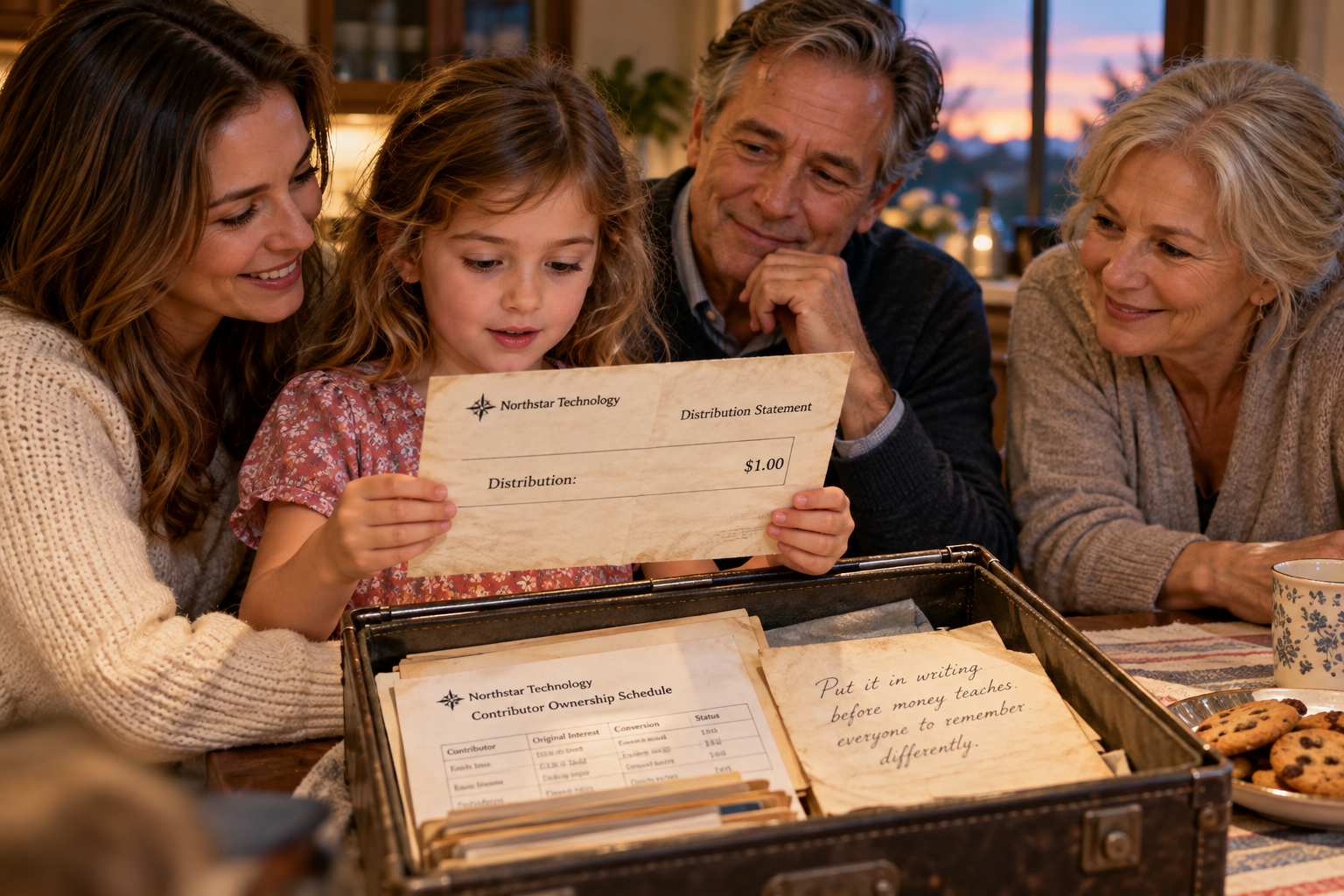
The one-dollar compensation statement appeared in a small display.
Not mine.
A duplicate Northstar produced.
I stood in front of it during opening day.
A group of students gathered nearby.
One said, “This is insane.”
Another asked, “Why would they give him one dollar?”
The first answered, “To piss him off.”
Not quite.
I almost corrected them.
Then stopped.
The archive existed so they could investigate.
Not so I could stand beside every artifact explaining the lesson.
A student opened the digital timeline.
Found Project Clear Title.
Read the compensation leverage documents.
“Whoa.”
There.
Curiosity doing its job.
No narrator required.
Anika joined me.
“Better than a building?”
“Much.”
“The board still likes the building.”
“Tell them no.”
“They know.”
Patrick came later.
He avoided Marcus’s interview at first.
Then watched it.
I found him standing at a terminal with headphones.
“What does he say?”
Patrick removed them.
“Same Marcus.”
“Meaning?”
“He thinks half of what he did was economically rational.”
“Probably does.”
“He admits the one-dollar pressure was wrong.”
“That’s not nothing.”
Patrick frowned.
“You've gotten annoyingly peaceful.”
“I’m old.”
“You’re not that old.”
“Compared with the first Atlas launch?”
“Fair.”
Marcus attended opening day quietly.
No speech.
No media.
He approached me near the technical display.
“Good archive.”
“Elaine did well.”
“She included my worst emails.”
“Yes.”
“She also included Thomas’s early support for contributors.”
“Yes.”
“That makes things complicated.”
“History usually is.”
He looked at the Relay diagram.
NO SINGLE MACHINE SHOULD BE THE TRUTH.
“Clare wrote that?”
“Yes.”
“Useful line.”
“Very.”
Marcus was silent for a moment.
Then said, “I wish we had bought you out for three million.”
I laughed.
“I believe you.”
“No litigation. No lost transaction economics. No regulators.”
“No Clear Terms.”
“Perhaps worth it.”
I looked at him.
“Would you have offered three million then if you knew Atlas would become what it became?”
He thought.
“No.”
“Then the problem remains.”
He nodded.
At least he understood.
We stood beside each other looking at the old diagrams.
No reconciliation.
No friendship.
Just two people who had spent years on opposite sides of a decision now old enough to view it behind museum glass.
That was enough.
Before leaving, Marcus said, “You were right about one thing.”
“What?”
“The transfer needed to be real.”
I waited.
“I treated consent as a cost to optimize.”
“Yes.”
“Bad habit.”
“Expensive habit.”
He almost smiled.
Then left.
Elaine approached afterward.
“What did he say?”
“Archive material.”
She looked interested.
“No.”
“Why?”
“Some conversations can remain conversations.”
The archivist looked personally wounded.
I enjoyed that.
That evening, our family went to dinner.
Sophie was home from school.
She had brought a boyfriend, which created a separate crisis I was not legally authorized to investigate.
He studied engineering.
Knew the Atlas story.
Tried very hard not to mention it.
I appreciated him immediately.
Halfway through dinner, Sophie said, “Tell them what Meridian wanted to name after Dad.”
Clare laughed.
I glared.
Her boyfriend looked terrified.
“A building?”
“Yes.”
“What did you say?”
“No.”
He stared.
“Why?”
I answered.
“Because buildings are difficult to correct.”
Clare kicked me under the table.
“Normal answer.”
I tried again.
“Because lots of people built Atlas.”
“That makes sense.”
Good kid.
After dinner, Sophie asked whether I was glad the archive existed.
“Yes.”
“More than the settlement?”
“Different.”
“What does the archive give you?”
I thought about it.
“Nothing.”
She frowned.
“Then why like it?”
“Because it doesn't belong to me.”
That was the point.
My story had stopped being mine alone.
Documents contradicted me.
Other voices complicated mine.
People could study it and reach conclusions I disliked.
That was healthier than recognition controlled by me.
Ownership again.
Sometimes the right ending was letting go.
Click here to continue reading: PART 32: The Anniversary of the One-Dollar Payment Brought Everyone Back Together, but the Final Question Was Whether We Still Needed the Story at All
The Envelope on My Desk Contained One Dollar, and Everyone Around Me Was Celebrating Something I Couldn’t Explain
Part 31 of 35