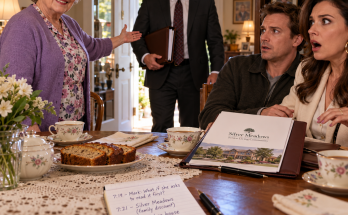
Gavin listened to his father’s recording alone first.
That was his choice.
No one argued.
When he returned, he carried the transcript folded in half.
He sat beside Lydia.
Not Julian.
Michael Mercer had known Gavin was not biologically his.
He knew before Gavin was born.
Lydia told him.
That fact mattered to Gavin more than any account balance.
“He stayed,” Gavin said.
Lydia nodded.
“He wanted you.”
Gavin stared at the transcript.
“Did he ever consider leaving?”
“Yes.”
The honesty hurt.
Lydia continued.
“For about a day.”
Gavin looked at her.
“Then?”
“He came home and started building your crib.”
That was all.
No speech.
No attempt to turn Michael into a saint.
A man had been hurt, made a decision, and spent the rest of his life acting on it.
Gavin wiped his face once.
Then asked us to continue.
Michael’s recording with Thomas occurred when Gavin was six.
Leonard had already invested through an intermediary in Mercer Industrial Supply, Michael’s small business.
Michael believed the capital came from an ordinary private investor.
Years later, he discovered the intermediary connected to Leonard.
He confronted him.
Leonard told Michael the investment was “for Gavin.”
That frightened him.
Why would a man Gavin barely knew finance his father’s company for a child?
Thomas suspected leverage.
Leonard knew Julian was Gavin’s biological father.
He understood Julian’s emotional vulnerability long before Gavin did.
If Leonard could create financial dependency around Gavin, he might someday influence Julian through his son.
A contingency.
Another human being turned into an instrument.
Thomas told Michael to repay the investment.
Michael tried.
Leonard refused early repayment through the intermediary.
So Thomas helped Michael refinance.
Using ordinary bank debt.
No Reserve B.
No hidden trust.
A clean exit.
For a while, it worked.
Then Michael died in a car accident when Gavin was sixteen.
The records had always treated it as accidental.
Weather.
Wet road.
No alcohol.
No mechanical defect found at the time.
Gavin looked at Mara.
“Are we reopening that too?”
No one wanted to answer too quickly.
Samuel’s MERCER directory contained the accident report.
Photographs.
Insurance documents.
And correspondence between Leonard and a private investigator.
One message was dated two weeks before Michael’s death.
M.M. refinance completed. Leverage lost.
That looked terrible.
The next:
Observe only. No contact.
Important distinction.
There was no instruction to harm Michael.
No evidence yet that the accident was anything other than an accident.
Mara said exactly that.
“We investigate facts. We do not turn proximity into murder.”
Gavin nodded.
My father’s rule again.
Do not punish assumption as fact.
The investigator’s later report described Michael leaving work the night of the accident.
Driving home.
Heavy rain.
Then nothing.
No surveillance beyond the office.
No evidence of tampering.
Forensic review of old photographs found no obvious contradiction in the original crash conclusion.
Gavin breathed differently after hearing that.
Not relieved exactly.
But grateful not to inherit another murder without proof.
After Michael died, Lydia struggled financially.
Julian stepped in.
At first indirectly.
School costs.
A loan refinance.
Later introductions.
Mentorship.
Gavin had interpreted Julian’s attention as recognition of talent.
It was that.
And guilt.
And biology.
And perhaps Leonard’s old design working exactly as intended.
“Did Leonard push you toward me?” Gavin asked Julian.
Julian thought carefully.
“He told me Michael had left Lydia exposed.”
“That isn’t an answer.”
“Yes.”
Julian admitted Leonard encouraged him to help.
He did not know Leonard had previously invested in Michael’s business.
“Would you have helped anyway?”
“Yes.”
Gavin looked at Lydia.
She nodded.
Julian had already begun asking about him after Michael died.
Leonard accelerated what was likely to happen.
That nuance mattered.
Manipulation did not require inventing desires.
Often it only redirected ones already present.
Samuel understood that too.
He had not created my instinct to solve financial problems.
He built circumstances where that instinct could be used.
Then Eleanor explained why she copied the MERCER directory.
Samuel had shown her selected portions months earlier.
He claimed Gavin’s entire career was engineered by Julian and Leonard.
Eleanor did not believe him.
She copied the full directory to verify.
“What did you find?”
“That Samuel exaggerated.”
Gavin’s early advantages were real.
Julian introduced him to investors.
Legacy capital entered later financing.
But LatticeForge itself was Gavin’s idea.
Its early customers were genuine.
The product was real.
Most employees had no connection to the old network.
The company’s later growth depended far more on operating performance than inherited capital.
Samuel’s transition plan described LatticeForge as if it were merely an asset produced by the network.
It was not.
That mattered legally.
And emotionally.
Gavin stared at Eleanor.
“You copied the file to protect me?”
“To protect the truth.”
Good answer.
Not him.
Truth.
“Then why delete Samuel’s copy?”
“I didn’t.”
The forensic logs still showed Samuel’s administrator key.
Eleanor possessed a copy.
But another copy could exist.
Samuel had said only Eleanor “should” have one.
Not that only she did.
Who else might?
His servers contained key-generation history.
Three administrator keys existed.
Samuel.
Eleanor.
And one created eighteen months earlier.
Label:
CONTINUITY.
Assigned to no name.
Used rarely.
The deletion came from that key.
Someone else.
Again.
Samuel refused at first to identify the continuity holder.
Investigators reminded him obstruction would complicate any cooperation agreement.
He finally answered.
“Mason.”
Mason Reed.
The former LatticeForge chief of staff who had already admitted selling the network map.
Mason had deeper access than he disclosed.
Confronted with the logs, he broke quickly.
Yes.
Samuel gave him the continuity key.
Yes.
He deleted the MERCER directory.
“Why?”
“Because I was told to.”
“By Samuel?”
“No.”
“Eleanor?”
“No.”
“Who?”
Mason stared at his attorney.
Then answered.
“Gavin.”
Gavin actually laughed.
Not because it was funny.
Because the accusation had become absurd.
“I didn’t even know the file existed.”
Mason insisted the instruction came from Gavin’s secure corporate account.
Sent after Samuel’s arrest.
But Gavin had surrendered his devices.
The message was real.
His account was compromised.
Again.
We traced the session.
It originated inside LatticeForge’s disaster-recovery environment.
Only a handful of administrators could access it.
Mason.
Two security engineers.
The CTO.
And Gavin’s former executive assistant.
Celia’s former assistant also had temporary credentials during a joint project.
The list widened.
Then the message metadata contained a clue.
The sender used a phrase:
Clean the old man’s file before Sloane sees it.
Gavin looked at me.
“I would never call Michael ‘the old man.’”
He was right.
He always called him Dad or Michael.
Samuel’s records showed another person used that phrase repeatedly.
Leonard.
But Leonard was dead.
Someone had copied not only credentials.
They copied voices, habits, identities.
The whole network had become a graveyard where living people wore dead people’s names.
Adrian searched old communications for the exact wording.
One match.
An email from Leonard to Peter:
Clean the old man’s file before Thomas sees it.
Different old man.
Same construction.
Who had access to Leonard’s email archive?
Peter.
Amelia before she died.
Samuel.
Daniel.
Vivian through copied records.
Nadine through the trustee archive.
And potentially anyone Samuel later allowed into his system.
Mason claimed the instruction appeared in a secure channel Samuel had told him to obey.
The account looked like Gavin’s, but Mason knew by then identities were often symbolic.
“So you knew it might not be Gavin.”
“Yes.”
“And deleted the file anyway.”
“Yes.”
“Why?”
“Because the message also said Eleanor had copied it.”
Mason believed no evidence would be lost.
He thought he was cleaning redundant data.
That explanation did not make the unauthorized deletion acceptable.
But it explained why he did not panic.
Then we asked who told him Eleanor possessed the copy.
He gave us the username.
LS-2.
Leonard Shaw Two.
A continuity identity.
Created after Leonard’s death.
Samuel’s face changed when shown it.
“I did not create that.”
Finally, something surprised him.
Forensics confirmed LS-2 first appeared nine years earlier.
Before Mason.
Before the current crisis.
It had accessed Samuel’s archive periodically.
Never altered much.
Mostly read.
Someone had been watching the watcher.
“Who knew your architecture well enough?” Mara asked Samuel.
He listed possibilities.
Amelia.
Leonard before his death.
Daniel partially.
Vivian.
One former technician.
Then he stopped.
“Who?” I asked.
Samuel looked at Julian.
“Raymond.”
That surprised me.
Raymond had spent years investigating Julian.
Perhaps he had also infiltrated Samuel.
Vivian confirmed Raymond learned about Samuel’s old routing architecture before going to Prague.
He believed someone was still using it.
Maybe LS-2 was him.
But the account remained active after Raymond died.
Unless he gave access to someone.
Who?
Raymond’s Prague archive held the answer.
A file labeled CONTINUITY LETTER.
Addressed to Evelyn.
Raymond wrote:
If I am stopped, use the Leonard channel. Samuel thinks it is his blind spot. It is actually mine.
Evelyn stared at the document.
“I never received this.”
It had remained unsent.
But another copy existed in Raymond’s scheduled cloud delivery.
Recipient:
Celia Hart.
Celia checked old spam archives.
Nothing.
The delivery service showed successful transmission three days after Raymond died.
To an address that looked like hers.
One character differed.
A typo?
No.
The near-identical address had been registered two years earlier.
By a privacy service.
Someone intercepted the continuity letter.
Whoever controlled the false Celia address gained Raymond’s access to LS-2.
That person could continue using Leonard’s identity after Raymond died.
We traced the domain registration payment.
Cryptocurrency.
No easy owner.
But login records survived.
One access from France.
One from Switzerland.
One from New York.
Then, six months ago, repeated logins from Cambodia.
No person identified.
Just infrastructure.
A commercial VPN exit.
The geography itself proved little.
We looked for behavioral evidence instead.
The false Celia account communicated with Mason three times.
With Samuel’s systems twice.
And once with Nadine.
Nadine remembered the message.
It arrived shortly after Raymond died.
It said:
He left instructions. Do not contact Vivian until Prague archive is secure.
Nadine obeyed for almost two weeks.
“Why?” Celia asked.
“I thought it was you.”
Celia stared at her.
“You thought I knew about Raymond’s secret archive and you didn’t call me?”
“I thought you had finally learned everything.”
“You could have asked.”
“Yes.”
Another assumption.
Another opening.
Then the false account sent Nadine a photograph of Marcus’s notebook.
A page only three people should have possessed at the time.
Nadine.
Vivian.
And whoever had photographed it before Vivian took the notebook.
“Who photographed it?” I asked.
Nadine’s face changed.
“My attorney.”
“Which attorney?”
A name we had seen before in estate records.
Claire Donnelly.
Marcus’s longtime estate lawyer.
She witnessed the earlier codicil.
Handled storage documents.
Worked with Nadine after Marcus died.
And had access to Marcus’s archive before Vivian stole the notebook.
Claire had never appeared central because she seemed purely administrative.
We contacted her firm.
Claire Donnelly retired four years ago.
Current residence:
New York.
She agreed to speak.
Her attorney attended.
At first, she denied knowing Raymond.
Then we showed the false Celia email.
She stopped.
“I was trying to preserve Marcus’s plan.”
The sentence could have come from anyone in this story.
Claire admitted registering the near-identical Celia address.
She did so at Raymond’s request.
That surprised us.
Raymond feared his communications were monitored.
He asked Claire to create a dead-drop address that resembled Celia’s but was controlled by counsel.
“Then why did you impersonate Celia?”
“I didn’t initially.”
Initially.
After Raymond died, Claire received the continuity letter.
She realized Raymond had gained access to Samuel’s system.
She used it.
“To do what?”
“Watch.”
Just watch.
For years.
Claire monitored Samuel.
Julian.
Nadine.
Vivian.
Evelyn.
Later Gavin.
Me.
Another watcher.
Another person convinced observation was harmless because she did not move money.
Except she eventually did more.
She sent instructions to Mason.
She used Gavin’s compromised account.
She ordered the MERCER directory deleted after learning Eleanor had copied it.
“Why?”
“Because Michael’s file contained private family material unrelated to asset tracing.”
“You had no authority to decide that.”
“No.”
“Why impersonate Gavin?”
“Because Mason would comply.”
That was the whole system reduced to one sentence.
Use the identity that gets the desired response.
Claire looked ashamed.
Then Celia asked her the question that changed everything.
“Did my father know you were doing any of this?”
“No.”
“Would he have approved?”
Claire looked down.
“Not at the end.”
At the end.
Marcus had changed.
That distinction kept returning.
Earlier Marcus hid money.
Later Marcus designed transparency.
Earlier Thomas built a secret reserve.
Later Thomas demanded independent examination.
Earlier Evelyn accepted compartmentalization.
Later she built Haven to escape it.
People changed.
But their systems preserved their worst decisions longer than their better ones.
Claire agreed to surrender the LS-2 credentials.
She also turned over Raymond’s continuity archive.
Inside was a document he had prepared shortly before Prague.
Not an accusation.
A timeline.
Twenty-seven years of decisions.
Each line named the person, what they knew, what they chose, and what happened next.
No dramatic language.
No villains.
Just sequence.
At the bottom Raymond wrote:
Every disaster began when someone decided the others could not be trusted with the truth.
I read it twice.
Then the final line:
The only solution is simultaneous disclosure to everyone with a legitimate claim.
Not public detonation.
Not secrecy.
Shared disclosure first.
Raymond had changed too.
Nadine had killed him trying to stop a version of Raymond that no longer existed.
She believed he still planned indiscriminate publication.
His final timeline showed otherwise.
He intended to gather us.
Give everyone the same evidence.
Then proceed through counsel.
If Nadine had asked one more question instead of drugging him, he might still be alive.
Celia closed her eyes when she understood.
Then she said quietly:
“That’s what we do.”
No one asked what she meant.
We knew.
Stop the sequence.
No more separate briefings.
No private heir.
No favored branch.
No secret rescue.
Every legitimate claimant would receive the same verified record.
At the same time.
Julian looked uncomfortable.
Good.
Samuel looked skeptical.
Better.
Gavin nodded.
Evelyn did too.
Vivian joined remotely.
Even Lydia agreed.
We began preparing the disclosure process.
Then Adrian interrupted.
“There’s one problem.”
Reserve B’s reconstructed ledger showed another beneficiary.
Not me.
Not Celia.
Not Gavin.
Not any known family member.
A trust established twenty-six years earlier.
Funded before Thomas and Marcus formally created their foundation plan.
Current value:
$63 million.
Beneficiary designation:
E.H.
Celia stared.
“Elena Hart?”
Her mother.
Elena had supposedly died before the original eighteen-million-dollar crisis.
The trust was opened in her initials after her death.
Or so we thought.
Then Adrian placed the formation date on the screen.
The trust had been created nine months after Elena Hart’s recorded death.