Three years after Chloe left for college, I stood in the same kitchen where she had once offered me birthday money for rent.
Not literally the same kitchen.
That one had belonged to the apartment above the laundromat.
But sometimes memory ignores architecture.
It places old rooms inside new ones.
Liam was packing for college.
Noah was pretending he would not miss him.
Chloe had graduated early after adding summer courses and was living in Milwaukee, working as a junior designer for a publishing company.
She still made art.
Some of it even made money.
Dad was delighted by that detail.
I reminded him money was not the point.
He said money remained a pleasant feature.
Some things did not need complete correction.
Mark and Valerie were still married.
They had survived their second beginning.
Not perfectly.
They stopped pretending perfect was available.
That probably helped.
Mark never regained the exact career path he had once expected.
He built another.
He worked for a smaller company now.
Less money.
Less travel.
He seemed happier.
We were not friends.
We had become something less dramatic and more useful.
People who shared history, children, and enough mutual respect to stop using the past as a weapon.
Sometimes he called about the children.
Sometimes college bills.
Once, inexplicably, he called to ask which plumber I used.
That might have been the moment I knew the divorce had truly healed.
Kevin sold his company and became a consultant.
He hated retirement within four months.
No one was surprised.
Jessica thrived in her promotion.
Her children grew.
Daniel remained part of their lives within clear boundaries.
Mom’s garden expanded to two plots.
Dad complained about this while building her a new tomato support system.
Their marriage lasted.
Not because staying was automatically virtuous.
Because they both continued choosing it.
Dad still attended therapy.
He claimed he went mostly because his therapist enjoyed arguing with him.
Mom said this was delusional.
I stayed out of it.
My business had changed too.
Dana handled most daily operations.
I worked four days a week.
Sometimes three.
The first time I took an entire Friday off without travel, illness, or family obligation, I spent two hours feeling guilty.
Then I went to a museum.
Alone.
I liked it.
I began drawing again.
Badly.
That was not false modesty.
My hands had forgotten things.
But I kept doing it.
One evening, Chloe visited and found a sketchbook on my table.
She opened it.
I grabbed it.
“No.”
She laughed.
“You snooped through mine for years.”
“I paid for yours.”
“That is not how privacy works.”
“Apparently I taught you too well.”
She stole the sketchbook back.
Flipped through several pages.
Then became quiet.
“What?”
“These are good.”
“They are not.”
“They’re interesting.”
“That is artist language for technically unfortunate.”
She smiled.
“Maybe.”
I threw a dish towel at her.
She kept looking.
Near the back was a sketch of my parents’ old porch.
Not the night they turned us away.
The estate-sale day.
Open door.
Empty steps.
No people.
Chloe stared at it.
“You should finish this.”
“It is finished.”
“It needs a person.”
“No.”
“Why?”
“Because the door is enough.”
She looked at me.
Then smiled.
“Okay.”
She understood.
The adult resource center became permanent.
Every year, hundreds of students used it.
Most never knew my story.
Good.
They did not need it.
The center was not a monument to what I survived.
It was infrastructure.
Something practical.
Something available.
That mattered more.
Kevin’s donation fund had grown through additional contributions.
We renamed it once the original money was no longer the majority.
The Continuing Student Emergency Fund.
No donor names.
No family mythology.
Just help.
Shirley attended every annual fundraiser.
She continued claiming retirement.
Nobody believed her.
On a cool October afternoon, she called me to the bakery.
“You sound suspicious.”
“I need a favor.”
“No.”
“You don’t know what it is.”
“Experience.”
“Come at four.”
I went.
Mom was there.
Dad.
Kevin.
Jessica.
Mark and Valerie.
Chloe had driven down from Milwaukee.
Liam was home for the weekend.
Noah arrived after school.
I stopped inside the bakery entrance.
“What is this?”
Shirley smiled.
“My retirement.”
“You’ve had six.”
“This one is real.”
Elena shouted from behind the counter, “It is not.”
Everyone laughed.
Then Shirley pointed at a table.
A cake sat there.
On top, in slightly crooked icing:
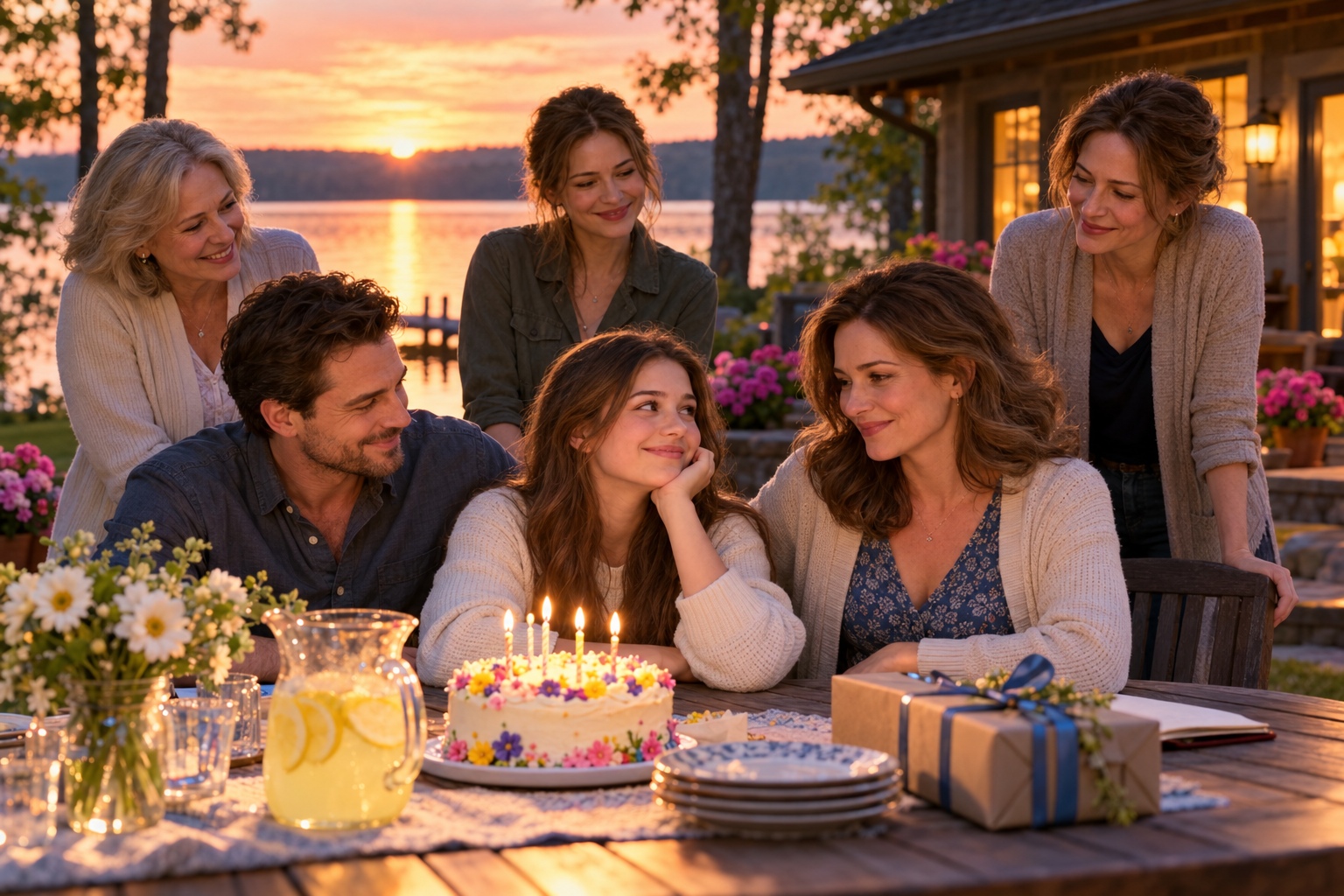
TWENTY YEARS IN BUSINESS — MITCHELL BOOKKEEPING SOLUTIONS.
I stared.
“What?”
Dana appeared from the back room.
“You forgot.”
“I did not forget.”
“You scheduled client reviews over the anniversary.”
“That is not forgetting.”
“It is accountant denial.”
I looked around.
Twenty years.
That seemed impossible.
I had started with receipts spread across Shirley’s bakery table.
One client.
Then three.
Then five.
Now the company employed more than thirty people across two offices.
But the number that caught me was not thirty.
It was twenty.
Twenty years since the beginning.
Longer than my marriage to Mark had lasted.
Longer than the period of family estrangement.
Long enough that the worst night of my life no longer occupied the largest percentage of my adulthood.
That realization nearly undid me.
Shirley handed me a plastic knife.
“Speech.”
“No.”
“Speech.”
Everyone joined her.
I hated them.
I stood beside the cake.
For several seconds, I had no idea what to say.
Then I looked around the room.
At Mark.
At Valerie.
At Mom.
Dad.
Kevin.
Jessica.
My children.
Dana.
Shirley.
People who had helped me.
People who had hurt me.
People who had done both.
“I don’t have a speech.”
Shirley booed.
I ignored her.
“When I started this company, I didn’t have a business plan.”
Dana said, “We know.”
“I had bills.”
Laughter.
“And one client who kept receipts in grocery bags.”
Shirley lifted her chin proudly.
“Advanced filing system.”
I smiled.
“I thought success would eventually feel like proving something.”
The room became quieter.
“I thought maybe if I earned enough, built enough, bought a house, raised the kids, then something about the past would change.”
Dad looked down.
Mark did too.
“It didn’t.”
I let that sit.
“The past stayed exactly where it was.”
I looked at Dad.
“That turned out to be okay.”
His eyes filled.
“Because the goal was never to make what happened acceptable.”
I looked around.
“The goal was to build a life where what happened was no longer in charge.”
Silence.
Then Shirley said, “That was annoyingly good.”
Everyone laughed.
We cut the cake.
No dramatic reconciliation followed.
We did not need one.
The reconciliation had been happening in hundreds of smaller moments.
Dad asking instead of deciding.
Mom speaking instead of smoothing.
Kevin telling the truth before being caught.
Jessica choosing without permission.
Mark accepting consequences.
Valerie refusing to make guilt her identity.
Me learning that boundaries were not punishments.
The children learning they could love all of us without managing any of us.
That was the family we had built.
Later, after everyone left, Dad remained near the bakery door.
“You need a ride?”
“No.”
He smiled.
“I’m asking, not assigning.”
“I noticed.”
He looked older.
More than during the hospital scare.
Gray hair.
Lines around his eyes.
Still Dad.
“Twenty years.”
“Yes.”
“I missed too much of the beginning.”
“You did.”
“I’m sorry.”
“I know.”
He hesitated.
Then he said, “I remember what you said that night.”
My breath caught.
“What?”
“At the house.”
I stared.
“You heard me?”
“Not clearly.”
He looked embarrassed.
“I was still inside the door.”
“What did you hear?”
“Something about watching what happened next.”
I laughed softly.
“You remember that?”
“Yes.”
“What did you think I meant?”
“That you were angry.”
“I was.”
“I thought you were threatening me.”
“That makes two people.”
“Who else?”
“Chloe.”
He smiled.
Then his face softened.
“What did you mean?”
The same question Chloe had asked years earlier.
This time, the answer was clearer.
“I meant I was going to survive.”
Dad nodded.
“I think part of me knew that.”
“Did you?”
“No.”
He smiled sadly.
“I thought you’d come back the next morning.”
“To your house?”
“To Mark.”
I shook my head.
“I know.”
Dad looked around the bakery.
“I was wrong about almost everything.”
“Not everything.”
“Name one.”
“You said I was stubborn.”
He laughed.
“That was accurate.”
“Very.”
He opened the door.
Then stopped.
“Your mother wants everyone Sunday.”
“For?”
“Dinner.”
“What’s the occasion?”
“Nothing.”
“Good.”
“You coming?”
“Yes.”
He smiled.
“See you Sunday.”
Dad walked outside.
The door swung closed behind him.
I looked at it.
Doors had followed me through my entire adult life.
Closed ones.
Locked ones.
Rented ones.
Office doors with my name on them.
A front door to a house I bought myself.
A dorm-room door I walked away from when my daughter began her own life.
My parents’ condo door, which I could now open with a key.
For years, I had thought the important part of that night outside my parents’ house was that Dad closed the door.
It was not.
The important part was what I did afterward.
I turned around.
I walked back to my children.
I got into the car.
And I drove.
Not toward a perfect future.
Toward a motel I could barely afford.
Toward fear.
Toward work.
Toward mistakes.
Toward a life I had not planned.
But forward.
Always forward.
Sunday dinner became exactly what Dad promised.
Nothing.
Mom made roast chicken.
Kevin arrived late.
Jessica brought dessert.
Chloe drove down.
Liam came home.
Noah complained that everyone talked too loudly.
Mark had the boys earlier and dropped them off at the condo.
He did not come inside because he had plans with Valerie.
Nothing dramatic.
Before dinner, I stood in Mom’s kitchen slicing bread.
Dad passed behind me carrying plates.
He stopped.
“What?”
“Nothing.”
“That face is never nothing.”
He smiled.
“I was thinking about the first time you came here.”
“This condo?”
“Yes.”
“You were terrified I’d judge the size.”
“I was.”
“I did.”
“I know.”
“It’s small.”
“Sarah.”
I laughed.
Dad put the plates down.
Then he looked at me.
“You know this is your home too.”
I considered correcting him.
Home was my house.
My children.
My life.
But I understood what he meant.
“Thank you.”
That was enough.
After dinner, Mom packed leftovers for everyone.
Dad argued with Kevin about football.
Jessica helped Mom clean.
Chloe showed Noah something on her phone.
Liam fell asleep on the couch.
I stood near the entrance putting on my coat.
My hand brushed the key in my pocket.
Dad noticed.
“You still have it.”
“Yes.”
“Good.”
I opened the door.
Cold air entered.
Dad called from behind me.
“Drive safe.”
“I will.”
No speech.
No symbolism.
No request that I stay.
I stepped into the hallway.
Then I looked back.
Dad stood inside.
The door was open.
For one second, I saw both nights at once.
The old porch.
Three children waiting in the car.
One blue duffel bag.
Dad telling me to return to the husband who betrayed me.
Kevin laughing.
Jessica calling me selfish.
Mom silent.
The door closing.
And now this.
Children grown.
Relationships changed.
Truth spoken.
A key in my pocket.
A father who finally understood that loving me did not give him ownership of my choices.
I smiled.
“Goodnight, Dad.”
“Goodnight, Sarah.”
I walked toward the elevator.
The door behind me remained open until I turned the corner.
But I no longer needed to watch.
I no longer needed proof.
Years ago, standing on that porch, I had looked at the house and whispered, “Watch what happens next.”
I once thought the answer was the business.
The money.
The house.
The independence.
I thought the answer would be everyone who rejected me eventually needing something from me.
For a while, that had felt satisfying.
But that was not what happened next.
What happened next was harder.
I learned to leave without hating everyone who stayed.
I learned to forgive without pretending.
I learned to help without rescuing.
I learned to love people without handing them control.
I learned that truth without choice can become cruelty, and choice without truth can become manipulation.
I learned that family does not earn permanent access simply by being family.
Access is built through behavior.
Maintained through respect.
Lost through repeated harm.
Sometimes rebuilt.
I learned that my children did not need a perfect mother.
They needed one who could admit when she was afraid, wrong, uncertain, or changing.
I learned that Mark’s betrayal belonged to Mark.
Dad’s closed door belonged to Dad.
Kevin’s silence belonged to Kevin.
Mom’s passivity belonged to Mom.
Jessica’s judgment belonged to Jessica.
I could understand those choices.
Forgive some.
Remain angry about others.
But I did not have to carry them as definitions of myself.
Outside, the parking lot was cold.
My car lights flashed when I unlocked it.
I sat behind the wheel.
For a moment, I did not start the engine.
Twenty years earlier, I had sat behind another wheel with three frightened children and no idea where we would sleep after the next night.
I wished I could reach backward.
Not to warn that woman.
Not to tell her everything would work out.
That would have been a lie.
Some things did not work out.
Some relationships never returned to what they were.
Some money was lost.
Some trust never fully regrew.
Some memories remained painful.
I would tell her something smaller.
Keep driving.
That was all.
Not because the road guaranteed a happy ending.
Because movement created choices.
And choices created a life.
I started the car.
My phone buzzed.
Chloe.
You forgot Mom’s leftovers.
I laughed.
Then another message appeared.
She says come back.
I looked toward the condo entrance.
Through the glass, Dad was standing there holding a paper bag.
He saw my headlights.
Raised the bag.
I could almost hear Mom yelling behind him.
For a moment, I considered making them keep the leftovers.
Then I smiled.
I got out of the car.
Dad opened the building door before I reached it.
“You forgot these.”
“So I’ve been informed.”
He handed me the bag.
“Your mother says there’s enough for tomorrow.”
“There’s enough for a week.”
“She doesn’t understand portions.”
“I know.”
Dad stood holding the door.
I took the bag.
“Thanks.”
“Anytime.”
I turned toward the car.
“Sarah?”
I looked back.
Dad smiled.
Nothing guilty in it.
Nothing pleading.
Nothing left to prove.
“Love you.”
“Love you too.”
I walked away.
Behind me, the door closed.
This time, the sound did not hurt.
Because I knew the difference now.
A door closing after you leave is not the same thing as a door being closed against you.
And even if someday another one was, I knew what I would do.
I would turn around.
Find the people who needed me.
Find the people I needed.
Find another road.
And keep going.
The End
Read more original stories on Feel Every Story.
The Door I Expected to Open Instead Closed While My Three Children Waited Behind Me in the Car
Part 35 of 35