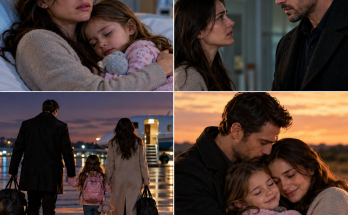
Toby turned forty-one on a Saturday.
One year after the birthday dinner that never happened.
He asked for no party.
Then Paige asked him again.
He said no.
Emma asked.
Still no.
I asked.
He narrowed his eyes.
“What are you planning?”
“Nothing.”
“That answer has become suspicious in this family.”
“I was thinking dinner at the cabin.”
He looked at me.
“How many people?”
“Six.”
“Who?”
“You, Paige, the children, me.”
“That’s five.”
“I can count.”
“Who’s six?”
“Harold.”
Toby laughed.
“Of course.”
“No band.”
“Good.”
“No champagne tower.”
“Better.”
“No raw bar.”
“Dad would haunt us.”
“Yes.”
He agreed.
We drove to Lake Arden in late afternoon.
The road project had begun miles away, but the cabin side remained quiet.
The conservation agreement had been finalized two months earlier.
Thirty-eight of the forty-three recovered acres would remain permanently protected from large-scale development.
The cabin parcel stayed in the trust.
Five acres near the road remained unrestricted in case future generations needed flexibility.
Not everything frozen.
Not everything sold.
A compromise.
Leon would have argued with it.
That made me trust it.
The conservation agreement reduced the theoretical market value dramatically.
I signed anyway.
Toby signed the necessary advisory acknowledgment.
Harold signed as trustee.
Nobody rushed.
Nobody hid the last page.
Nobody said, “Just sign here.”
We read everything.
It took three hours.
Then we went for sandwiches.
Leon would have approved of that part.
The criminal cases had moved into their less dramatic phase.
Appeals.
Restitution.
Professional discipline.
Asset recovery.
Occasional letters from prosecutors.
Voss remained incarcerated.
Martin’s health had declined.
Grant was serving his sentence.
Vivian too.
Rowe lost his license.
Rourke forfeited vessels and accounts.
Crane’s career in acquisitions ended.
Monica could no longer work in positions involving protected medical records.
Consequences spread according to each person’s role.
Not perfectly.
Nothing human ends perfectly.
Sherry wrote me twice.
I answered once.
Her first letter apologized.
Her second did not ask forgiveness.
That was why I answered.
I wrote three sentences.
I hope you use this time to become someone you respect. Paige loves you. I will not discuss money or property with you again.
I did not sign Love.
I signed Mara.
Paige still visited her.
Toby had not.
The children knew Grandma Sherry had “broken serious rules and had to be away.”
That was enough for their age.
Paige and Toby remained married.
Not magically repaired.
They went to counseling.
They argued.
They changed passwords.
They rewrote wills.
They stopped giving relatives automatic authority because “family” appeared beside a name.
Paige learned to tell her mother no without explaining for twenty minutes.
Toby learned to notice when silence was a decision.
I learned to call him when I missed him instead of waiting to see whether he would notice.
That may have been the most embarrassing improvement.
At the cabin, Emma helped me set the table.
Six plates.
Six chairs.
She counted twice.
“Grandma, we have exactly enough.”
“Yes.”
“Should we put another chair in case someone comes?”
“No.”
“What if somebody comes?”
“They can ask.”
She accepted that.
Children understand boundaries better than adults when nobody teaches them to feel guilty about them.
Harold arrived carrying a bakery box.
“You brought cake?”
“I was instructed.”
“By whom?”
“Paige.”
“Did you verify authorization?”
He stared at me.
Toby laughed from the porch.
“That joke is going to last until you die.”
Harold set down the box.
“I regret helping this family.”
“No, you don’t.”
“No.”
He smiled.
“I really don’t.”
We ate outside because the weather was mild.
No speeches were planned.
That lasted until Matthew stood on his chair.
“I have a speech.”
Paige closed her eyes.
“Sit down.”
“No.”
Toby said, “Let him speak.”
Matthew cleared his throat.
“Happy birthday, Dad. You are old.”
We applauded.
He sat.
Best speech of the year.
After cake, Toby walked to the dock.
I followed.
The sunset was turning the water copper.
For a while, neither of us spoke.
Then he said, “I’m glad you came last year.”
“To the venue?”
“Yes.”
“You told me not to.”
“I know.”
“You sounded very convincing.”
He looked embarrassed.
“I’ve apologized.”
“Many times.”
“Not enough.”
“Enough.”
He nodded.
“I keep thinking about that call.”
“So do I.”
“I said the table was full.”
“Yes.”
“There was literally a room for seventy-two people.”
I laughed.
“That was one of the more insulting details.”
“I told my mother there wasn’t room for her at a party she paid for.”
“You were manipulated.”
“I also made the call.”
There it was.
Responsibility without self-destruction.
He had learned.
“I was angry with you.”
“I know.”
“I’m still glad you’re my son.”
He looked toward the lake.
“I spent years assuming you’d always understand.”
“Yes.”
“That was unfair.”
“Yes.”
“You really enjoy agreeing with that.”
“A little.”
He smiled.
Then said, “Dad would’ve told me I was an idiot.”
“Your father lacked nuance.”
“He would’ve been right.”
“Sometimes.”
We stood together.
Then Toby asked, “Do you regret keeping the cabin?”
“No.”
“Would you ever sell it?”
“Yes.”
He looked surprised.
“Really?”
“If someday it becomes a burden.”
“But the conservation agreement.”
“Land can still be sold with restrictions.”
“To who?”
“Someone who wants trees more than condos.”
He nodded.
“You don’t think we have to keep it forever.”
“No.”
“Even after all this?”
“Especially after all this.”
I looked at him.
“Voss and Grant and Sherry made the land too important. I won’t make the same mistake in the opposite direction.”
Toby considered that.
“So what is it?”
“A cabin.”
“That’s it?”
“A very troublesome cabin.”
He laughed.
I continued.
“A place your father loved. A place you love. A place the children might love.”
“And if they don’t?”
“Then they don’t.”
That freedom was Leon’s real gift.
Not ownership.
Choice protected long enough to remain choice.
Toby looked across the water.
“I used to think inheritance was Dad deciding my future.”
“So did I.”
“What do you think now?”
“It’s the opposite.”
“How?”
“He tried to stop other people from deciding it before you arrived.”
Toby nodded slowly.
The trust had done exactly that.
Imperfectly.
Painfully.
But enough.
Back at the cabin, Paige was collecting plates.
I took them from her.
“You’re a guest.”
“I’m family.”
“Family can be guests.”
She smiled.
That sentence meant more than it sounded.
For years, family had meant access.
Keys.
Documents.
Opinions.
Entitlement.
Now family could simply mean someone invited to dinner.
Harold sat in Leon’s old porch chair.
I had almost thrown it away years earlier.
The left arm wobbled.
“Do not break that,” I told him.
“It is already broken.”
“Leon built it.”
“That explains the structural problem.”
I threw a napkin at him.
He laughed.
Later, he gave me a thin envelope.
“What is this?”
“Something from the old archive.”
I immediately became suspicious.
“Legal?”
“No.”
“Financial?”
“No.”
“Forged?”
“Almost certainly not.”
I opened it.
A photograph.
Leon and me at the cabin.
Probably twenty years earlier.
I was sitting on the dock with my feet in the water.
Leon stood behind me holding a fish far too proudly.
On the back, in his handwriting:
Mara says this place costs too much and catches too few fish.
Below it:
She is right about both.
I laughed.
Then I noticed another line.
If Toby ever gets this place, remind him he inherits the repairs too.
I showed Toby.
He groaned.
“Dad.”
Paige laughed.
“Congratulations on your legacy.”
Toby turned the photograph over again.
“He really didn’t take this place seriously.”
“He loved it.”
“That’s what I mean.”
I understood.
Love did not require worship.
Leon could treasure something and still joke about selling it when the roof leaked.
That balance had been missing from everyone who came after him.
Grant saw value.
Sherry saw entitlement.
Voss saw structure.
Martin saw leverage.
I had nearly seen obligation.
Leon had simply seen a place.
That evening, after everyone left except Toby’s family, I walked to the old survey marker.
The box where Leon hid the deed remained empty.
I had considered removing it.
Instead, I cleaned the rust and left it.
Not as a shrine.
As a reminder.
Evidence does not always need to stay hidden.
The truth had done enough hiding.
Emma came up behind me.
“What’s that box for?”
“Your grandfather kept an important paper there.”
“Why?”
“He didn’t trust the right people.”
She thought about that.
“Did he trust you?”
“Yes.”
“Then why didn’t he give it to you?”
Children ask excellent questions.
“I think he thought he had more time.”
“Oh.”
She accepted that too.
Then she took my hand.
“Grandma?”
“Yes?”
“Can we make hot chocolate?”
“Yes.”
“With marshmallows?”
“Yes.”
“Two?”
“As many as you want.”
She ran toward the cabin.
I followed more slowly.
Inside, Toby was trying to start a fire.
Badly.
Paige was correcting him.
Matthew was asleep sideways on the couch.
Six dinner plates waited beside the sink.
Six chairs surrounded the table.
Exactly enough.
No one had been erased to make room for someone else.
No one had been invited because of money.
No one was keeping score.
My phone buzzed.
For one irrational second, I remembered Daniel Caldwell calling about $27,300.
Then I looked.
A bank alert.
Ordinary.
Monthly utility payment.
I laughed.
Toby glanced over.
“What?”
“Nothing.”
I put the phone away.
Outside, the protected woods stretched behind the cabin.
Beyond them ran a road that had made the property valuable enough for people to betray one another.
The road could stay.
The value could stay.
Neither had authority over us anymore.
I poured hot chocolate into six mismatched mugs.
Emma added far too many marshmallows.
Toby finally got the fire going.
Paige opened the window because smoke filled the room.
Harold had forgotten his cake box, so half a birthday cake remained on the counter.
Nothing about the evening was elegant.
Leon would have loved it.
I sat at the table.
My walnut chair was at home.
This one was old pine, scarred by decades of plates and elbows.
Toby sat across from me.
There was room.
Not because somebody had counted correctly.
Because nobody at this table believed love required anyone else to disappear.
A year earlier, my son told me the table was full.
I believed him long enough to stay home.
Then a venue manager called and asked one ordinary question about my money.
That question opened everything.
The forged charges.
The trust.
The stolen land.
The signatures.
The lies.
And eventually the things we had refused to say to one another.
I lost the version of my family that existed before that call.
I did not want it back.
That family confused silence with peace.
Help with control.
Inheritance with entitlement.
Forgiveness with restored access.
The family sitting around Leon’s battered table was smaller in some ways.
But it was honest.
Emma pushed the marshmallow bag toward me.
“Grandma, you need more.”
“I have enough.”
She frowned.
“You only have one.”
I looked into my mug.
She was right.
“Fine.”
I added another.
Toby smiled.
“Careful. Reckless financial behavior.”
Paige groaned.
“Toby.”
I laughed so hard I nearly spilled the chocolate.
For once, the old accusation had no power.
It was only a bad joke among people who knew the truth.
And when I looked around the table, there was no empty place waiting to be explained.
The End
Read more original stories on Feel Every Story.
I Had Already Paid for My Son’s Birthday Dinner When He Quietly Told Me There Was No Seat Left for Me
Part 35 of 35