The phone rang ten minutes after Jennifer's last message.
Thomas looked at the screen.
"Michael."
He answered.
"Mr. Harris."
I could hear Michael's voice from across the kitchen, loud and sharp even though the phone was several feet away.
Thomas listened.
His expression changed.
"No."
Another pause.
"Margaret is competent and fully aware of her decisions."
Michael said something else.
Thomas stood.
"You cannot enter the property."
Another pause.
His jaw tightened.
"Do not threaten my client."
He listened again.
Then his voice became colder.
"I strongly suggest you speak with your own attorney before making another attempt to access the property."
He ended the call.
"What did he say?"
"He threatened legal action."
"Already?"
"He said if you continue refusing access, they will challenge your estate."
I looked at the folder.
"Then let them."
Thomas gave me a small smile.
"That's what I expected you to say."
He began gathering the documents.
Then he stopped.
"There is something else."
I sighed.
"There's always something else."
He opened another section.
This time, he pulled out several bank statements.
I recognized the account immediately.
One of my investment accounts.
"What about it?"
"Look at the authorized users."
I read the names.
Mine.
Richard's.
Then another.
Michael.
I stared at it.
"That's impossible."
"I thought so too."
"I never added him."
"I know."
"Richard wouldn't have."
"I know."
"Then how did his name get there?"
Thomas pointed to a transaction.
Someone had accessed the account two years earlier.
No money had been withdrawn.
That should have reassured me.
It didn't.
"What did they access?"
"Financial records."
"Why?"
"We don't know."
I looked closer.
Then I saw another access attempt.
And another.
Three in total.
Michael.
Jennifer.
Lisa.
My children had accessed my financial information without telling me.
I felt something cold settle in my stomach.
"How far back?"
"That's what we need to determine."
"What are you going to do?"
"Audit everything."
"How long?"
"Ten years."
I nodded.
"Do it."
Thomas closed the folder.
"I will."
He stood to leave.
At the door, he paused.
"Margaret?"
"Yes?"
"Don't contact your children."
"Why?"
"If they know we're investigating, they may start destroying evidence."
I stared at him.
"Are you saying they did something illegal?"
"I'm saying we don't know yet."
He opened the door.
"But the house may not be the real issue."
Then he left.
I stood in the hallway long after the door closed.
For years I had described my children with harmless words.
Busy.
Distracted.
Self-absorbed.
Young.
Maybe careless.
Now another possibility had entered my mind.
Maybe they hadn't simply been waiting for me to die.
Maybe they had already been preparing for what would happen afterward.
I returned to the kitchen.
Richard's letter was still on the table.
I picked it up.
The page caught the light differently.
Something was written on the back.
I turned it over.
There was another sentence.
One I had missed because I had been crying.
If they ever come together demanding the house, don't believe it is a coincidence.
My fingers tightened around the paper.
At that exact moment, my phone buzzed.
Unknown number.
I opened the message.
Ask your children what happened to the money Richard left before he died.
I read it twice.
Then another message appeared.
Because they already know.
I sat down.
Richard's estate had always seemed straightforward.
The house came to me.
His investments came to me.
The insurance protected me.
At least, that was what I believed.
I called Thomas.
He answered immediately.
"I was expecting you."
"Someone sent me a message."
"What did they say?"
I read both messages.
"Forward them."
I did.
Then I asked the question that had suddenly become impossible to avoid.
"What money did Richard leave before he died?"
Thomas was silent.
"Thomas?"
"When Richard died, several accounts were transferred to you."
"I know."
"But there were also investments that didn't appear clearly in the final probate inventory."
I stood.
"What investments?"
"I'm still trying to establish that."
"How could you not know?"
"Richard used another financial adviser for some private investments."
"Who?"
"Daniel Mercer."
The name stirred something in my memory.
"Mercer Financial?"
"Yes."
"I thought Richard stopped using him."
"So did I."
"Is he still alive?"
"Yes."
"Then call him."
"I already did."
"And?"
"He refused to discuss Richard's accounts."
"Why?"
"Confidentiality."
I stared out the window.
"I'm his widow."
"I know."
"I have a right to know what happened to my husband's assets."
"That's what we're going to establish."
I looked at the snow-covered yard.
"How long?"
"Several weeks."
"I don't have several weeks."
"You do."
"No."
My voice sharpened.
"My children are involved."
"We don't know that."
"Someone says they are."
"Someone may be trying to frighten you."
"Then find out."
Thomas was silent.
Finally he said, "I will."
That afternoon another message arrived.
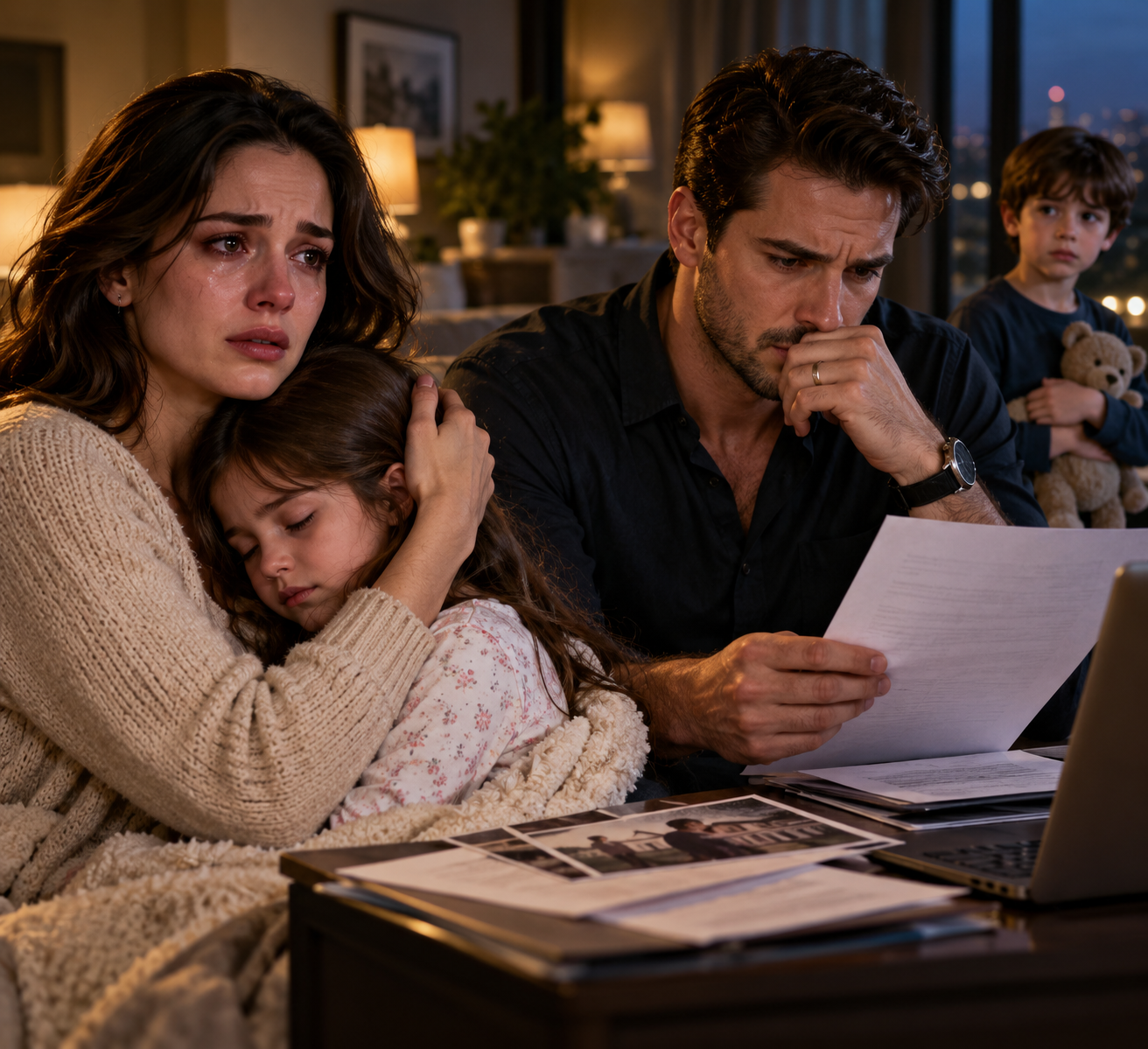
This time, there was a photograph.
I opened it.
My heart stopped.
Richard stood in front of an office building.
Beside him was Daniel Mercer.
And beside Daniel were Jennifer, Michael, and Lisa.
All three of my children.
I had never seen the photograph.
Underneath it was a message.
Ask them why they met Richard's financial adviser six months before he died.
Six months.
The same period Richard had mentioned in his letter.
I called Thomas again.
"I have a photograph."
"Send it."
I did.
He called back within minutes.
"I recognize the building."
"Where?"
"Mercer's old office."
"Why were my children there?"
"I don't know."
"Then find out."
"I will."
That night I couldn't sleep.
At 4:17 in the morning, I got out of bed.
The house was completely dark.
I walked into Richard's study.
I hadn't properly entered that room in months.
His desk remained where he had left it.
His leather chair was still pushed slightly away from the desk.
Books lined the shelves.
Our tenth-anniversary photograph sat beside an old brass lamp.
I sat in his chair.
The leather creaked beneath me.
For a moment, I closed my eyes.
Then I remembered something.
Richard had kept important papers in a locked drawer.
After his death, Thomas had told me there was nothing significant inside.
But I had never opened it myself.
I pulled the drawer.
It was empty.
Almost.
At the back lay a small brass key.
I recognized it.
It belonged to the basement safe.
I hadn't opened that safe since Richard died.
I took the key downstairs.
The basement was colder than the rest of the house.
Boxes were stacked along the walls.
I moved several aside.
The safe sat behind them.
The key fit.
I turned it.
The lock clicked.
Inside were old passports.
Insurance documents.
Property records.
Several envelopes.
And a black notebook.
The cover carried a single handwritten word.
Private.
I sat on the basement floor and opened it.
The first pages contained ordinary financial notes.
Then I saw the names.
Jennifer.
Michael.
Lisa.
Below each were dates and amounts.
Jennifer — eighteen thousand dollars for tuition debt.
Michael — thirty-two thousand toward a business loan.
Lisa — fourteen thousand five hundred for medical and housing expenses.
I turned another page.
And another.
There were dozens of entries.
Hundreds of thousands of dollars.
Richard had been helping our children financially for years.
I knew he helped them.
I had never understood how much.
But the later entries were different.
The handwriting grew tighter.
The notes shorter.
Jennifer asking about the trust.
Michael requesting access to an investment account.
Lisa suggesting the house should eventually be divided equally.
I kept reading.
Then I found the sentence that made my hands shake.
They think Maggie doesn't know anything.
I stopped.
The next page contained only one line.
I am beginning to worry about what they may do after I am gone.
I sat completely still.
Richard had known.
All those years ago, while I believed our family was merely going through ordinary problems, he had seen something darker.
I turned to the final page.
There was an account number.
Beneath it:
$1,200,000 — protected account.
My breath caught.
One point two million dollars.
I had never known the account existed.
At the bottom, Richard had written:
Do not transfer until Maggie is ready.
I called Thomas.
He arrived less than an hour later.
When he saw the notebook, he stopped.
"Where did you find this?"
"In the safe."
He photographed the account information.
Then he made a call.
Twenty minutes later, he hung up.
"It's real."
I closed my eyes.
"What is it?"
"A trust account."
"Whose name?"
"Yours."
I stared at him.
"Mine?"
"Yes."
"Why didn't I know?"
"Richard established it privately."
"For me?"
"Apparently."
I looked at the notebook.
"What was he protecting me from?"
Thomas didn't answer immediately.
Then he said, "Possibly your own children."
I shook my head.
"I don't want to believe that."
"I know."
"But the evidence—"
"I know."
We spent the morning examining everything.
Richard had documented conversations.
Questions his children had asked.
Concerns about the house.
Questions about his life insurance.
Questions about investments.
Questions about whether I could manage the estate without assistance.
Then I found one entry.
Michael asked how quickly the house could be sold after Maggie's death.
I swallowed.
Another:
Jennifer wants to know whether Maggie intends to leave the house equally to all three.
Then:
Lisa says they should wait until Maggie is emotionally vulnerable.
I put the notebook down.
"I can't read anymore."
Thomas closed it.
"There's more."
I looked at him.
"What?"
He opened another folder.
Inside were bank documents.
I recognized my signature.
But I did not recognize the paperwork.
"What is this?"
Thomas looked at me.
"Power of attorney."
I frowned.
"I never signed this."
Thomas placed the document on the table.
And suddenly the house, the gate, the inheritance, and everything my children had said over the previous year seemed much smaller than the problem sitting in front of me.